
✨ AI Summary
- The blog post discusses the growing trend of game art outsourcing, projected to reach USD 12.4 billion by 2034, with 60% of game studios reportedly outsourcing art tasks.
- It provides a comprehensive guide to selecting a game art outsourcing studio, considering factors like portfolio quality, service coverage, production experience, and project fit.
- The post details the types of art services that can be outsourced, including concept art, 2D and 3D game art, character and environment animation, and motion design.
- It also lists the top 10 game art outsourcing studios to consider in 2026, highlighting the importance of choosing between a freelancer, a boutique studio, and a full-pipeline partner based on your project's requirements.
- The post concludes with tips on how to evaluate a game art outsourcing partner and the outsourcing process.
Finding a reliable art partner in game development often comes down to one thing: keeping production moving without sacrificing visual quality. Scaling up for a major release or outsourcing niche 3D assets requires external teams that genuinely understand your pipeline.
The game art outsourcing service market was valued at USD 5.8 billion in 2025 and is projected to reach USD 12.4billion by 2034, according to Verified Market Reports.
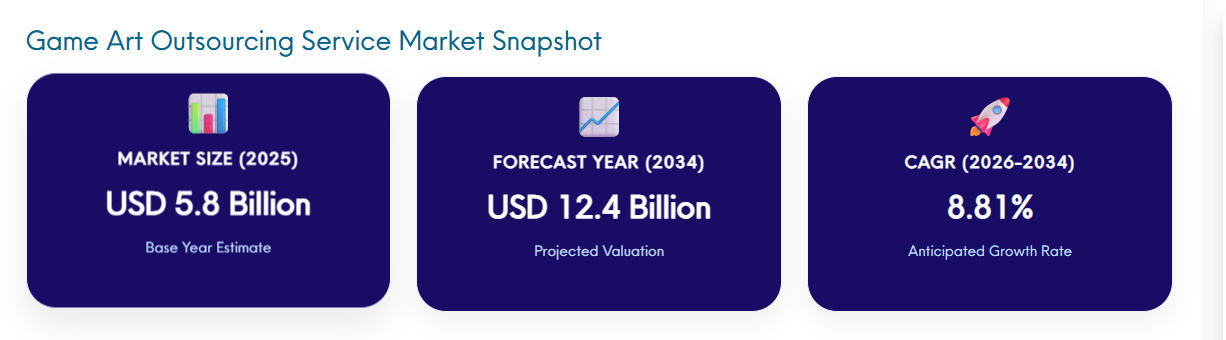
Source: Verified Market Reports
Business Research Insights also reports that 60% of game studios outsource art tasks, showing how widely this model is used across game development. With that in mind, we’ve selected 10 game art outsourcing companies to consider in 2026, based on factors such as portfolio quality, service coverage, production experience, and project fit.
Here’s what we cover:
- How to evaluate a game art outsourcing studio across five criteria that actually matter
- The full outsourcing process, from brief to engine-ready delivery
- Which platforms and art types need specialist partners
- How to choose between a freelancer, a boutique studio, and a full-pipeline partner
- A comparison table to guide your decision
What Types of Art Can Be Outsourced?
There is no single way to structure game art outsourcing. Some teams outsource one type of asset, while others bring an external studio into several stages of production. The important part is knowing what can be separated into its own scope and where an outside team can add the most value.
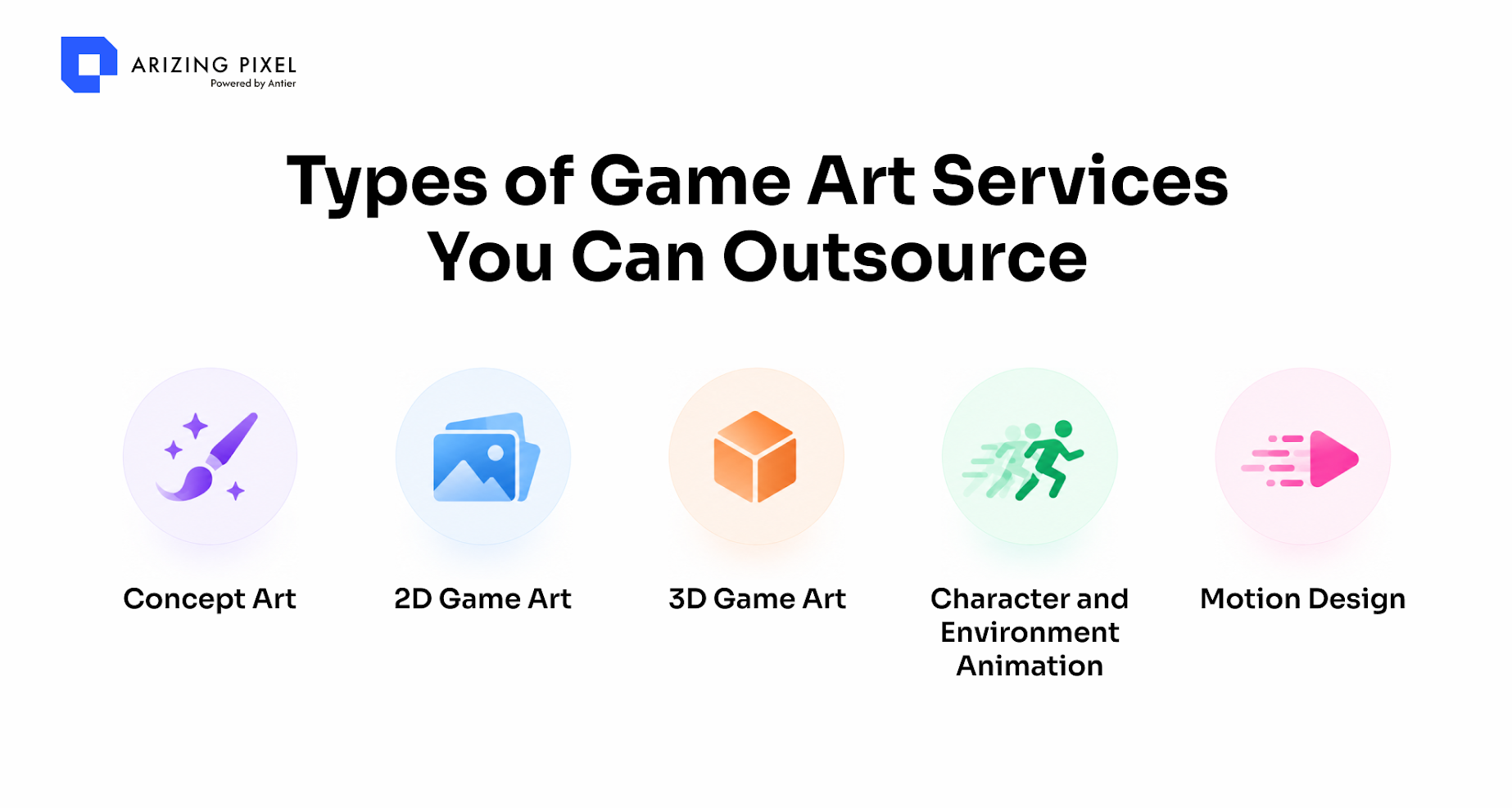
1. Concept Art: This art includes characters, creatures, environments, props, and early visual development. Concept work can cover the whole game or focus on a particular stage, such as exploring different visual directions before production begins.
2. 2D Game Art: External artists can create sprites, icons, UI elements, backgrounds, illustrations, and other 2D assets for mobile and other game formats.
3. 3D Game Art: This covers character models, environments, props, textures, and optimized assets prepared for the project’s engine and technical requirements.
4. Character and Environment Animation: Outsourced animation can include rigging, idle and combat cycles, gameplay movement, cinematic sequences, and environmental loops.
5. Motion Design: Studios can also take care of UI motion, cinematics, trailers, launch videos, and other branded content.
Concept art is often handled as its own phase. Once the concepts are approved, the resulting style guide and references can move into 3D production with the same or a different outsourcing partner. It is a simple way to break a larger art budget into manageable production stages.
The Top 10 Game Art Outsourcing Studios Worth Knowing in 2026
The studios listed below represent a cross-section of the market, from enterprise-scale partners handling AAA console pipelines to multi-platform specialists working across mobile, Web3, and Roblox. The right choice depends on your asset volume, platform mix, and production timeline, not on reputation alone.
1. Arizing Pixel
A full-pipeline game art outsourcing studio covering concept art, 2D art, 3D game art, character and environment animation, and motion design under a single production roof. Delivers across mobile, Web3, Roblox, Telegram, and AR/VR platforms. The studio’s model is built around single-pipeline ownership: one team handles art, animation, and engine preparation without external handoffs, keeping style guide adherence tight across large volumes of assets.
Book a 15-minute pipeline review to discuss your project requirements & timelines
2. Room 8 Studio
A co-development and art outsourcing partner primarily serving AAA and mid-tier publishers. Strong in character art, and co-development for console and PC titles. Its teams can support projects from individual art assets to broader production requirements, making it a flexible option for studios handling large or complex game pipelines.
3. Virtuos
One of the good game development and outsourcing groups globally, with extensive experience supporting major publishers and game franchises. It handles AAA-scale art production across console, PC, and mobile platforms, with studios in Europe and Asia. Its broad production network allows teams to access specialized art capabilities across different stages of development.
4. Lakshya Digital
A Technicolor-owned studio specializing in game art outsourcing services for AAA console and mobile platforms, with depth in 3D character art, environment art, and cinematic production. Its teams work across different visual styles and production requirements, supporting studios that need additional art capacity for large-scale projects.
5. N-iX Game & VR Studio
N-iX Game & VR Studio covers game art outsourcing with additional capability in VR content. Its services combine art production with game engineering, making it suitable for mid-tier studios looking for a partner that can contribute to both creative and technical requirements.
6. Starloop Studios
A mid-size game art outsourcing studio with published work across mobile and PC formats. Its services cover 2D art, 3D modeling, animation, and other production needs for game developers. The studio can work with different visual styles and project scopes, making it a practical option for teams seeking dedicated external art support.
7. Pingle Studio
An Eastern European outsourcing studio covering 3D game art for mobile and indie developers, with a portfolio spanning casual and mid-core titles. Its teams work on areas such as character design, environments, animation, and game-ready assets. This range makes Pingle a suitable choice for studios looking for an external team across multiple stages of art production.
8. ZVKY
A game art and design studio working across mobile and VR formats, with an emphasis on stylized character and environment work. Its portfolio includes visual development and production-focused art for different types of interactive experiences. The studio can support teams looking for distinctive visual styles and specialized art production.
9. Melior Games
Focused on game art outsourcing for mobile, Melior Games provides services including 2D character art, UI art, and illustration-style asset production. Its teams can adapt artwork to different game genres and visual directions, supporting studios that need additional creative resources. The company also works across broader game development services.
10. Stepico Games
A game art studio working across mobile, PC, and blockchain game formats, with published work in 3D art and animation. Its capabilities cover areas such as character and environment art, animation, and game development. This combination allows studios to bring in external support for both individual art requirements and wider production needs.
Freelancer vs. Studio vs. Full-Pipeline Partner: Which Fits Your Production?
Choosing the wrong partner structure costs more than money. It costs timeline. Here’s a direct comparison across five criteria that matter in a real production environment.
| Criteria | Freelancer | Boutique Art Studio | Full-Pipeline Outsourcing Studio |
|---|---|---|---|
| Asset volume capacity | Low. Best for single assets or small batches | Medium. Handles defined scopes with a small team | High. Handles large, ongoing production volumes |
| Style guide adherence | Variable. Depends on the artist | Moderate. Consistent within one art type | Strong. Consistent across asset types |
| Platform coverage | Limited. Usually one specialty | Moderate. Supports one or two platforms | Broad. Mobile, Web3, Roblox, Telegram, AR/VR |
| Revision process | Direct. Managed with the artist | Defined. Follows the studio workflow | Structured. One contact manages revisions |
| Delivery ownership | Client-managed. You oversee production | Studio-managed. Delivers within scope | End-to-end. Brief to engine-ready files |
The tradeoff with a full-pipeline studio is specificity at small scale. If you need a single icon set or a handful of UI sprites, a freelancer is faster and leaner. Full-pipeline partners are built for volume, continuity, and cross-platform consistency. They’re the right fit when your production has sustained art requirements across a run of several weeks or months, not for a one-off micro-brief.
How to Evaluate a Game Art Outsourcing Partner: 5 Criteria That Hold Up
A strong game art partner should feel like a natural extension of your production team. That means understanding your visual direction, working within your technical setup, and keeping pace with the demands of production. Here are five areas worth checking before you choose a studio.
- Style guide fluency: Look for a studio that can take your existing references, character sheets, and art guidelines and turn them into consistent production work. Review multi-asset samples to see how well the visual language carries across characters, environments, props, and other assets.
- Engine-ready delivery: Your game assets need to perform smoothly within the target engine alongside looking right visually. Confirm that the studio delivers assets in the required Unreal Engine or Unity format, with LOD optimization, naming conventions, and other technical requirements handled as part of the workflow.
- Platform-specific experience: Each platform comes with its own production requirements. Roblox, for example, has specific polygon and texture considerations, while Web3 games may require NFT-compatible formats and consistent asset specifications. Review examples from the studio that match your target platform and project type.
- Pipeline transparency: How does the studio handle revisions? What’s the milestone structure? Who is your production contact when a batch comes back needing rework? Studios that answer these questions clearly in the proposal phase save significant time during production.
- Scale flexibility: A funded studio’s asset needs change across production phases. The partner brought in for pre-production concepting may need to scale up significantly for a production sprint. Confirm whether the studio can absorb volume increases without renegotiating the entire engagement.
The Outsourcing Process: From Brief to Engine-Ready Assets
Here’s how a professional game art outsourcing engagement runs from start to finish.
Step 1: Brief and scope alignment
Share your art bible, style references, technical specs (polygon budgets, texture sizes, engine format), and asset list. The studio confirms scope, timeline, and milestone structure before production begins.
Step 2: Style exploration and concept development
For new IP or visual development work, the concept art phase runs first. Characters, environments, and key props are developed in sketch and refined form before any 3D modeling begins.
Step 3: Asset production
3D modeling, texturing, and rigging proceed against the approved style guide. Batches are delivered at defined milestones, typically every 2 weeks, for review.
Step 4: Revision and QA
Revisions are handled within the agreed round structure. Most professional studios build two revision rounds per milestone into the engagement structure.
Step 5: Engine preparation and delivery
Assets are optimized for the target engine (Unreal Engine, Unity, Roblox Studio, or platform-native SDK), LODs are applied, and final files are packaged for handoff.
A realistic total timeline for a mid-size outsourcing engagement, covering concept through engine-ready delivery of a full character and environment asset set, typically runs 5-10 weeks depending on asset count and complexity. Single-phase work like concept art alone can run 2-4 weeks for a defined scope.
Get a tailored shortlist of artists for your game’s engine and visual style
Platform-Specific Art Outsourcing: Web3, Roblox, and Telegram
Not every outsourcing relationship is equivalent across platforms. Each has distinct technical requirements that affect how art is built and delivered.
- Web3 and NFT games: Require character and asset art designed for on-chain tokenization. That means consistent trait-layer architecture, rarity tier visual differentiation, and metadata-compatible asset export formats. Standard 3D game art outsourcing pipelines aren’t automatically configured for this. Confirm a studio has shipped NFT-ready asset sets, not just general 3D art.
- Roblox: Operates inside Roblox Studio, with its own polygon limits, surface appearance settings, and avatar mesh standards. Outsourcing game art for Roblox means working within those constraints from the first model, not retrofitting a standard 3D asset after the fact. Ignoring the technical spec during production adds significant rework at the delivery stage.
- Telegram games: The visual language is typically 2D, illustration-heavy, and optimized for small screen rendering. 2D game art outsourcing for this format prioritizes frame efficiency and UI clarity over detailed 3D environments.
Who does game art outsourcing for Web3 or NFT games? A full-pipeline studio with confirmed blockchain game development experience and NFT asset production in its published work. Platform claims without a portfolio trail aren’t sufficient for this format, given how technically specific NFT asset architecture is.
What to Prepare Before Contacting a Game Art Outsourcing Studio
Studios give better scoping responses and faster timelines when a brief arrives with these elements ready:
- Asset list with rough counts by type (characters, environments, props, UI elements)
- Style references (mood boards, in-engine screenshots, or competing titles with a note on what specifically appeals)
- Technical specs (polygon budget, texture resolution, target engine and version)
- Milestone expectations and hard delivery dates
- Revision round expectations and internal approval process
A complete brief shortens the scoping phase by 1-2 weeks. It also gives a studio the information needed to flag scope conflicts before production begins, rather than mid-sprint.
How to Know You have Found the Right Game Art Outsourcing Partner
“Good” in this context isn’t about portfolio aesthetics alone. A studio’s finished assets can look compelling on a case study page while its production process creates friction at every milestone.
A genuinely capable game art development company demonstrates the following before a contract is signed:
- Provides a named production contact and a defined milestone structure in the proposal
- Can maintain consistent style-guide execution across large, multi-asset batches.
- Delivers assets in your specific engine format, with LOD optimization and technical requirements handled for the target platform.t
- Has platform-specific examples for the format your title is built on
- Offers a scoped pilot engagement for larger projects before full commitment
Conclusion
The game art outsourcing market is growing because production needs are growing faster than internal teams can scale. With the global games market at USD 201.6 billion and studio headcounts contracting, the demand for qualified outsourcing partners isn’t slowing. The studios that perform well in this environment absorb real asset volume, maintain visual consistency across platforms, and deliver in formats the target engine can use on day one.
At Arizing Pixel, we offer game art outsourcing services around exactly that: concept through engine-ready delivery, across mobile, Web3, Roblox, Telegram, and AR/VR, without handoffs between teams, positioning us as one of the most capable game art outsourcing companies for studios that need multi-platform production done right.
Book an art pipeline consultation and bring your brief. We’ll return a scoped delivery plan with Clear milestones, platform-specific process details, and a timeline shaped around your asset list.
Frequently Asked Questions
01. What is the current market value of game art outsourcing services?
The game art outsourcing service market was valued at USD 5.8 billion in 2025 and is projected to reach USD 12.4 billion by 2034.
02. What types of art can be outsourced in game development?
Game art that can be outsourced includes concept art, 2D game art, 3D game art, character and environment animation, and motion design.
03. How do game studios typically utilize outsourcing for art tasks?
Approximately 60% of game studios outsource art tasks, indicating that this model is widely used across the game development industry.

