
✨ AI Summary
- The blog post discusses the increasing demand for external game art production due to the fast-paced nature of hyper-casual mobile games, highlighting the projected growth of the global game art outsourcing service market to USD 1.27 billion by 2035.
- The author delves into the intricacies of 2D game art outsourcing, including what it covers, how various game studios handle it, and the pros and cons of freelancers, in-house teams, and outsourcing studios.
- They also provide a detailed look at the 2D game art production pipeline from the initial discovery to final delivery and revisions.
- The post offers insightful advice on what to look for in a 2D game art outsourcing partner, including style consistency, technical delivery capability, and revision structure, among others.
- The author concludes by emphasizing the importance of careful outsourcing partner selection for successful game production.
Every small mobile studio hits the same wall eventually. The art team’s good, genuinely good, but a hyper-casual concept moves faster than three or four artists can keep pace with when you’re burning through variant after variant during testing. That gap is real, and it reflects the growing demand for external game art production. The global game art outsourcing service market is valued at approximately USD 0.65 billion in 2026 and is projected to reach USD 1.27 billion by 2035, growing at a 9% CAGR from 2026 to 2035, according to Business Research Insights.
So the real question is whether you bring in a freelancer for extra production capacity, partner with an outsourcing studio, or build an in-house team. This guide gets into what 2D game art outsourcing actually covers, how the pipeline runs week to week, and what separates a partner worth signing with from one that just looks good on a portfolio page.
What 2D Game Art Outsourcing Actually Covers
2D game art outsourcing means handing the flat, layered work, character sprites, background illustrations, UI components, icon sets, animation frames, and ad creatives off to a team outside your studio. 3D is a different job. Most studios that run both keep the teams apart, and honestly, that’s the right call. 2D and 3D art rely on distinct tools, techniques, and production pipelines, even when they contribute to the same game.
Depending on the project scope, studios can hire 2D game artists for specific roles or work with a specialized outsourcing team to handle the complete art production pipeline.
A 2D game art production scope for a single mobile title can include:
- Character sprites and walk/idle/attack cycles exported as sprite sheets compatible with Unity’s 2D sprite renderer or Spine’s skeleton system
- Environment tile sets and parallax backgrounds built to repeat cleanly across variable screen resolutions
- UI and HUD elements designed against platform store asset guidelines for iOS and Android
- Ad creative variants sized and formatted for Meta, Google UAC, and TikTok placements
- Concept art and style guides that lock visual direction before batch production begins
2D game asset outsourcing also frequently includes animation, either frame-by-frame or bone-based via Spine or DragonBones, which affects the file format and integration requirements on your end.
The Market Signal Behind 2026’s Outsourcing Demand
Mobile gaming reached USD 165.37 billion in 2025 and is projected to hit USD 196.41 billion in 2026 at a CAGR of 18.8%, per Research and Markets. To put that figure in context: USD 196.41 billion in 2026 exceeds the combined global box office revenue of the film industry across several consecutive years. Art production demand scales with that growth directly, because every new title needs assets.
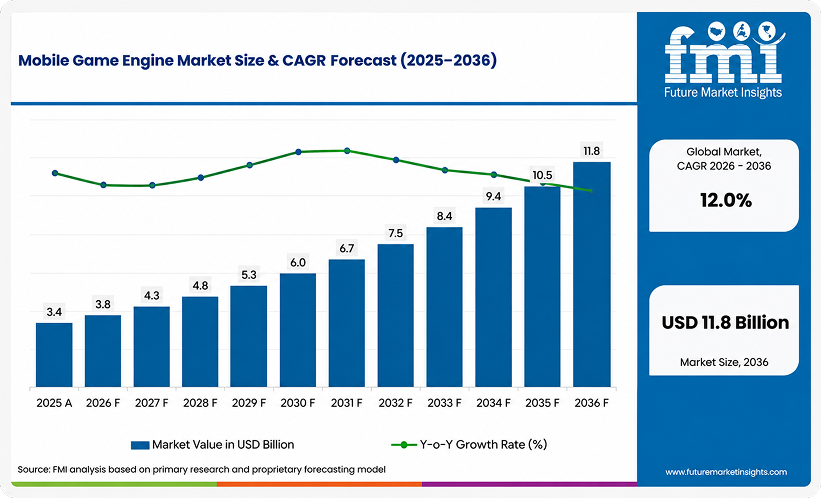
Source: Future Market Insights
2D art remains an important part of this ecosystem. Future Market Insights estimates that 2D game engines account for 34.0% of the mobile game engine market in 2026, reflecting continued use of sprite-based and 2D workflows in mobile development. These workflows can support lightweight assets, rapid iteration, and deployment across a broad range of mobile hardware.
For studios working with tight production schedules, these requirements make art production capacity, consistency, and technical delivery important considerations when deciding between freelancers, internal teams, and specialized outsourcing studios.
Freelancer vs. In-House Team vs. 2D Art Outsourcing Studio
Before committing to any production path, it helps to see the trade-offs in one place. The comparison below is based on common production variables for a hyper-casual or casual mobile title targeting iOS and Android.
| Factor | Freelancer | In-House Team | 2D Art Outsourcing Studio |
|---|---|---|---|
| Setup time | 1–2 weeks | 4–12 weeks | 1–2 weeks |
| Consistency | Varies by artist | High | High with art direction |
| Engine-ready assets | Depends on expertise | Fully controlled | Delivered to agreed specs |
| Revisions | Usually flexible/ad hoc | Internal | Defined revision rounds |
| Scalability | Limited | Hiring-dependent | Multiple artists available |
| IP & NDA | Individually negotiated | Internal | Defined at project start |
| Post-art support | Usually art only | Depends on team | May include development and launch support |
Not Sure Which Production Model Fits Your Game?
The freelancer path works well for a single asset type when you have a clear style guide and don’t need animation or engine integration. When you need 200 sprites in 6 weeks with consistent proportions across 4 character classes, that’s a pipeline problem rather than just an art problem, and it’s where a studio structure earns its place.
How the 2D Game Art Production Pipeline Works
Understanding the sequence matters before you brief anyone. Here’s how a professional 2D game art production pipeline runs from first contact to integration-ready delivery.
Step 1: Discovery and style brief
The studio starts with your game design document, references, and technical requirements. Platform target Unity, Godot, Cocos2d gets locked here, along with resolution specs, animation method, frame-by-frame or Spine skeletal, and file format expectations.
Step 2: Style exploration and art direction
A concept artist produces 2 to 4 style explorations covering character proportion, color palette, and shading approach. You approve one direction before batch production starts. This phase uses tools like Adobe Photoshop, Procreate, and Figma for visual development and iteration.
Step 3: Asset production
Production artists build the full asset list against the approved style guide: sprites, tiles, UI, and animation frames, all moving in parallel across the team. Photoshop handles raster art, Illustrator covers vector UI, Spine or DragonBones drive the animation rigs, and Aseprite steps in when the style calls for real pixel art.
Step 4: Technical review and engine preparation
Assets are exported with correct naming conventions, atlas-packed for Unity’s sprite packer or equivalent, and validated against the game’s resolution and memory budget. Studios with development capability handle this as part of the pipeline rather than leaving it to the client’s own team.
Step 5: Integration support and revision
The studio delivers final files into your repository or build environment. Revision rounds, typically 2 to 3 per asset category, are resolved here. Good studios define revision scope in the contract upfront so neither side is guessing about what constitutes a new request versus a covered change.
What to Look for in a 2D Game Art Outsourcing Partner
This is where buyers often narrow their criteria too fast, focusing on portfolio aesthetics when the harder questions are about pipeline and delivery.
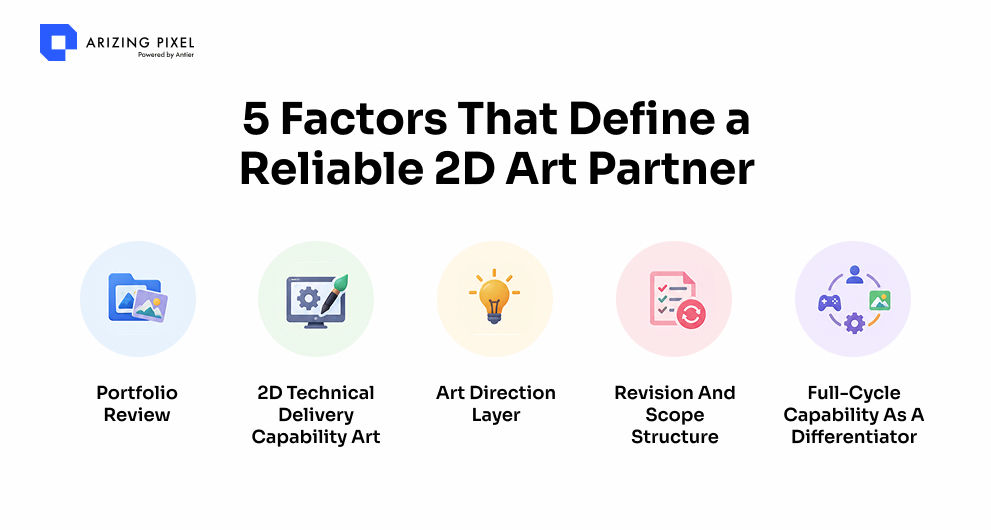
- Portfolio review: style range vs. style depth: A portfolio featuring 12 different styles across 12 games demonstrates versatility, while deeper examples from individual projects reveal consistency and production expertise. For your title, you need to confirm the studio can execute your specific style consistently across 200+ assets, not just produce a polished hero piece. Ask to see a sprite sheet set or a full character roster from a single shipped title, not just highlight renders.
- Technical delivery capability: Does the studio deliver atlas-packed sprite sheets or individual PNGs? Do they export Spine animation files or pre-rendered frame sequences? Have they delivered into Unity’s 2D sprite system or a custom engine? These answers determine whether you receive game-ready assets or source files your own team still needs to process.
- Art direction layer: Studios with a dedicated art director reviewing output before delivery produce more consistent batches than teams where each artist works independently. Ask whether an art director or lead reviews and approves assets before they are delivered to the client.
- Revision and scope structure: Undefined revision terms are the single most common way outsourced art projects blow their budget. Nail down the rounds, what each covers, and what counts as out-of-scope before anyone signs.
- Full-cycle capability as a differentiator: A pure-play 2D art studio delivers art, that’s the whole job. A full-cycle studio can support the project across concept art, 2D and 3D production, animation, game development, integration, and launch. For a founder shipping their first title, that’s one less handoff to go wrong.
Get game-ready 2D art built around your style and technical requirements.
2D Art Styles That Work for Mobile in 2026
Mobile hardware diversity shapes this decision more than most founders expect. These are the styles most commonly used across hyper-casual and casual mobile titles, with their production implications:
- Flat vector / geometric: Low asset weight, clean on small screens, fast to produce, naturally suited to Illustrator-based pipelines. Strong for hyper-casual titles targeting broad Android reach.
- Hand-painted / painterly: Visually rich, higher per-asset production time, works well for mid-core RPGs and narrative-driven titles. Requires Photoshop-native production and larger file budgets.
- Pixel art: Device-agnostic by design, retro appeal drives strong retention in casual and adventure genres, produced in Aseprite or Photoshop. Sprite sheets run lightweight on memory, an advantage on lower-spec devices.
- Cartoon / character-driven: Strong for character-based hyper-casual and idle games, requires Spine for animation to stay performant, scales well to ad creative production because character rigs can be repurposed across multiple ad formats.
The right style is both a creative and technical decision, influencing asset production volume, animation methods, memory requirements, and downstream ad creative costs.
Red Flags When Evaluating a Studio
Not every signal of concern is visible in a portfolio. Watch for these during outreach and scoping:
- Studios start batch production without first aligning on concepts and visual direction.
- Revision rounds, scope, and approval processes are not clearly defined upfront.
- Portfolios showcase polished hero renders without production asset sets that demonstrate consistency.
- Proposals do not specify the export formats and technical requirements for the target game engine.
- Assets are delivered without review from a dedicated art lead or art director.
Wrapping up
The 2026 mobile market favors studios that deliver on schedule with consistent, monetization-ready art and seamless engine integration. Outsourcing 2D game art production is a pipeline decision first and an aesthetic decision second, and the partner you choose either extends your team’s capability or creates a handoff bottleneck you’ll spend the rest of production recovering from.
At Arizing Pixel, we operate as a full-cycle studio, delivering everything from concept art and 2D game asset outsourcing through development and launch, which means we function as your 2D game art outsourcing partner across the entire production arc, not just the art phase.
Frequently Asked Questions
01. What does 2D game art outsourcing cover?
2D game art outsourcing includes tasks such as creating character sprites, background illustrations, UI components, icon sets, animation frames, and ad creatives, which are handled by an external team.
02. Why is there a growing demand for game art outsourcing?
The demand for game art outsourcing is increasing due to the rapid pace of hyper-casual game development, which often exceeds the production capacity of small in-house art teams.
03. What are the projected market values for game art outsourcing by 2035?
The global game art outsourcing service market is projected to grow from approximately USD 0.65 billion in 2026 to USD 1.27 billion by 2035, with a CAGR of 9% from 2026 to 2035.

