
✨ AI Summary
3D game art outsourcing services add production capacity with agreed quality and engine-ready delivery. Write the scope down, judge a studio on pipeline fit before portfolio, and expect clean meshes, organized textures, and handover documentation. Check engine skill, since Unreal is the primary engine for 42% of developers (GDC 2026). Control risk with milestone reviews and clear asset ownership.
3D game art outsourcing services affect your release date, your budget, and your control over the art. Studio heads, CEOs, and publishers make those calls, and the results depend on how the partner is chosen, scoped, and managed.
The pressure to get this right is rising. In the GDC 2026 State of the Game Industry survey of more than 2,300 professionals, 28% of respondents said they were laid off in the past two years. Leaner teams still have milestones to hit, and an external art partner is one way to add capacity without adding headcount.
This guide gives you what you need to decide with confidence:
- A scoping table you can hand to any studio
- A handover checklist for engine-ready 3D environments
- Five areas to evaluate and five questions for your first vendor call
- A risk plan for style drift, scope creep, and asset rights
Read it before your next vendor call. If you want a studio to review your asset list against these criteria, the conclusion shows you how to get started.
What 3D Game Art Outsourcing Services Cover
Professional 3D game art services cover every asset type a game needs, from first sculpt to engine-ready file. A 3D game art outsourcing studio usually offers these production layers:
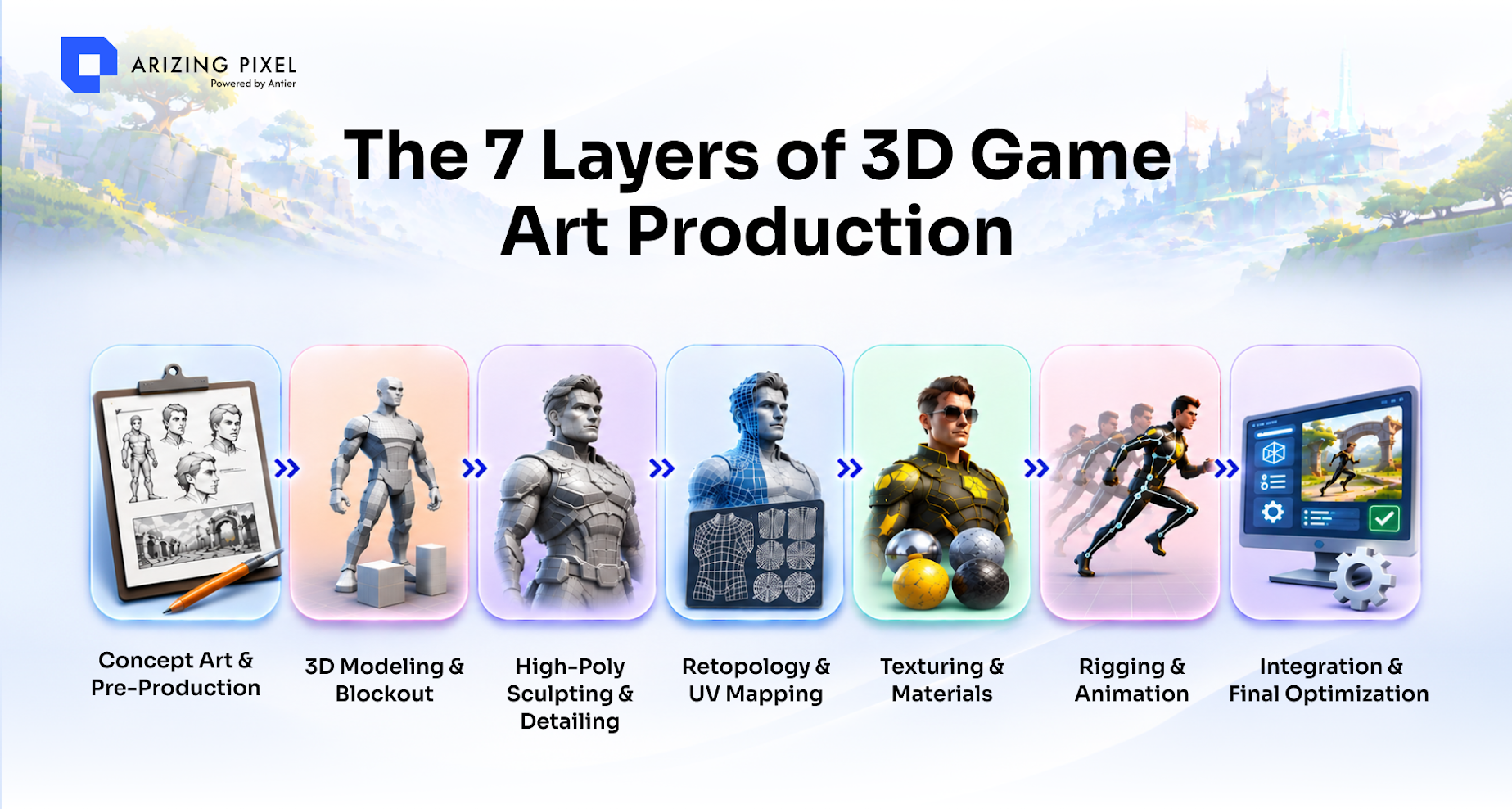
- Concept Art & Pre-Production: Developing the visual direction through references, moodboards, sketches, concepts, and design exploration.
- 3D Modeling & Blockout: Building the asset’s shape, form, and proportions using high-poly or low-poly modeling techniques.
- High-Poly Sculpting & Detailing (Where applicable): Adding surface details, anatomy, folds, hard-surface elements, and other defining features.
- Retopology & UV Mapping: Optimizing geometry, creating clean topology, and preparing UV layouts for texturing.
- Texturing & Materials: Applying colors, surface details, roughness, metallic properties, and PBR materials to bring assets to life.
- Rigging & Animation (Where applicable): Creating skeletons, skinning, and movement systems for characters and other animated assets.
- Integration & Final Optimization: Importing assets into Unity or Unreal Engine, setting up materials, lighting, and testing performance to ensure game readiness.
Buyers can outsource a single layer, such as 3D environment design services for one level, or hand over a full art pipeline. The scope you choose sets the team size, the review schedule, and the handover format.
Get a layer-by-layer plan for your next milestone.
What the 2026 GDC Survey Means for Your Outsourcing Decision
Three findings from the GDC 2026 State of the Game Industry survey shape outsourcing decisions this year. The survey drew more than 2,300 game industry professionals.
| Finding | Result | What it means for your decision |
|---|---|---|
| Layoffs | 28% of respondents were laid off in the past two years, and 33% in the United States. Half said their employer had layoffs in the past 12 months. | Teams are leaner. External capacity covers peaks without permanent hires. |
| Engine use | 42% of developers use Unreal Engine as their primary engine, against 30% for Unity. Unreal adoption is higher at AA studios (59%) and AAA studios (47%). | Ask every studio which engine and version it ships in. |
| Generative AI | 52% see a negative effect on the industry, rising to 64% among visual and technical artists. Among AI users, the most common use is research or brainstorming (81%). | Ask every studio how it uses AI tools and who reviews the output. |
Source: GDC 2026
A partner also brings specialist depth. Studios that need 3D environment artists for games for one release can add that skill without a long hiring cycle, and release it when the milestone closes.
How to Scope Custom Environment Design
A written scope is the main control a buyer has over cost, quality, and schedule. Custom environment design covers unique locations built for one game. Game environment art outsourcing works best when both sides agree on these eight items before production starts:
| Scope item | What to define | Why it matters |
|---|---|---|
| Asset list and zones | Each location, the props in it, and the camera view players will have | Sets the volume of work and the review order |
| Art style and references | Reference images, a style guide, and one approved sample asset | Prevents style drift across artists |
| Technical limits | Target platforms, engine version, performance budget per scene | Keeps assets inside what the game can run |
| Modularity | Which parts use reusable kits and which are unique hero assets | Controls production effort and visual variety |
| Texture and material rules | Resolution targets, naming, material setup, and texel density | Keeps the look consistent across assets |
| Lighting and atmosphere | Time of day, mood references, and who owns the final lighting pass | Avoids rework at integration |
| Milestones and acceptance | Review dates, feedback rounds, and pass or fail criteria for each asset | Gives both sides a shared definition of done |
| Handover and ownership | File formats, folder structure, documentation, and asset rights | Makes delivery usable on day one |
Start with a pilot environment. A single zone built to the full scope shows how the studio communicates, handles feedback, and meets technical limits. Judge the pilot against the acceptance criteria before you commit to full production.
How 3D Game Art Outsourcing Is Priced
Studios price 3D game art in a few common ways. Knowing the models and the cost drivers helps you compare quotes line by line.
| Pricing model | How it works | Best fit |
|---|---|---|
| Fixed price per asset or batch | An agreed price for a defined asset list | Clear scope and an approved style |
| Time and materials | Billing by hours or days worked | Evolving scope or early prototyping |
| Dedicated team | A monthly engagement for a set team | Long production with steady volume |
| Milestone-based | Payments tied to approved milestones | Larger environments with staged reviews |
Seven factors drive the cost of any quote:
- Asset complexity and quality level
- Art style, realistic or stylized
- Volume and batch size
- Number of revision rounds
- Technical requirements such as LODs, rigging and platform limits
- Schedule pressure
- Clarity of the scope
Ask every studio for an itemized quote per asset or zone, the number of revision rounds included, the rate for change requests, and the contents of the handover package.
What Leadership Decides in an Outsourcing Project
Five decisions sit with leadership, and each one shapes cost, schedule, and risk.
- Pilot or full commitment: Build one zone first to test fit before you commit to the full project.
- Pricing model: Pick fixed price, time and materials, dedicated team, or milestone-based to match how clear your scope is.
- Asset ownership: Agree on rights, file storage, and access in the contract before work starts.
- Quality bar: Set the engine, version, and standards every asset must meet.
- Accountability: Name one owner on your side for scope, reviews, and sign-off.
What 3D Environment Design Services Should Deliver
Professional 3D environment design services end with assets your engineers can drop into the build. Use this checklist at each milestone review:
| Deliverable | What to check |
|---|---|
| Source files | Organized scene files, sculpts, and texture projects that your team can reopen |
| Engine-ready meshes | Clean topology, correct scale and pivots, consistent names |
| UVs and textures | Even texel density, organized texture sets, material setups that match the style guide |
| Collision and LODs | Collision and level-of-detail meshes where the engine setup needs them |
| Lighting pass | A lit scene that matches the approved mood references |
| Documentation | Folder structure, naming rules, and setup notes for your team |
Test a sample scene in your target engine build before full production starts.
How to Evaluate a 3D Game Art Outsourcing Studio
A good game environment design company shows its process as clearly as its portfolio. Review five areas before you sign:
- Portfolio fit: Look for shipped or showcased work in your art style, genre, and engine. Ask which artists worked on each piece.
- Pipeline and tools: Confirm the studio works in your engine and version, and ask which tools it uses for sculpting, retopology, texturing, and rendering.
- Team structure: A strong team has an art lead, 3D environment artists for games, technical artists, and a reviewer who checks assets against the specification.
- Communication and review: Ask for a named point of contact, a regular review schedule, and a written feedback process.
- Security and rights: Check how the studio protects your files, and have your legal team review the terms on asset ownership.
Questions worth asking in the first call:
- Which engine version do you deliver into, and how do you test assets in it?
- How do you keep one style across several artists?
- What does your handover package contain?
- How do you handle a change request mid-milestone?
- How do you use AI tools in your pipeline, and who reviews the output?

Shortlisting studios? Book a call to test these questions on your project.
Warning signs include a portfolio with no breakdowns, vague answers about engine delivery, and no plan for review milestones. Ask for references from studios with a similar project size.
Risks and How to Manage Them
Most problems in 3D game art outsourcing trace back to an unclear brief. Plan for these five risks:
- Style drift: Several artists can produce uneven results. Approve one sample asset first and review every batch against it.
- Scope creep: Changes made mid-milestone move the schedule. Log each change request and agree its impact in writing.
- Technical mismatch: Assets that pass visual review can still fail in the engine. Test each batch in your target build.
- Communication gaps: Time zones and handoffs delay feedback. Fix a review cadence and one point of contact on each side.
- Asset rights and security: Confirm ownership terms, file storage, and access rules in the contract before work begins.
Conclusion
The best 3D game art outsourcing services start with a written scope, a pilot environment, and clear acceptance criteria. Those three steps give decision makers control over schedule, quality, and engine delivery, whichever partner they choose.
Arizing Pixel offers 3D game art outsourcing services that cover character modeling, texturing and materials, lighting and rendering, environment and level design, game design and compositing, and rigging and animation.
The team works in Blender, ZBrush, TopoGun, and Adobe Substance 3D Painter, and delivers to Unreal Engine and Unity. Share your asset list and style references, and Arizing Pixel will scope a pilot environment for your project.
Frequently Asked Questions
01. What are the benefits of using 3D game art outsourcing services?
3D game art outsourcing services can help improve your release date, manage your budget, and provide more control over the art by adding capacity without increasing headcount, especially for leaner teams.
02. What types of services do 3D game art outsourcing studios typically offer?
Outsourcing studios usually provide services including concept art, 3D modeling, high-poly sculpting, retopology, UV mapping, texturing, rigging, animation, and final optimization for game engines.
03. How can I prepare for my first vendor call regarding 3D game art outsourcing?
You can prepare by using the guide that includes a scoping table, a handover checklist, evaluation areas, questions for the vendor, and a risk plan for potential issues like style drift and scope creep.

