
✨ AI Summary
- This blog post explores the top concept art studios for game development in 2026, offering insights into what makes a successful studio and how to choose the right one for your game.
- The post highlights four key traits that the top studios have in common: a streamlined process, a documented style guide, platform-specific knowledge, and transparent use of AI.
- The blog also lists the top 5 studios, including Arizing Pixel, iLogos, Virtuos, Lakshya Digital, and Zatun, detailing their services and specialties.
- The post further discusses the importance of concept art in game development and the role of AI in the creative process.
- It also provides a comparison of dedicated studios, freelance artists, and in-house teams, along with an overview of the concept art production process.
The best concept art studios for game development in 2026 share four specific traits: a single-pipeline process, a documented style guide, platform-specific knowledge across Roblox, mobile, and Web3, and transparent AI usage where a human artist owns the final call, not the software. Concept art outsourcing covers character concepts, environment direction, prop references, and the visual-identity style guide, delivered before 3D production ever begins.
Roughly 60% of game studios already outsource art tasks, with specialized skills and production efficiency as the primary drivers, per Business Research Insights. That same source notes that approximately 30% of potential outsourcing engagements are disrupted by communication and quality control issues, which means choosing the right concept art company is as much a process question as a portfolio question.
In this blog, you’ll get to know:
- Top 5 concept art studios for game development in 2026
- What concept art outsourcing covers and where it fits in production
- How to choose the right concept art studio for your game
- Typical timelines for different concept art deliverables
- How AI is changing the concept art workflow
- Studio vs. freelance vs. in-house options
- What to look for in a studio’s portfolio and workflow
Top 5 Concept Art Studios for Game Development in 2026
Here are five concept art studios worth considering based on their game-art capabilities, production experience, platform coverage, and ability to support projects beyond individual artwork.
1. Arizing Pixel
Arizing Pixel offers concept art for characters, environments, creatures, props, and weapons, as well as visual development. Its workflow connects concept creation with 2D and 3D game production, helping teams maintain consistency from initial ideas to final assets. The studio supports projects across mobile, PC, console, Roblox, Unity, Unreal Engine, and Web3.
Don’t Let the Wrong Art Direction Slow Your Game Down
2. iLogos
iLogos provides concept art alongside 2D and 3D game art, character design, animation, UI/UX, and game development. Its broad capabilities make it suitable for teams that want to combine concept development with additional outsourced production services.
3. Virtuos
Virtuos provides concept art, 2D/3D game art, character and environment production, and game development services. Its global production capabilities make it a strong choice for large-scale and AAA game projects.
4. Lakshya Digital
Lakshya Digital specializes in large-scale game art outsourcing, covering areas such as character art, environments, 2D and 3D production, and animation. Its production capacity makes it particularly relevant to larger studios and publishers handling high-volume requirements.
5. Zatun
Zatun combines concept art with broader game development and production services, including character design, environments, 3D art, animation, and full-cycle development. Its experience across multiple platforms makes it a versatile option for studios needing support beyond concept development.
How These Studios Were Evaluated
A strong portfolio is important, but it doesn’t tell the whole story. We ranked these studios based on the factors that matter most in a real game production pipeline:
- Concept art capability: Character, environment, prop, and visual development expertise.
- Production integration: How effectively concepts can move into 2D and 3D production.
- Service range: Ability to support projects beyond standalone illustrations.
- Platform experience: Familiarity with mobile, PC, console, Roblox, Web3, and VR projects.
- Scalability: Ability to handle both smaller projects and growing production needs.
- Workflow and communication: Clear processes for briefs, revisions, approvals, and final delivery.
The right studio ultimately depends on the project. For projects requiring consistent visual direction across multiple assets, an integrated concept-to-production workflow can be a major advantage.
What Concept Art Studios Actually Deliver for Game Development
Concept art is not the same as game art. Game art is production-ready, optimized meshes, finalized textures, and export-ready assets. Concept art is the visual decision layer that comes before all of that. A concept art outsourcing studio delivers the references and direction that make production art possible. The gap between concept art and game art is the gap between a decision and its execution. Studios that skip rigorous concept art frequently find themselves rebuilding 3D models because the visual direction was never locked.
For games targeting Roblox, mobile, or Web3 platforms, the concept art stage also has to account for platform-specific constraints. A character concept for a Roblox game carries different polygon and rendering assumptions than one destined for a PC title, and a concept art studio with cross-platform experience will bake those constraints into the reference rather than leaving them as a surprise for the production team.
The Market Behind the Decision
The game art outsourcing service market was valued at USD 1.5 billion in 2024 and is projected to reach USD 3.8 billion by 2033, growing at a CAGR of 10.8% from 2026 to 2033, according to VerifiedMarketReports. A market doubling in under a decade means the supply of qualified studios is expanding, but so is demand from studios that can’t afford to staff full visual development teams internally.
A separate sizing from Intel Market Research values the game art design service category at USD 3.49 billion in 2026, projecting it to reach USD 5.28 billion by 2034 at a CAGR of 7.5%.
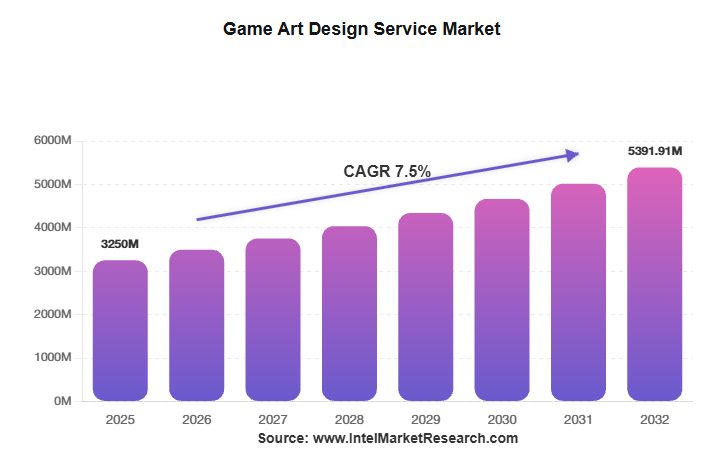
Source: Intel Market Research
The Question Every Buyer Needs to Ask in 2026
This is the one question most buyers aren’t asking yet, and it’s the most consequential one. According to GDC’s 2026 State of the Game Industry survey, AI usage among game industry professionals concentrates heavily in research and brainstorming (81%), daily tasks and code assistance (47% each), and prototyping (35%). Asset generation sits at just 19%, and player-facing AI content at only 5%, both far below research use. The split matters
What it means in practice:
– Studios using AI as a brainstorming force multiplier can run wider visual exploration in less time, testing 20 art direction hypotheses where a traditional pipeline tests 5
– Studios leaning on AI for final delivery introduce consistency and IP ownership risks that feed downstream into your production pipeline
– The buyer’s question isn’t “does this studio use AI?” It’s “at which stage, and what does a human artist own before the file leaves the studio?”
A concept art studio that uses AI responsibly compresses the exploratory phase without handing over authorship of the output. That’s a meaningful distinction when you’re building visual IP for a Web3 title or an NFT game where original authorship has commercial and legal implications. If a studio can’t explain specifically where AI assists their artists versus where a senior artist makes the final visual call, that’s a pipeline transparency issue worth surfacing before contracts are signed.
Dedicated Studio Partner, Freelance, or In-House: A Direct Comparison
Buyers at the evaluation stage typically compare three engagement models. Here’s how they differ on the criteria that matter most for a game concept art production engagement:
| Criterion | Dedicated Concept Art Studio | Freelance Concept Artist | In-House Visual Dev Team |
|---|---|---|---|
| Deliverable scope | Full style guide, character, environment, props, asset references | Usually single-asset or single-character | Full visual development capacity |
| Timeline reliability | Contractual milestones and dedicated capacity | Depends on individual availability | Subject to internal priorities |
| Pipeline integration | Direct handoff to 2D/3D production | Buyer manages handoff | Native integration |
| Style guide ownership | Produced and documented by studio | Often informal or absent | Internally managed |
| Web3 / NFT readiness | Varies; confirm with the studio | Rare | Rare |
| Sub-outsourcing risk | Varies; single-pipeline studios can reduce this | None | None |
| Ramp-up time | 1–2 weeks for onboarding | Usually days | Months for hiring and onboarding |
Ultimately, the right choice depends on your project’s scope, budget, timeline, and production needs.
How Long Does Concept Art Actually Take?
Timeline expectations for game concept art outsourcing vary significantly by deliverable type. Here are realistic ranges based on standard production-stage scope:
- Single character concept (3 to 5 silhouette variants + one final rendered direction): 1- 2 weeks.
- Full character concept sheet (front, side, back, detail callouts, expression variants): 2- 3 weeks.
- Environment concept (one biome or location, mood pass + 2 to 3 key scenes): 1 – 2 weeks.
- Style guide (governing document for a complete game’s visual direction): 3 to 6 weeks depending on scope and number of asset categories covered.
- Complete pre-production visual development package (characters, environments, props, style guide): 6 to 12 weeks for a mid-size game title.
These are estimated timelines and may vary depending on the project’s scope, complexity, requirements, and feedback process. The actual timeline can be adjusted according to the specific needs of each project.
For projects with specific platform or technical requirements, such as Roblox, mobile, PC, console, or Web3, these requirements should be discussed during the initial briefing. Providing these details early helps the concept art team create designs that align with the project’s technical needs and reduces the possibility of major revisions later in the production process.
Need professional game concept art?
The Concept Art Production Process: Phase by Phase
Understanding the process helps a buyer evaluate whether a studio’s workflow fits their production timeline. Here’s how a rigorous concept art production pipeline runs from brief to final delivery:
Phase 1: Brief and Creative Alignment
- Buyer provides game design document, genre reference, target platform, and any existing visual direction
- Studio runs an alignment session to confirm art style, character archetypes, world tone, and key constraints
- Output: A written creative brief signed off by both parties
Phase 2: Visual Research and Mood Boarding
- Studio assembles reference libraries: genre benchmarks, lighting and color references, style direction examples
- Mood boards are reviewed and approved before any original work begins
- This phase is where AI-assisted research tools (Midjourney, Adobe Firefly for reference generation) are most appropriate
Phase 3: Thumbnail and Silhouette Exploration
- Rapid loose sketches across multiple design directions
- Character silhouettes, environment thumbnails, prop sketches
- Typically 4 to 8 directions per major asset category before narrowing
Phase 4: Direction Selection and Refinement
- Buyer selects 1 to 2 directions per category for refinement
- Artists develop selected directions to higher fidelity, adding color, lighting, and detail callouts
Phase 5: Final Concept Sheets and Style Guide Assembly
- Finalized character sheets, environment keys, prop references compiled
- Style guide document assembled: color palette, line weight standards, material language, lighting rules
- Deliverables formatted for handoff into a 2D or 3D production pipeline
Phase 6: Handoff and Asset Integration Support
- Studio answers production questions as the art team builds from concepts
- Amendments and clarifications on reference sheets
Studios that provide post-delivery support help production teams clarify design decisions and ensure 2D and 3D artists maintain consistency when building assets from the concepts.
What to Look For When Evaluating a Game Concept Art Agency
Portfolio review is table stakes. Every studio has a portfolio. These are the questions that separate studios with real production capability from those that can produce attractive standalone art:
1. Does the portfolio show style range or just style consistency?
A studio that only shows one visual style is a style vendor, not a visual development partner. Look for work across genres: stylized mobile, realistic PC, low-poly Web3, high-fidelity console.
2. Are environment concepts and character concepts both present?
Some game concept art agencies specialize narrowly. If your project needs both, confirm both are in production scope.
3. Does the studio produce style guides, or only asset illustrations?
Style guide production is a distinct capability. Ask to see a sample.
4. What tools does the studio’s team use day-to-day?
Adobe Photoshop, Procreate, Clip Studio Paint, and ZBrush (for 3D-informed concept work) are standard across professional concept art studios. Blender is increasingly used for blocking out 3D perspective guides before painting over them. Studios using Unreal Engine’s lighting environment as a reference tool for environment concepts signal a production-connected pipeline.
5. Is sub-outsourcing disclosed?
Some studios route work through third parties. A single-pipeline studio where the concept artists you’re briefing are also the artists delivering the final files removes a meaningful quality control variable.
6. What’s the revision and feedback protocol?
A structured round count (typically 2 to 3 rounds per deliverable) with clear milestone approvals is a sign of a production-managed engagement.
That standard applies at the studio level too. The strongest concept art companies aren’t making technically polished images in isolation. They’re making visual decisions that hold up when a 3D artist, a UI designer, and a marketing team all need to build from the same reference.
Conclusion
Choosing among the best concept art studios for game development in 2026 is ultimately a pipeline decision, not just a portfolio one. The right studio delivers style guides and asset references that a 2D or 3D production team can actually build from, maintains art-direction consistency across every deliverable category, and addresses the AI question transparently rather than avoiding it. Platform readiness matters too: a concept art company with confirmed experience across mobile, Roblox, and Web3 environments brings brief-to-pipeline alignment that a general illustration vendor can’t match.
At Arizing Pixel, we deliver exactly that: character concepts, environment direction, style guides, and full pre-production visual development within a single integrated pipeline, so your team never inherits a brief that loses something in translation. We work across the genres and platforms where concept art has to be both visually strong and production-connected, making us one of the best concept art studios for game development teams building at any scale.
FAQs
1. How many concept art pieces does a game need?
Scope varies by game type. A hyper-casual mobile title might need 3 to 5 character concepts, 5 to 8 environment concepts, and a single-page style guide. A mid-scale RPG with 4 to 6 character archetypes, 3 biomes, and a prop library can run to 60 to 100 individual concept pieces before production begins. The right answer comes from a scoped brief, not a fixed number.
2. What questions should I ask a concept art studio before hiring?
Ask how they handle revision rounds and who approves milestone deliverables. Ask whether the style guide is a contractual deliverable or an informal document. Ask whether the studio sub-outsources any phase of the work. Ask what their handoff format is for 3D production teams. And ask for examples of work from the same genre, platform, and visual complexity as your project, not just their best single pieces.
Frequently Asked Questions
01. What are the key traits of the best concept art studios for game development in 2026?
The best concept art studios share four traits: a single-pipeline process, a documented style guide, platform-specific knowledge across Roblox, mobile, and Web3, and transparent AI usage with human oversight on final decisions.
02. Why do game studios outsource art tasks, and what challenges do they face?
Approximately 60% of game studios outsource art tasks primarily for specialized skills and production efficiency. However, about 30% of outsourcing engagements face disruptions due to communication and quality control issues.
03. What should game developers consider when choosing a concept art studio?
Game developers should evaluate a studio's portfolio, workflow, production experience, platform coverage, and their ability to support projects beyond individual artwork when selecting a concept art studio.

