
✨ AI Summary
- The blog post discusses the increasing maturity of metaverse education platform development in 2026, with a focus on delivering measurable educational outcomes.
- Institutions are moving beyond pilot programmes and commissioning custom platforms, defining learner engagement metrics, and incorporating Learning Management System (LMS) integration.
- The three key decisions for long-term success are platform architecture, multi-cohort learner design, and seamless system integration.
- The global metaverse in education market reached USD 21.98 billion in 2026, indicating committed budget allocation by schools, universities, and enterprise L&D teams.
- The post also notes that immersive training programs reduce seat time by up to 75% and quadruple knowledge retention.
Metaverse education platform development in 2026 has entered a new phase of maturity. Many institutions are moving beyond pilot programmes to deploy immersive learning environments designed to deliver measurable educational outcomes. Enterprise buyers are commissioning custom platforms, defining learner engagement metrics, and incorporating Learning Management System (LMS) integration and interoperability requirements into procurement and implementation planning. The question most buying teams face is no longer whether to build, but how to structure the platform to deliver measurable outcomes rather than a visually impressive demonstration that struggles to scale beyond initial deployment.
This article explores the three decisions that have the greatest impact on long-term success: platform architecture, multi-cohort learner design, and seamless system integration.
Why the Metaverse in Education Market Has Shifted From Concept to Infrastructure
The numbers behind the metaverse in education market are now large enough to drive institutional procurement cycles rather than simply justify pilot funding. According to Research and Markets, the global metaverse in education market reached USD 21.98 billion in 2026, up from USD 15.73 billion in 2025. A year-over-year growth rate of that magnitude does not reflect experimentation. It reflects committed budget allocation by schools, universities, and enterprise L&D teams.
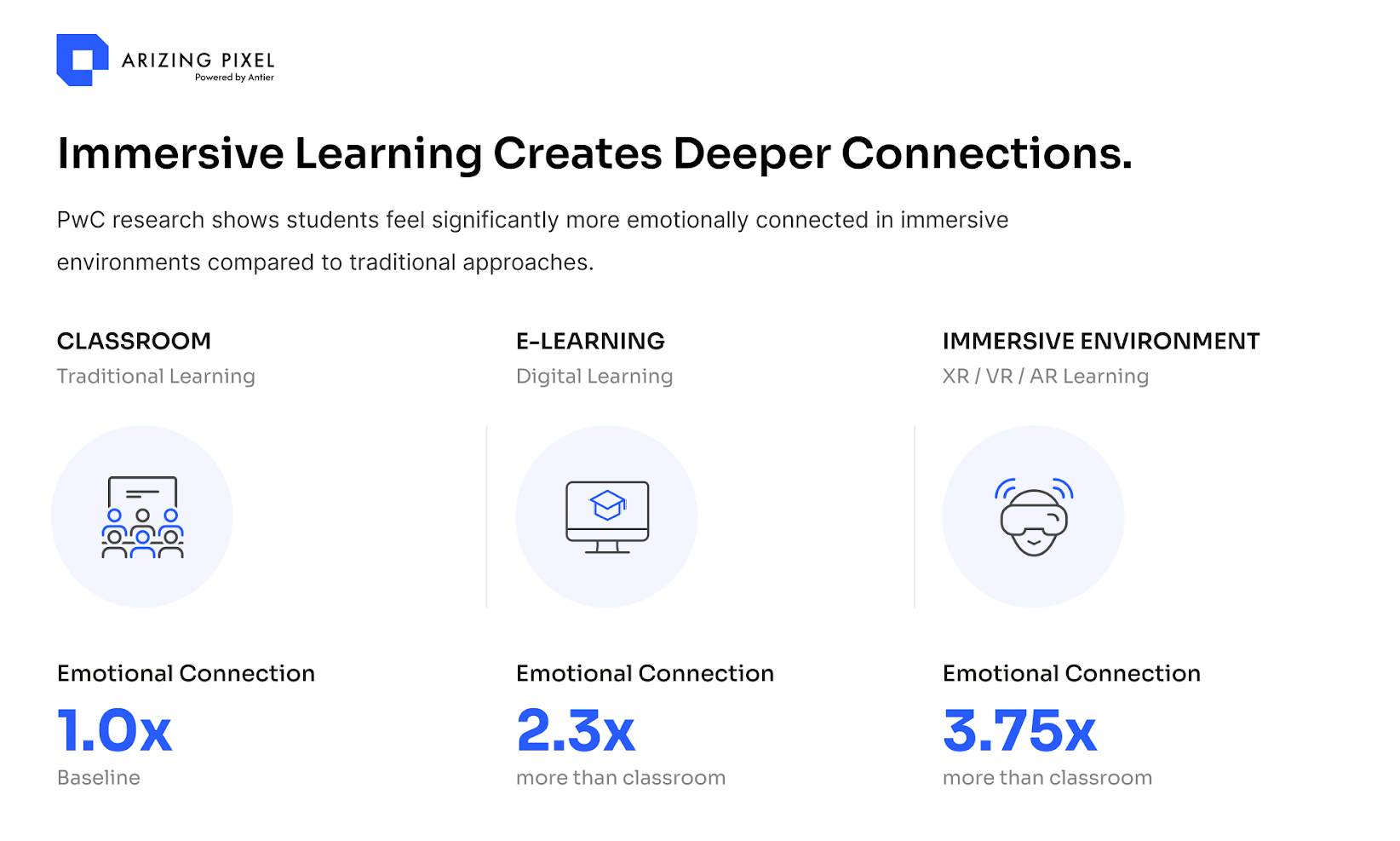
The retention data is equally procurement-ready. Mordor Intelligence’s VR in Education Market report finds that immersive training programs reduce seat time by up to 75% while quadrupling knowledge retention compared to conventional instruction. These are numbers a digital learning director can carry directly into a budget-justification conversation with a CFO or a board committee.

Your Learners Are Changing. Is Your Platform Ready?
What Metaverse Education Platform Development Actually Involves
A metaverse education platform is a purpose-built or platform-configured digital environment where learners interact with spatial content, instructors, peers, and assessments through avatars or XR interfaces. Building one requires decisions across four layers:
- Environment layer: 3D spatial design, virtual classroom architecture, and campus navigation
- Experience layer: Gamification logic, AI-driven content personalization, and subject integration across a shared space
- Technology layer: AR, VR, and AI integration, plus the infrastructure that keeps the environment performant at cohort scale
- Connectivity layer: How the platform talks to existing LMS platforms, credential systems, and identity management tools
Most platform briefs from institutions address the first two layers in detail and underspecify the last two. That gap is where builds run over budget and over schedule.
Build Custom or Configure Within an Existing Platform?
The highest-friction decision in any metaverse education platform development project is the architecture choice. Building a fully custom metaverse campus gives an institution complete control over environment design, data ownership, and feature roadmap. Deploying within an existing platform like Roblox, Sandbox, or Decentraland compresses time-to-launch and reduces upfront engineering cost, but introduces constraints on LMS connectivity, branding, and content governance.
Neither approach is universally correct. The right choice depends on the institution’s audience size, data compliance requirements, integration complexity, and how much of the platform is expected to evolve after launch.
| Factor | Custom Build | Platform-Configured (Roblox / Sandbox / Decentraland) |
|---|---|---|
| Environment control | Full control over branding, environments, and user experience | High degree of customization within platform capabilities and guidelines |
| Estimated cost range | Higher initial investment, depending on scope | Lower initial investment with platform-specific pricing and monetization models |
| Time to deploy | Longer development timeline due to custom engineering | Faster deployment using existing platform infrastructure and tools |
| LMS integration | Fully tailored integrations with institutional systems | Integration options vary by platform and may require middleware |
| Audience scalability | Optimized for institution-wide and multi-campus deployments | Well suited for community-driven experiences, pilots, and platform-native audiences |
| Data ownership | Optimized for institution-wide and multi-campus deployments | Data management follows the platform’s governance and privacy framework |
| Content governance | Institution defines moderation, compliance, and access policies | Content is governed by both institutional practices and platform policies |
For EdTech product leads building a commercial learning platform, custom development almost always produces the better long-term asset. For institutions testing a single subject or running a bounded pilot cohort, a platform-configured deployment can prove the concept before a full build is commissioned.
Architecting Metaverse Education Platforms for Multiple Learner Cohorts
Most discussions around metaverse education platform development assume a single learner profile, whether K-12 students, university learners, or corporate training participants. Real-world education ecosystems rarely operate this way. Universities often need one platform to support undergraduate students, postgraduate researchers, faculty, and continuing education programs. Similarly, EdTech providers may serve schools, vocational institutes, and enterprise clients from the same platform.
Supporting multiple learner cohorts is not a feature that can be added after deployment. It is an architectural decision that shapes the platform from the outset. Identity management, content delivery, permissions, scalability, and user experience all depend on designing for diverse audiences during the planning phase rather than retrofitting functionality later.
Key architectural considerations for multi-cohort metaverse education platforms include:
- Role-based access and permissions: Different learner groups require distinct access to content, instructor tools, administrative privileges, and moderation controls. These permission layers should be embedded into the platform architecture from the beginning.
- Flexible curriculum support: A well-designed metaverse learning platform should accommodate multiple subjects, departments, and learning pathways within a unified environment, enabling interdisciplinary education without maintaining separate virtual campuses.
- Scalable infrastructure: Platforms serving multiple cohorts simultaneously must be designed to handle high concurrent user volumes, live sessions, and growing institutional demands without compromising performance.
- Localisation and accessibility: Institutions often support learners across different regions, languages, and accessibility requirements. Language preferences, accessibility standards, regional compliance, and content permissions should be configurable at the cohort level rather than applied globally.
LMS Integration: The Question Most Platform Briefs Leave Unanswered
Higher education institutions and enterprise L&D teams rely on established LMS to manage enrolment, assessments, learner progress, certifications, and reporting. A metaverse education platform that cannot integrate with the existing LMS creates a parallel ecosystem, resulting in duplicate learner records, manual grade transfers, fragmented analytics, and additional administrative overhead. At institutional scale, this is rarely a sustainable approach.
Effective LMS integration for a metaverse learning platform should include:
- Standards compliance: Support for industry standards such as LTI (Learning Tools Interoperability) and xAPI (Experience API/Tin Can API) enables learning activities, completion records, and assessment data to flow automatically between the metaverse platform and the LMS.
- Identity federation: Single Sign-On (SSO) integration allows learners and instructors to access both the LMS and the metaverse environment using a single set of credentials, simplifying user management and improving security.
- Gradebook and analytics synchronisation: Assessments, participation data, and learning analytics generated within the metaverse should synchronise directly with the LMS, eliminating the need for manual exports or duplicate reporting.
- Content interoperability: Institutions that rely on SCORM-based learning content should have a defined strategy for importing existing learning assets, integrating them with the metaverse platform, or transitioning to native immersive learning experiences where appropriate.
These integration requirements should be defined during the platform planning stage, before selecting a development partner. Addressing them early reduces implementation risk, improves project predictability, and helps avoid costly scope changes during development.

Have a Platform Idea? Let’s Discuss It
Before You Scope Your Build: A Decision Checklist
Use these criteria to frame an initial platform brief before entering a vendor conversation:
– Do you need full data ownership, or is platform-governed data storage acceptable for your compliance requirements?
– Will the platform serve one learner cohort or multiple cohorts with different access levels?
– Does your institution run an existing LMS, and have you specified which integration standard you require?
– Is the platform a long-term curriculum asset or a time-bounded pilot?
– Have you defined success metrics, seat-time targets, retention benchmarks, or completion rate thresholds before selecting a development model?
– What is your post-launch content update model? Does your team update content in-house, or does the development partner need to build a content management interface?
A clear answer to each of these questions before the first scoping call significantly reduces the likelihood of mid-project scope expansion.
Conclusion
The metaverse in education market is producing procurement decisions at a scale and speed that makes platform architecture choices consequential in ways they were not two years ago. Institutions that commission a custom metaverse education platform without resolving their build model, multi-cohort structure, and LMS integration requirements upfront will spend more time and budget correcting those gaps after launch than it would have taken to specify them correctly from the start. At Arizing Pixel, we build and configure metaverse education platforms designed for institutional scale, from XR-powered virtual campuses to platform deployments in Sandbox and Decentraland, and we start every engagement by scoping the decisions that most development briefs leave unresolved, including build architecture, cohort design, and LMS integration, so that metaverse education platform development delivers measurable learning outcomes from day one. Ready to scope your build?
Talk to our team about your platform requirements, and we will help you define the architecture before a line of code is written.
Frequently Asked Questions
01. What is the current state of metaverse education platform development in 2026?
In 2026, metaverse education platform development has matured, with many institutions moving beyond pilot programs to implement immersive learning environments that focus on measurable educational outcomes.
02. What factors are influencing the procurement of metaverse education platforms?
The procurement of metaverse education platforms is influenced by significant budget allocations from schools and universities, driven by the market's growth to USD 21.98 billion in 2026, and the proven effectiveness of immersive training programs in enhancing knowledge retention.
03. What are the key decisions that impact the success of metaverse education platforms?
The key decisions that impact the success of metaverse education platforms include platform architecture, multi-cohort learner design, and seamless system integration.

