
According to Sensor Tower’s State of Gaming 2026 report, approximately 95,000 mobile games were downloaded every minute. To capture that audience at a global launch or a massive live ops season, your studio requires a deeply structured roadmap. The production of characters, seamless UI, and vibrant environments across diverse mobile devices demands precise technical budgets and a tightly synchronized schedule.
As the industry mantra goes: “Beautiful art acquires players, but a flawless pipeline retains them.” The most successful studios win with highly repeatable processes that deliver flawless assets exactly on time. In this guide, explore a structured mobile game art production pipeline, including texture budgeting, live ops calendar planning, and vendor evaluation scorecards to improve production efficiency, maintain asset quality, and manage project costs.
How Live Ops Changed Mobile Game Art Production in 2026
Sensor Tower’s State of Gaming 2026 press release reveals that while mobile game downloads shrank in 2025, in-app purchase revenue still climbed to $82 billion. This marks a definitive industry pivot from sheer user acquisition to long-term player retention. Furthermore, Newzoo forecasts that mobile games will generate a staggering $121.1 billion by the end of 2026, reaching an audience of 3.1 billion players.
Live ops, seasonal events, and IP collaborations are important strategies for retaining existing players and increasing in-game spending. This evolution fundamentally changed the art production landscape. Every battle pass, holiday event, and brand collaboration demands a massive, continuous influx of fresh visual content. Studios must operate with a deliberate, forward-focused strategy. A rock-solid art calendar allows your team to turn that relentless content demand into a highly manageable and profitable schedule.
Let us examine exactly how a modern production pipeline operates to fulfill this massive demand
Find the right production model for your game’s scope and requirements
How the Mobile Game Art Production Pipeline Works, Step by Step
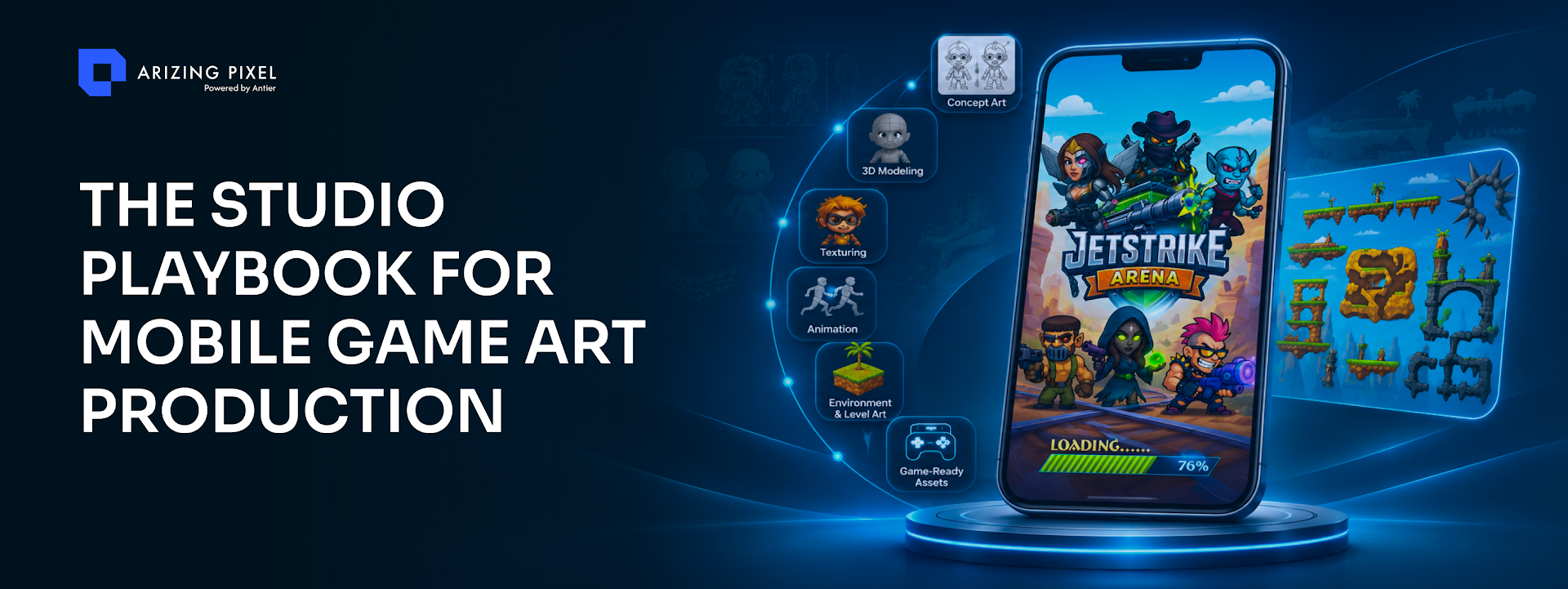
A structured mobile game art production pipeline typically follows eight stages to maintain visual consistency, technical quality, and delivery control. While the terminology varies across studios, the core deliverables consistently match this proven structure:
| Stage | What the team produces | Review gate |
|---|---|---|
| Art direction | Style guide, color palette, reference board | Creative lead approves the look |
| Concept art | Character, environment, and prop concepts, turnarounds | Concepts approved |
| Asset production | 2D sprites and illustrations, 3D models and textures | Review against the style guide |
| UI and icons | Screens, buttons, icons, HUD | Usability check on real devices |
| Animation and VFX | Character cycles, UI motion, effects | Playback review in the engine |
| Optimization | Compressed textures, atlases, simplified meshes | Performance budget met |
| Engine integration | Assets imported, named, and organized | Build review |
| Device QA and live ops | Visual fixes, event and seasonal content | Release checklist |
Establishing your style guide early provides every artist with the exact same target. It ensures any new internal teammate or external outsourcing partner matches your existing look flawlessly. Concept art acts as your testing ground to validate that direction prior to heavy production, guaranteeing that character silhouettes remain highly readable at small resolutions.
How to Choose 2D, 3D, or Hybrid Art for a Mobile Game
The ideal art style depends heavily on your core game mechanics. 2D and 3D game art each suit different camera angles, device targets, and update schedules. We evaluate the decision using these specific criteria:
| Criterion | 2D fits when | 3D fits when | Hybrid fits when |
|---|---|---|---|
| Camera | The camera stays fixed | The camera moves or rotates | Characters stay flat in a 3D space |
| Animation volume | Frame or skeletal cycles cover the need | Many reusable animations are needed | Characters require minimal animation compared to worlds |
| Device range | Low-end devices are a priority | Mid-range and above are the target | The team can test both asset types |
| Update cadence | Fast, frequent content drops | Fewer, larger drops | Mixed cadence |
| Team skills | Illustration-led team | Modeling and rigging skills | Both skill sets on call |
How to Plan Mobile Game Art Around Live Ops Events
Live ops transforms game art into an ongoing, high-volume production service. To maintain a steady and stress-free pace, plan every event backward. Start at the live date and map out the brief, concept review, production, engine integration, and device QA.
This table provides a robust baseline framework for your production team. Adjust it based on your game’s specific cadence.
| Event type | Typical art assets |
|---|---|
| Seasonal event | Key art, themed UI skin, icons, store banners, effects |
| IP or brand collaboration | Licensed character art, themed UI, approval-gated key art |
| Season or battle pass | Reward art, progress UI, icons, key art |
| Limited-time offer | Offer banner, item icons, store UI |
| New character or skin | Concept, model or sprites, animation, icons |
| UI refresh | Screen redesign, icon set, animation, device QA |
Collaborations require a generous buffer time for licensor approvals. Build those gates into your calendar early to keep your artists engaged in productive tasks while awaiting feedback from IP holders.
Where Does Generative AI Fit in Mobile Game Art?
The industry continues to navigate the role of generative AI. The GDC 2026 State of the Game Industry survey (polling over 2,300 professionals) found that 36% currently utilize generative AI tools at work. Meanwhile, 52% believe these tools are having a negative impact on the game industry.
Currently, the most successful and widely accepted practical use case involves early research and rapid brainstorming (81%).
Establishing a clear AI policy in your art brief builds trust with your partners. Cover these four bases:
- Where AI receives approval to assist (like mood boards or rapid concepting).
- Where artists must create final production assets completely by hand.
- How the vendor manages training data and disclosure.
- Who legally owns the final outputs.
Get the artistic resources and production support your project needs.
In-House Versus External Versus Hybrid Art Production
Studio executives constantly weigh overhead against flexibility. When you evaluate how to structure your team, you must compare the three primary models to make the best commercial decision for your project economics.
- The In-House Team: This model suits core IP creation and early prototypes. Internal teams provide deep product knowledge and immediate communication. However, this approach carries high fixed overhead and slow recruitment cycles, which limits your ability to scale up quickly for seasonal events.
- The Fully External Pipeline: This setup serves studios with strong technical leadership but limited art staff. It provides access to additional production resources and specialist skills without requiring permanent internal hiring. This model suits studios working toward tight soft-launch schedules or managing large asset requirements.
- The Hybrid Approach: This strategy powers heavy live ops schedules. Your internal team defines the visual style and handles key art. Your external partner executes high-volume asset creation, such as seasonal skins and UI elements. This model allows internal teams to retain creative oversight while external artists handle additional production requirements during peak development and live ops cycles.
| Production Model | Best Commercial Use Case | Best Commercial Use Case | Main Trade-off |
|---|---|---|---|
| In-House | Core mechanics and initial visual tests | Deep product knowledge | High fixed overhead |
| Fully External | Fast soft launches or full game art | Predictable costs and instant capacity | Requires airtight briefs |
| Hybrid | Massive live ops and seasonal content drops | Protects internal bandwidth | Requires one dedicated manager |
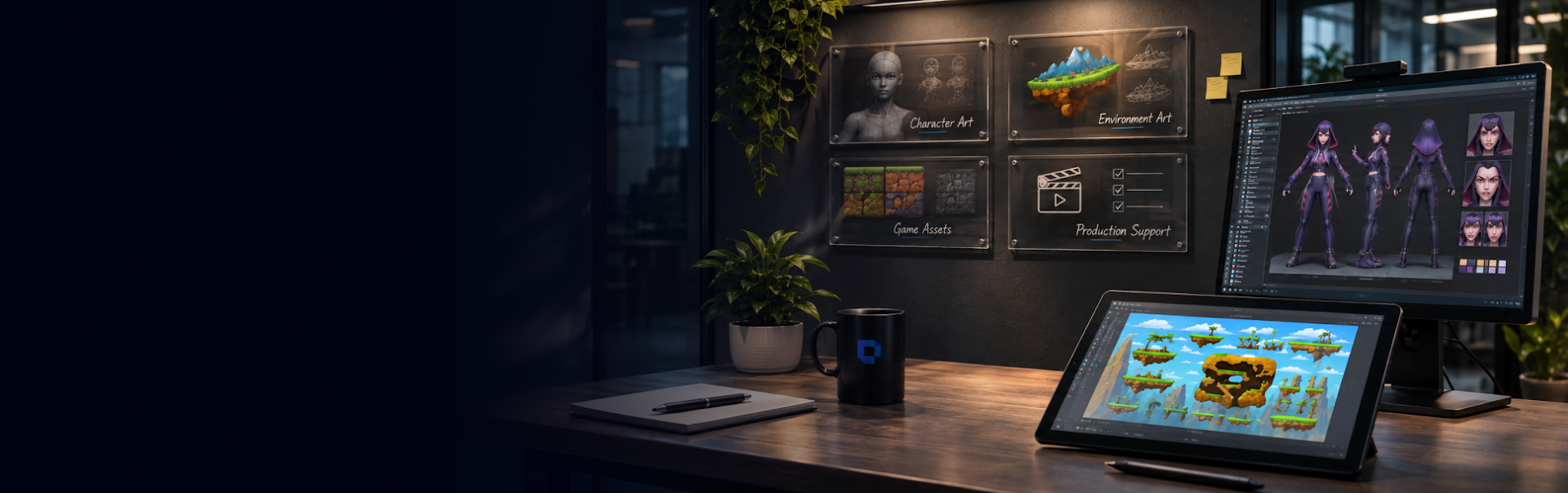
Once a studio selects its production model, the next step is defining which art requirements should remain internal and which should be assigned to an external partner. These requirements can range from specialized mobile game UI design and character production to complete 2D and 3D asset pipelines.
How to Score a Mobile Game Art Studio
When you evaluate game art outsourcing studios, put them all through the exact same filter. Score each criterion from 1 to 5, apply a weight based on what matters most to your project, then multiply the numbers and add them up.
| Criterion | Example weight |
|---|---|
| Shipped mobile art | 20% |
| Performance discipline | 15% |
| Style consistency | 15% |
| Engine and file fit | 10% |
| Process and communication | 10% |
| Live ops capacity | 10% |
| AI policy and ownership | 10% |
| Revision terms | 5% |
| Pilot result | 5% |
Use a weighted scorecard to compare shortlisted studios objectively. Evaluate their portfolios, technical capabilities, communication processes, and performance during a paid pilot before committing to a larger production agreement.
What Drives the Cost of Mobile Game Art Production
To forecast an accurate budget, game producers must look past the initial asset count. Project costs align directly with scope, visual complexity, and team composition. When you prepare a budget for an external studio, evaluate these five exact cost drivers:
- Asset Complexity: A static UI icon requires a fraction of the budget compared to a complex 3D boss character. Categorize your asset list by difficulty tier to secure an accurate quote.
- Animation Volume: Animation costs depend on rigging complexity, the number of animation sequences, character movement, facial expressions, and required revisions. Characters with multiple combat or interaction states generally require more production effort than static assets.
- Dimensionality: 2D production budgets typically account for illustration, sprite creation, and frame or skeletal animation. 3D production requires additional allocations for modeling, UV mapping, texturing, rigging, and animation.
- Revision Rounds: Vague feedback inflates budgets. A contract with a strict cap on revision rounds forces clear communication and protects your financial runway.
- Continuous Content: Launch day marks the start of your expenses. To maintain cost efficiency for live ops, negotiate a monthly retainer for battle passes and seasonal skins rather than individual asset contracts.
The best way to secure an accurate quote involves the provision of a highly detailed brief and a locked-in style guide to your partner on day one.
Final Words
Mastery of mobile game art production comes down to the treatment of the process as a strict, predictable pipeline. Phone hardware limits dictate almost every choice you make, from your texture compression formats down to the invisible pixel space on your UI tap targets. Preparation for these technical realities ensures a premium player experience. At Arizing Pixel, we provide highly optimized 2D game art, 3D game art, concept art, and UI/icon design for studios and publishers globally. We engineer our assets specifically to perform seamlessly in engines like Unity and Unreal.
Request the Mobile Game Art Production Toolkit from Arizing Pixel, or reach out to us today to talk about scale and growth for your mobile game art pipeline on your next big release.
Frequently Asked Questions
01. What is the significance of a structured mobile game art production pipeline?
A structured mobile game art production pipeline is crucial for maintaining visual consistency, technical quality, and timely delivery of assets, which helps studios effectively manage production efficiency and project costs.
02. How have live ops impacted mobile game art production in 2026?
Live ops have shifted the focus from user acquisition to long-term player retention, requiring studios to produce a continuous influx of fresh visual content for events and collaborations, thus changing the art production landscape.
03. What are the key components of a successful mobile game art production strategy?
A successful strategy includes texture budgeting, live ops calendar planning, vendor evaluation scorecards, and a rock-solid art calendar to manage the demand for new content efficiently.

