
✨ AI Summary
- Game development often requires more work than initially anticipated, making outsourcing an attractive option for studios looking to manage their workload.
- In his BAFTA Games Lecture, Hideo Kojima said that a game is built through many decisions and revisions that follow the first image in one's head.
- Game art outsourcing services can support either a small, clearly defined assignment or a wider production requirement, as long as the studio and its partner agree on the art direction, deliverables, and technical expectations.
- Outsourcing is a viable solution for studios facing layoffs while still having to meet production goals.
- It also offers a quicker alternative to the slow process of hiring and onboarding new staff.
There is usually a point in game development when the art list becomes longer than the team expected. More props are needed for a level. A character design gets revised. The environment needs another pass, and the animation team is waiting for updated models. The original vision has not necessarily changed. The amount of work required to deliver it has.
During his BAFTA Games Lecture, Hideo Kojima said, “If you’re going to create a piece of art, the first image is in your head.” That first image matters, but a game is built through the many decisions and revisions that follow it.
Studios have different ways of handling the workload. Some grow their internal art departments; others work with external specialists when a project demands additional capacity. Game art outsourcing services can support either a small, clearly defined assignment or a wider production requirement, provided the studio and its partner agree on the art direction, deliverables, and technical expectations.
Why Studio Economics in 2026 Changed the Math on Outsourcing
Half of all respondents in the GDC 2026 State of the Game Industry report said their current or most recent employer conducted layoffs in the past 12 months. Among US-based respondents, the figure rises to one in three personally laid off over the past two years. Studios didn’t shrink their production ambitions alongside their headcount. They still have titles to ship, milestones to hit, and publisher commitments to honor.
That’s the structural argument for game art outsourcing services right now. It isn’t about cost arbitrage.
- Art teams that once held six to ten people internally now hold three or four
- Rehiring is slow: sourcing, interviewing, onboarding, and reaching full production velocity on a new hire can take four to six months on a well-run team
- An external art partner can be briefed and producing within two to three weeks on a scoped engagement, provided the studio delivers clear reference materials and an art direction document at kickoff
When should you outsource versus build in-house? Outsourcing fits when you have a defined asset volume, a set visual style, and a delivery window that can’t flex. Internal hiring fits when you need someone permanently embedded in creative direction and daily cross-functional decisions. For most mid-size studios navigating 2026’s production environment, those aren’t mutually exclusive, but the timing difference matters.
Need one trusted creative partner from concept to handover?
What Types of Art Can Be Outsourced
The answer is broader than most production leads initially budget for.
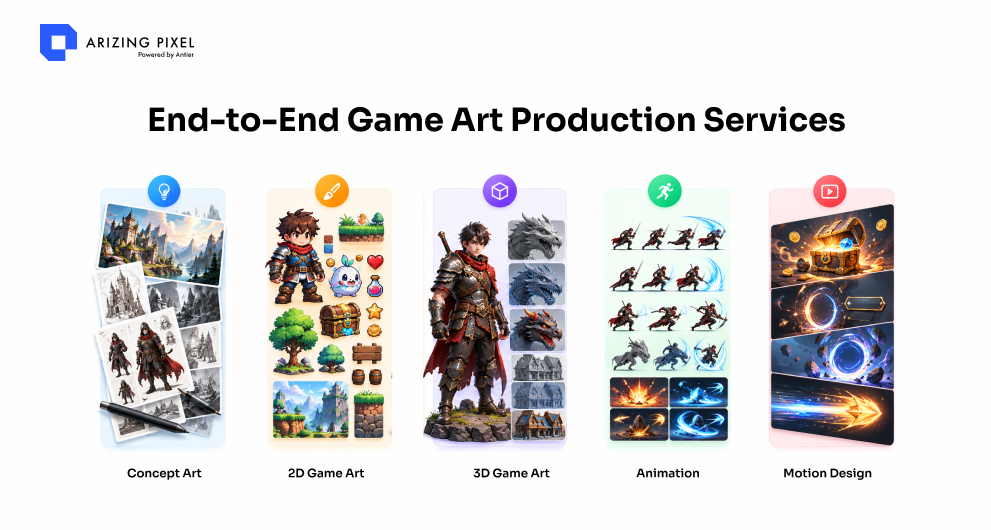
- Concept art: Character, creature, environment, prop, and weapon design. Structured deliverables include silhouette rounds, colour scripts, material callouts, orthographic views, and layered source files structured for 3D handover.
- 2D game art: UI illustration, isometric assets, sprite sheets, icon sets, background art, and marketing key art. 2D game art production services span casual, mid-core, and Web3 visual styles.
- 3D game art: Character and creature modeling, environment and prop production, texturing, detailing, optimization passes, and engine preparation. A full 3D game art production services engagement can begin from your existing concept art or from an art guidelines document.
- Animation: Character rigs, in-game animation sets, and cinematic sequences in both 2D and 3D
- Motion design: UI motion, trailers, launch videos, and branded content
According to Business Research Insights, 60% of game studios already outsource art tasks, with specialized skills and production efficiency as the primary drivers. The market for game art outsourcing services specifically sits at approximately USD 0.65 billion in 2026, projected to reach USD 1.27 billion by 2035 at a 9% CAGR, based on the art-specific scope measured by Business Research Insights.
Freelancer, Boutique Studio, or Full-Pipeline Partner: Which Fits Your Production?
This is the comparison most studios actually need to make, and most evaluations skip it.
| Factor | Freelancer | Boutique Art Studio | Boutique Art Studio |
|---|---|---|---|
| Asset volume capacity | Low to medium; typically one discipline | Medium; usually one or two disciplines | High; concept art through engine-ready assets across disciplines |
| IP documentation | Variable; depends on the contract | Partial; depends on studio practices | Comprehensive documentation, including source files, iteration history, and tooling notes |
| Platform coverage | Usually focused on one platform | Typically mobile and PC | Mobile, Web3, Roblox, Telegram, and AR/VR |
| Iteration speed | Can be slower due to reliance on one person | Faster with a small team | Potentially faster through an integrated pipeline with fewer handoffs |
| Engine-readiness | Asset files delivered; optimization may remain your responsibility | Partial engine preparation | Optimized assets for Unity, Unreal Engine, or Roblox Studio, according to project scope |
| Visual consistency at scale | Consistency can become harder to maintain as volume grows | Manageable for smaller projects | Supported by shared style guides, art direction, and documented QA processes |
The tradeoff with a full-pipeline partner is commitment. You’re aligning your production schedule with another studio’s capacity planning, which means the onboarding pass (style guide review, engine spec confirmation, file format alignment) carries real weight. Studios that skip that step typically spend the first two weeks of production correcting avoidable mismatches. A single freelancer carries lower commitment overhead but scales poorly once your asset list exceeds what one person can hold.
Brad Hendricks, CEO and founder of Blind Squirrel Games, made the distinction at a 2026 GDC Festival panel: outsourcing applies when a studio “wants something siloed in a box” for specific deliverables such as assets, QA, or cinematics. That framing holds up. When the deliverable is discrete and bounded, a boutique studio or freelancer may be sufficient. When the deliverable is an entire title’s worth of art across multiple disciplines and platforms, a full-pipeline game art outsourcing partner is the more durable choice.
How the Game Art Outsourcing Process Works, Step by Step
There’s a version of this process that runs smoothly and a version that creates revision debt. The difference is almost always in how thoroughly the first two steps are handled.
- Production intake and scoping (Week 1)
Define the asset list, visual style, platform targets, and engine. The studio reviews your concept art or art direction document and returns a confirmed scope with delivery phases. - Art direction alignment (Days 3–7)
Share reference materials: mood boards, approved colour palettes, character sheets, and any existing in-game screenshots. The external studio produces a style validation pass (one character or one environment section) before committing to full production. This is the stage most studios rush, and most revision cycles trace back to it. - Production phase (Weeks 2–8+ depending on scope)
Assets move through modeling, texturing, detailing, and optimization in parallel across the team. Iteration rounds are scheduled, not ad hoc. Most structured engagements build in two rounds of revisions per asset batch. - Engine preparation and QA (Week before delivery)
Files are optimized for the target engine, whether Unity, Unreal Engine 5, Roblox Studio, or a Web3-specific build environment. Poly counts, LODs, texture atlases, and naming conventions are confirmed against your project’s technical requirements. - Delivery and handover documentation
Final delivery includes layered source files (not flattened exports), a delivery note confirming tooling used during production, and an asset log for your own project documentation.
How long does game art outsourcing take? A scoped character art batch of 10 to 15 hero characters typically runs four to six weeks from confirmed brief to engine-ready delivery. An environment kit for a mid-core mobile title (8 to 10 modular pieces with LODs) typically runs six to eight weeks. A full 2D game art production services engagement covering UI, icons, and background art for a casual mobile title can run eight to twelve weeks depending on the total asset count.

Clear your art backlog with a production partner that delivers consistent, platform-ready assets
Platform-Specific Art Production: Mobile, Web3, Roblox, and Telegram
Most evaluation guides for game art development studios treat platform as a footnote. It isn’t. Can you outsource art for Web3, Roblox, or mobile specifically? Yes, and the production constraints differ meaningfully across those platforms.
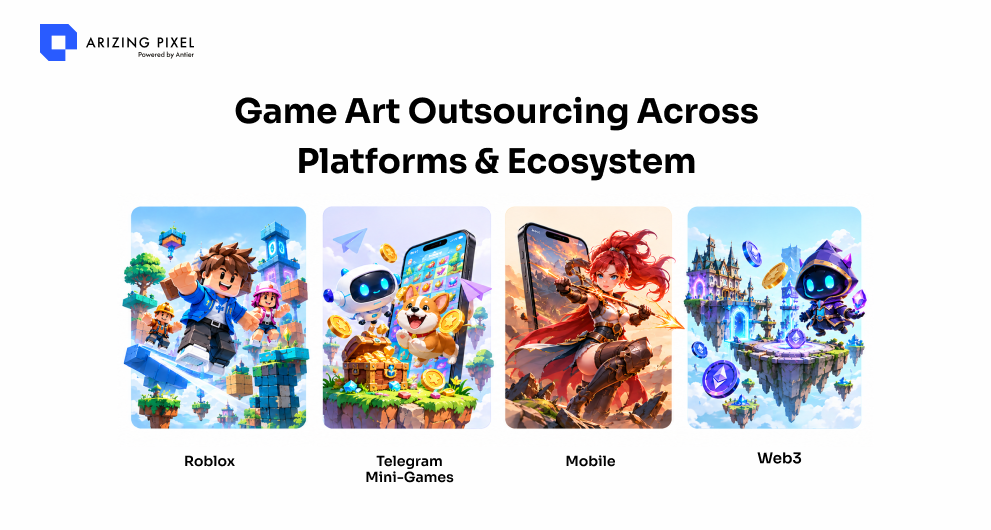
- Roblox: Art production for Roblox operates inside Roblox Studio’s specific polygon budget, texture size ceilings, and material system. Character designs follow R15 and R6 rig structures. Partners producing Roblox content without platform-specific experience consistently overproduce asset complexity, which creates both performance and certification problems
- Telegram mini-games: Visual formats are compact, with a strong emphasis on immediate readability at small screen sizes and fast load performance. 2D game art production services for Telegram titles lean toward high-contrast illustration styles and optimized sprite sheets
- Mobile: Poly counts, draw call budgets, texture compression formats (ASTC for iOS, ETC2 for Android), and UI scaling across device resolutions require an art partner who works inside those constraints from the first modeling pass, not as a post-production optimization
- Web3: 2D game art services and 3D game art services for blockchain titles need tokenizable asset structures. Character and item art produced for NFT or P2E contexts often requires layered attribute separation (body, clothing, accessories as distinct layers) for trait-based generation pipelines, plus engine-ready formats for the underlying game build
Which engines do outsourcing studios typically work with? Unreal Engine 5, Unity, Roblox Studio, and Godot cover the majority of production needs across these platforms. Web3 titles sometimes use custom engines or Three.js-based environments, which changes the file format and optimization requirements accordingly.
Key Criteria for Choosing a Game Art Outsourcing Studio
A strong game art outsourcing partner for game studios produces engine-ready deliverables, not files that need a second optimization pass from your internal team. Here’s the specific list to evaluate against:
- Can they deliver high-quality assets tailored to your target platform and its documented technical requirements?
- Can concept art, 2D art, and 3D art be produced seamlessly under one roof, ensuring smooth transitions between production stages?
- Do they provide layered source files, tooling notes, and iteration history for transparent collaboration?
- Are revision rounds clearly structured and scheduled to support predictable production timelines?
- Do they conduct style validation before scaling up production to ensure visual consistency?
Is engine-ready delivery, including poly counts, LODs, naming conventions, and texture formats, integrated into their standard workflow?
Final Words
Game art outsourcing services in 2026 aren’t a workaround for studios that can’t staff up. They’re a production model that 60% of studios already use by choice, according to Business Research Insights, because specialized skills, platform-specific constraints, and the volume demands of a modern title make a full-pipeline external partner the more practical option for most production schedules. The studios navigating this well have clear briefs, structured handover requirements, and partners who deliver engine-ready assets with complete IP documentation.
At Arizing Pixel, we build game art outsourcing services around exactly that model, covering mobile, Web3, Roblox, and Telegram under a single production pipeline from concept through engine-ready delivery.
Frequently Asked Questions
01. When should a game studio consider outsourcing art production instead of building an in-house team?
A game studio should consider outsourcing when they have a defined asset volume, a set visual style, and a delivery window that cannot flex. In contrast, building in-house is preferable when a permanent team member is needed for creative direction and daily decision-making.
02. What are the benefits of using external art partners for game development?
External art partners can be briefed and start producing within two to three weeks on a scoped engagement, which is significantly faster than the four to six months it can take to onboard new internal hires. This allows studios to meet tight deadlines and maintain production momentum.
03. How has the game industry landscape changed in 2026 regarding studio staffing and production?
In 2026, many studios have reduced their internal art teams from six to ten members to just three or four due to layoffs, yet they still have ambitious production goals. This shift has made outsourcing a strategic necessity rather than a cost-saving measure.

