✨ AI Summary
- In the Play and Earn gaming industry, the focus has shifted from prioritizing the economy to enhancing the gameplay experience first.
- This change was sparked by the failure of many games between 2022 and 2024, which prioritized the economy and failed to attract and retain players.
- Now, successful Play and Earn game development in 2026 hinges on creating engaging gameplay, incorporating skill-based progression, retention loops, and asset utility before adding the token layer.
- The global Play to Earn market is expected to reach USD 6.37 billion in 2026, with capital flowing towards structured builds over speculative launches.
- This blog post offers a comprehensive guide to understanding the importance of gameplay-first development, evaluating Play and Earn game development companies, and knowing when to add a blockchain layer.
The foundation of every successful play and earn game development in 2026 is gameplay, with the token layer added only after the core experience is proven. Between 2022 & 2024, games that prioritized the economy over gameplay mechanics failed at scale. The ones still operating, and the ones now attracting serious capital, built skill-based progression, genuine retention loops, and asset utility into the core before a single smart contract was written. The global P2E market is projected to reach USD 6.37 billion in 2026, according to Global Growth Insights. That capital is flowing toward structured builds rather than speculative launches.
What you will learn in this guide:
– Why the gameplay-first sequence is the single structural requirement for a viable play and earn economy in 2026
– What institutional investment signals about where the market is headed
– How to stage a play and earn build from core loop to token integration to smart contract architecture
– When to add a blockchain layer and what standards apply
– How to evaluate a play and earn game development company against the failure patterns of early GameFi
– What the build vs. outsource decision looks like for a Web3 founder scoping a project now
Why 2026 Is a Structurally Different Market for Play and Earn
The speculative phase of blockchain gaming ended badly. Projects that launched with inflationary token models and no genuine gameplay loop burned through communities inside 6 to 18 months. That correction was painful, but it produced something useful: a clear record of what structural decisions caused the failures.
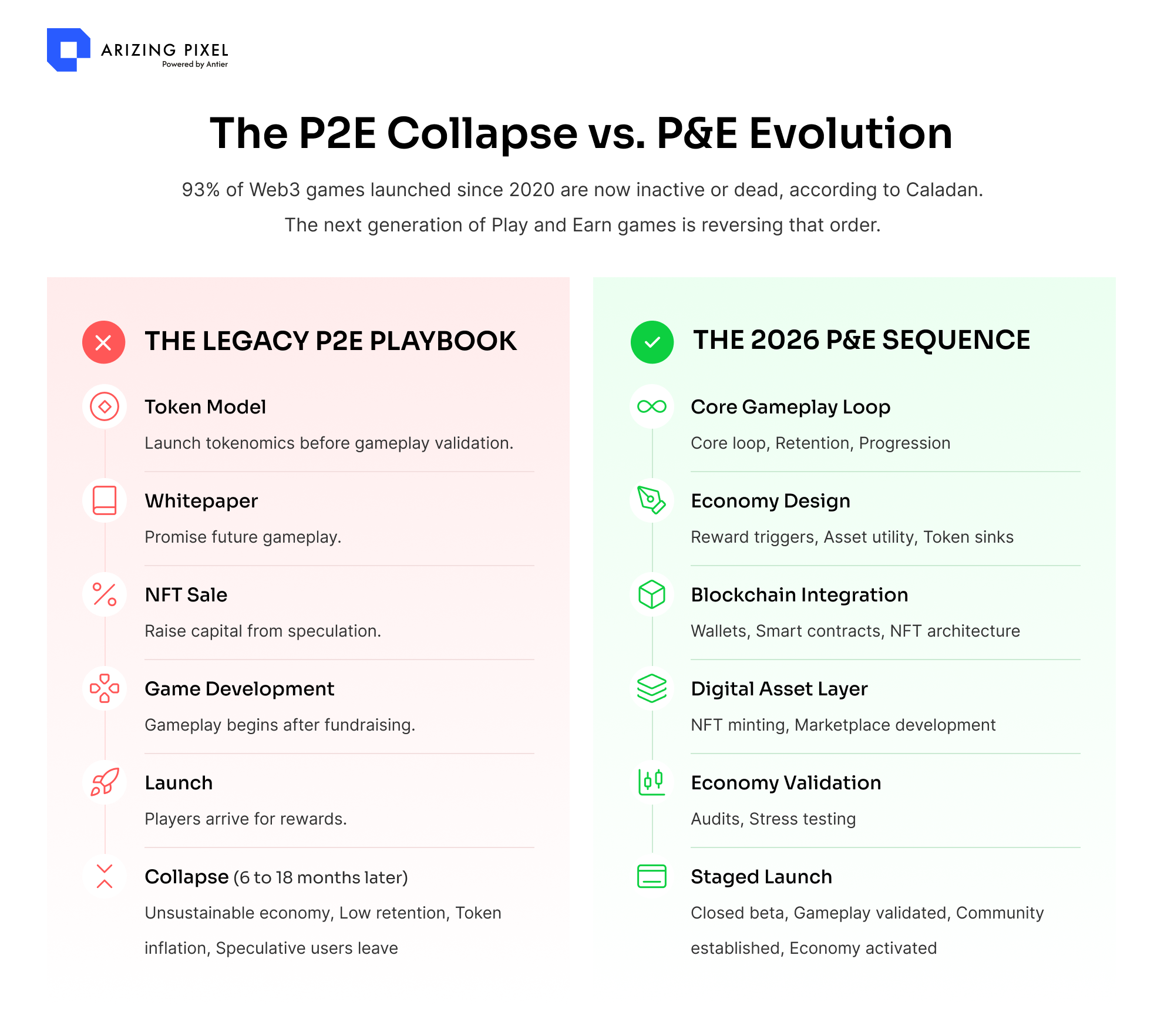
Data Source: Caladan Research (93% Web3 games inactive since 2020)
What this means for a founder scoping a play and earn build today:
- The market rewards structural discipline, not whitepaper ambition.
- Players in 2026 have lived through failed GameFi projects and are skeptical of earn-first messaging.
- The mobile gaming market now reaches 3.2 billion players, but token rewards alone cannot drive success. Retention mechanics must first prove effective on a 5-inch screen, according to Dataintelo.
- Investors and ecosystem partners now ask about core loop retention before they ask about tokenomics.

Ready to scope your P&E build with a studio that designs both the game & the economy?
What Makes a Play and Earn Game Economically Viable in 2026?
The question most founders ask first is: what blockchain should we build on? The more useful question is what keeps a player in the game without a financial incentive on day one.
Successful Play and Earn game development in 2026 starts with these structural foundations, all of which should be in place before the token layer is introduced.
- Skill-based progression system: Player advancement is earned through gameplay rather than wallet size, creating genuine long-term retention that is independent of token price fluctuations.
- Gameplay-driven token sinks: Upgrades, crafting, territorial control, and competitive entry fees remove tokens from circulation through meaningful player decisions, helping maintain a balanced in-game economy.
- Utility-first digital assets: NFTs should deliver real in-game functionality beyond secondary market trading. Assets with practical gameplay value remain relevant even when trading activity declines.
- Diversified revenue streams: Primary asset sales, secondary market royalties, in-game purchases, battle passes, subscriptions, and competitive entry fees collectively support a sustainable game economy without relying on a single revenue source.
- Cross-chain asset interoperability: Standards such as ERC-721 and ERC-1155, supported across networks like Polygon, BNB Chain, and Immutable, enable digital assets to move across compatible ecosystems, enhancing their long-term utility and perceived value while expanding player reach.
The failure pattern in early play and earn game development was structural separation. Game designers built gameplay while blockchain teams designed the economy independently, creating misaligned systems. Token inflation lacked in-game sinks, asset values relied on new players, and success was measured by token price instead of player retention. Modern play and earn game development solves this by designing gameplay and blockchain as one integrated system.
How to Create Play and Earn Game: The Build Sequence That Works
Play and earn game development in 2026 follows a staged sequence, not a parallel track. Economy design does not run alongside game design. It follows it.
| Stage | What Gets Built | What Is Deliberately Deferred |
|---|---|---|
| 1. Core Gameplay Loop | Core gameplay mechanics, player progression, and retention systems | Tokenomics, smart contracts, and wallet integration |
| 2. Game Economy Design | Token sinks, reward mechanisms, and digital asset utility framework | Live token launch, public NFT minting, and marketplace deployment |
| 3. Blockchain Integration | Smart contract development, blockchain selection, and wallet SDK integration | Public launch and token exchange listings |
| 4. Digital Asset Layer | NFT minting, ERC-721/ERC-1155 implementation, and NFT marketplace development | Secondary market promotion and trading campaigns |
| 5. Economy Validation | Smart contract security audits, token flow stress testing, and sink-to-source ratio analysis | Full-scale player rollout |
| 6. Staged Launch | Closed beta with wallet-enabled players, economy monitoring, and iterative balancing | Public token trading until the in-game economy is fully validated. |
How to Choose a Play and Earn Game Development Company That Builds for Survival
Most studios that offer game development services were built for the 2021 to 2022 market. Their processes reflect that era: token model first, whitepaper next, game later. Evaluating an experienced gaming studio in 2026 means asking different questions than those that governed the last cycle.
What to ask before signing:
- Does the studio have shipped Web3 titles with documented post-launch retention data, not just launch announcements?
- Can the team show you where economy design enters the production timeline relative to core loop completion?
- Does the studio have in-house smart contract engineers who have worked alongside game designers on the same project, not on separate tracks?
- What audit partners do they use, and at which stage does the audit occur?
- Can the studio build across multiple chains, including Polygon, BNB Chain, and Immutable X, or are they locked to one ecosystem?
- Does the studio produce original game art, or does it rely on asset libraries? Original asset design matters for NFT differentiation at the collection level.
- Has the team worked on mobile-first Web3 builds? With 82% of emerging-market players accessing games via smartphone, mobile architecture is not optional.
What the answers reveal?
A studio that leads with tokenomics is still working from the old playbook. A studio that leads with session time, Day 7 retention targets, and skill-progression design before discussing smart contracts is operating from the framework the current market rewards. The right play and earn game development company does not hand off economy design to a separate blockchain consultant. Both systems need to be shaped by the same team at the same table.
The documented failure pattern was structural separation. When the concept art team, the game design team, and the blockchain team work in sequence rather than together, the token layer lands on a game that was never designed to absorb it.
Deciding When to Add the Token Layer: A Founder’s Checklist
This is the decision most founders get wrong. Adding the token layer too early is the single most common structural mistake in play and earn game development. The checklist below is the practical filter.
Need Help Planning Your P&E Development Roadmap?
Before you proceed to token integration, look for:
- The core gameplay loop holding players across multiple sessions with zero financial reward in play. If it can’t do that, a token won’t fix it; it’ll just delay finding out.
- Real token sinks already built into the game and tested with non-token incentives first, not sketched on a whiteboard.
- Every planned NFT asset has a documented in-game function that doesn’t depend on secondary market activity to matter. If the only reason it’s valuable is that someone else might buy it, that’s speculation wearing a utility costume.
- The economy stress-tested against a scenario where new player growth stalls, not modeled assuming constant new entry.
- Smart contract audit scope defined and a real audit partner already selected, not budgeted for later.
- Chain selection finalized based on the target audience’s actual existing wallet behavior, not chosen for grant money on the table.
1. Signals that you are ready:
– Closed beta players are returning for gameplay reasons they can articulate beyond earning
– Session length is stable or growing independent of token price movement in comparable projects
– The studio’s economy designer and lead game designer can describe the sink-to-source ratio without referring to a separate document
2. Signals that you are not ready:
– The whitepaper is more developed than the game design document
– The primary player acquisition strategy depends on token price appreciation
– Asset value in the planned collection cannot be explained without referencing a secondary marketplace
Conclusion
The play and earn market in 2026 no longer rewards the old “launch token first” approach. Institutional investors now evaluate projects based on player retention, engagement, and long-term sustainability rather than short-lived token price spikes. As a result, capital is flowing toward studios and infrastructure providers that prioritize gameplay first and introduce blockchain ownership only after the core experience has proven its value.
Founders who follow this play and earn game development model and partner with a studio capable of designing both the game experience and the blockchain architecture as a unified system are building the type of projects today’s investors are willing to back.
At Arizing Pixel, we build play and earn games from the core gameplay loop to smart contract integration as one connected development process, ensuring that engaging gameplay and sustainable Web3 mechanics evolve together rather than competing with each other.