✨ AI Summary
- The blog post provides an in-depth look at the complex systems and requirements necessary for gacha game development, a genre poised to reach USD 4,598.9 million in 2026 and grow to USD 15,700.84 million by 2035.
- It discusses key components like the pull engine, pity system, rarity economy, and others, as well as the regulatory requirements, Web3 considerations, outsourcing decisions, and development timelines.
- The post also highlights the importance of understanding the art and client build, and the impact of regulatory changes on the game architecture.
- It compares traditional gacha and Web3 gacha, suggesting the latter may require additional infrastructure for blockchain-based asset ownership and other features.
- The post concludes with a checklist for Web3 gacha founders and a guide to gacha game development costs.
A gacha game in 2026 requires more production infrastructure than any other mobile genre. The pull engine, pity system, rarity economy, server-side odds management, age-verification layer, and storefront compliance stack all need to be in place before a single banner goes live. Understanding the full scope of gacha game development costs starts with considering these essential systems, along with the art and client build.
The global gacha games market is projected to reach USD 4,598.9 million in 2026 and grow to USD 15,700.84 million by 2035 at a 14.6% CAGR, per Market Reports World. This guide covers the key systems, regulatory requirements, Web3 considerations, outsourcing choices, live-service architecture, and development timelines.
What Systems Does a Gacha Game Actually Require?
Gacha game development scope is wider than most founders expect when they first sit down to estimate it. The visible layer, including art, UI, and narrative, represents roughly 40% of the work. The systems underneath play a crucial role in making the game commercially viable.
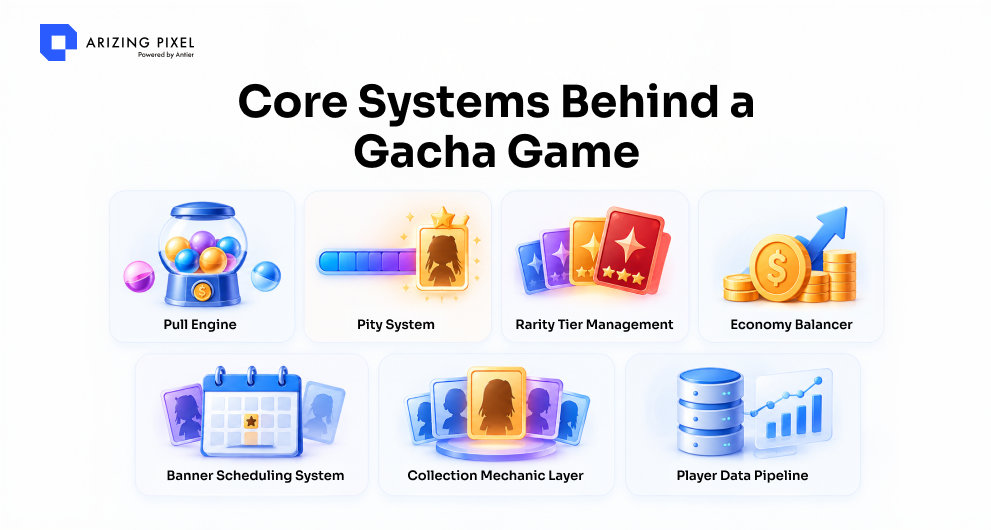
Core systems required in every gacha build:
- Pull engine: Randomized draw logic with weighted probability tables, rate modifiers, and real-time session tracking.
- Pity system: Hard pity and soft pity counters, stored server-side, never client-side, because client-side pity is both a cheating surface and a compliance failure.
- Rarity tier management: Item scarcity logic tied to banner schedules, seasonal drops, and limited-pool mechanics.
- Economy balancer: In-game currency sinks, premium currency conversion, freemium gate logic, and microtransaction integration.
- Banner scheduling system: Timed campaign drops with configurable start/end dates, rollover handling, and promotional offer stacking.
- Collection mechanic layer: Completion tracking, set bonuses, duplicate resolution, and inventory management.
- Player data pipeline: Behavioral telemetry, A/B testing infrastructure for gacha rates and item pools, and session-level retention analytics.
The team roles required to deliver these systems span game designers with specific gacha economy experience, backend engineers capable of building server-authoritative odds systems, front-end developers for the draw animation and reveal UX, and QA specialists who can stress-test randomization at scale. Art style has a direct effect on scope. A 2D gacha with illustrated card assets and spine-animated characters requires a significantly different pipeline than a 3D gacha with real-time rendering, skeletal rigs, and dynamic camera pulls on summoning sequences.

Know What Your Gacha Game Will Take to Build
Titles like Genshin Impact and Honkai: Star Rail demonstrate what a 3D production pipeline demands at the premium end; Arknights and AFK Arena represent the 2D art model at commercial scale. Both work, but the team composition, the asset volume, and the render pipeline differ enough that treating them as equivalent scope tiers is a planning error.
The Regulatory Layer That Now Lives Inside Your Architecture
Regulation is no longer a post-launch checkbox. In 2026, it is a first-class production decision that affects storefront access, server design, and market reach before a game ships.
What changed and when:
- The FTC finalized loot box and gacha disclosure rules in September 2025, requiring publishers to display exact pull probability percentages across all US storefronts and distribution channels.
- PEGI’s new interactive risk categories took effect in June 2026, mandating a minimum PEGI 16 rating for any game containing paid random items regardless of its content rating.
- The European Parliament’s Internal Market and Consumer Protection Committee passed a report in late 2025 recommending that the Digital Fairness Act prohibit loot boxes in games accessible to minors across EU member states.
- The FTC settled with HoYoverse on January 17, 2025, which became the most significant named official regulatory action against a gacha publisher to date.
What does this mean for your architecture?
Displaying pull rates is not a UI decision. It is a backend systems decision. Probability percentages must be stored, versioned, and rendered server-side so they can be audited. An age verification layer is now required infrastructure in Brazil and is likely to become so across PEGI-rated markets. The PEGI 16 designation changes your storefront eligibility and changes the audience segmentation logic in your player data pipeline. Gacha games that embed these requirements in the architecture from day one spend far less rework budget than those that retrofit them after an initial build. The FTC/HoYoverse settlement made that pattern concrete.
Here are a few must-ask questions to consider when researching gacha game development and compliance:
- Do gacha games need to disclose pull rates?
Yes, in the US as of September 2025, with enforcement applicable to all storefront distribution channels.
- What countries have banned or restricted gacha mechanics?
Brazil has banned loot box sales to minors since March 2026, and EU-wide restrictions are actively in legislative progress.
- How does PEGI 16 affect gacha game distribution?
Any game with paid random items now requires, at minimum, a PEGI 16 rating in Europe from June 2026 onward, which directly limits storefront placement for titles previously rated lower.
Traditional Gacha vs. Web3 Gacha: A Build Complexity Comparison
The development scope for a Web3 gacha game differs from a traditional gacha game across eight specific areas. Both can use similar pull mechanics, but Web3 implementations may introduce an additional infrastructure layer for blockchain-based asset ownership, verifiable issuance records, smart-contract mechanics, and wallet integration.
| Scope Dimension | Traditional Gacha | Web3 Gacha |
|---|---|---|
| Pull Engine | Server-side, proprietary logic | Smart contract-governed, on-chain verifiable |
| Pity System | Database-stored per player account | On-chain pity counter, immutable per wallet |
| Rarity Tier | Game-defined, publisher-controlled | Blockchain-verifiable, provably scarce |
| Asset Ownership | Publisher-held, non-transferable | Player-held NFTs, tradable on secondary markets |
| Compliance Layer | Probability disclosure UI + server audit | Disclosure UI + on-chain audit trail + wallet KYC |
| Backend Infrastructure | Game server + CDN + analytics | Game server + blockchain node + NFT marketplace |
| Specialist Roles Added | Standard gacha development team | Smart contract engineer, tokenomics designer, blockchain QA |
| Deployment Targets | iOS, Android, PC | iOS, Android, PC + Ethereum, Polygon, or BNB Chain |
One important editorial point: If this section is intended for a technical article, I would avoid presenting Web3 gacha as inherently requiring every blockchain component shown in the table. The complexity depends heavily on whether assets, pity, randomness, trading, and transactions are actually implemented on-chain. This makes the comparison more technically credible.

Planning Your Gacha Game Budget? Start With the Right Scope.
Platforms and engines used in gacha development
- Unity is the dominant engine for mobile gacha due to its cross-platform build tooling and Spine animation support.
- Unreal Engine 5 suits 3D gacha with cinematic summon sequences and real-time lighting demands
- PC and mobile can be built simultaneously using Unity’s multi-platform export. Still, the UI/UX design must account for aspect ratio and input method differences from the start, not retrofitted.
- Blockchain deployment for Web3 gacha typically targets Ethereum, Polygon, or BNB Chain depending on gas cost requirements and ecosystem reach.
The In-House vs. Outsource Decision for Gacha Development
Gacha game development is one of the harder genres to staff internally, specifically because the skill sets that define a well-functioning gacha game are rare individually and rarely found clustered in a single hire.
Why outsourcing gacha development is a rational scope decision:
- Pull-engine balancing requires someone who has calibrated probability tables across multiple live titles. A general game designer can learn the mechanics, but calibration intuition develops through direct experience with where gacha economies actually deflate.
- Smart contract pity systems require a blockchain engineer who understands both Solidity and game economy logic simultaneously. That profile is genuinely scarce.
- Compliance architecture for multi-region gacha requires someone who has already navigated the FTC disclosure layer, PEGI rating changes, and jurisdiction-specific age verification requirements. Building that institutional knowledge from scratch adds months to your timeline.
- Art pipelines for gacha are high-volume by nature. A single banner event might require 10 to 15 unique character illustrations, multiple rarity frame treatments, and animated summon sequences on a three- to four-week production cycle. Internal art teams are rarely sized for that throughput at launch.
Where in-house still makes sense:
If a studio already has a live gacha game and is expanding it, internal LiveOps teams who know the specific economy are often the right choice for ongoing content. The tradeoff is speed: internal teams familiar with the existing codebase can ship content faster, but they carry the technical debt of whatever architecture decisions were made at launch. A studio inheriting a non-compliant architecture from a prior build may find the retrofit more expensive than a rebuild.
What a Gacha Game Needs to Survive Past Year One
The 70% shutdown figure from Automaton West’s November 2025 research, drawn from approximately 2,200 titles, deserves more than a citation. It describes a structural problem, not bad luck.
Most gacha games that close in year two share one of three specific architecture gaps: banner economics that drain the player base faster than new content can replace it, server infrastructure that can’t handle burst traffic during limited-time events, or a content pipeline that ran out of roadmap before retention had time to compound.
What live-service durability requires at the architecture level:
- Server-side session scaling that handles 10x normal load during banner launches without degrading pull response times.
- A content scheduling system that can run overlapping events without manual intervention per event
- Player behavior telemetry that surfaces banner fatigue signals early enough to adjust drop rates before churn accelerates.s
- A roadmap that plans 6 to 12 months of content before the launch banner clears
Genshin Impact crossed $10 billion in all-platform lifetime player spending by the end of 2025, the fastest any game in history reached that mark according to Niko Partners. That figure represents one end of a very wide range. The architecture decisions Genshin made at launch, including server-side control over pull logic, player data infrastructure designed to handle massive session volumes, and a six-week content cadence, were not retrospective additions. They were foundational scope decisions made before the first banner shipped.
Making the Build Decision: A Checklist for Web3 Gacha Founders
Before committing to a gacha game development budget and timeline, work through these scope-defining questions:
- Pull engine: Will your pity system live server-side, on-chain, or both? The answer determines your backend engineering scope and your compliance audit trail.
- Asset ownership model: Are your rarity tiers verifiable on-chain via NFTs, or publisher-controlled in a database? The answer determines your secondary market strategy and your player acquisition story.
- Compliance layer: Which markets are you launching in at launch, and which regulatory requirements (FTC disclosure, PEGI 16, Brazil Lei 15.211/25) apply to each? The answer determines your age verification and probability display UI scope.
- Art pipeline: How many characters, frames, and animated sequences does your launch banner require? Multiply that by your planned banner cadence to get a realistic ongoing art volume estimate.
- Token economy: If you’re building a P2E layer, do your in-game currency sinks and earn rates support a tokenomics model that stays solvent past the first six months? If unsure, that’s the first thing to design, not the last.
- Server architecture: Can your infrastructure handle a 10x traffic spike on banner day without degrading the pull experience? That spike is not a corner case; it is the predictable state of every limited-time event.
- LiveOps plan: Do you have 6 months of content roadmapped before launch? If not, the game’s survival window shortens significantly.
Before committing to a gacha game development budget and timeline, work through these scope-defining questions. For a broader look at the costs involved in building a gacha game, see our guide on how much it costs to create your own gacha game.
FAQ: Live-Service and Post-Launch Questions
Why Do Most Gacha Games Shut Down Within 2 to 3 Years?
The most common driver is banner economy miscalibration that compresses the player spending curve into the first 6 months, leaving no sustainable revenue base to fund content development in year 2. Server costs continue regardless of active player count, so a game that front-loads its monetization and doesn’t reinvest in content reaches an inversion point where operating costs exceed revenue.
What Does a Gacha Game Need to Survive Past its First Year?
Three things matter most: a content pipeline scheduled at least two banner cycles ahead at all times, server infrastructure built for burst capacity from day one, and a behavioral analytics layer that catches retention signals early enough to act on them. A gacha game built on reactive LiveOps rather than planned content cadence is almost always the one that closes in month 18.
Conclusion
Gacha game development cost in 2026 depends on more than just gameplay and visuals. Backend systems, pity mechanics, compliance, content production, LiveOps, and Web3 features can all shape the final budget.
At Arizing Pixel, the development scope is planned upfront, covering everything from game economies and banner systems to backend infrastructure and on-chain functionality where required.
Frequently Asked Questions
01. What are the essential systems required for developing a gacha game in 2026?
Essential systems include a pull engine, pity system, rarity tier management, economy balancer, banner scheduling system, collection mechanic layer, and player data pipeline.
02. How is the gacha games market projected to grow in the coming years?
The global gacha games market is projected to reach USD 4,598.9 million in 2026 and grow to USD 15,700.84 million by 2035, with a CAGR of 14.6%.
03. What percentage of gacha game development work is attributed to the visible layer, such as art and UI?
The visible layer, including art, UI, and narrative, represents roughly 40% of the total work in gacha game development.