✨ AI Summary
- AI-powered tap-to-earn games are losing players due to a lack of proper integration of AI into the reward loop, resulting in a 60% to 80% player drop-off after an airdrop event.
- To combat this, AI should be designed into the reward loop from the start, adapting to individual player behavior and preferences.
- This approach creates opportunities for better player engagement, adaptive rewards, and game economies.
- The AI in games market is projected to add $34.10 billion between 2025 and 2030, and the play-to-earn NFT games market is set to increase from $1.98 billion in 2026 to $13.98 billion by 2035.
- Developers should focus on building AI-integrated tap-to-earn games differently than first-generation studios did, incorporating AI architecture from the beginning, adapting the game to the player, and focusing on sustainability.
AI-powered tap-to-earn games aren’t failing because of the mechanic. They’re failing because of how AI gets added to them. The pattern is consistent: acquire players fast, spike engagement around an airdrop window, then watch 60 to 80 percent of that base evaporate within weeks. The fix isn’t a better onboarding flow or a shinier reward animation. It’s designing AI into the reward loop from the ground up, so the system learns what keeps each player returning rather than simply tracking what they clicked last session.
The growing role of AI in Web3 gaming is creating new opportunities for smarter player engagement, adaptive rewards, and game economies. Technavio projects the AI in games market to add USD 34.10 billion between 2025 and 2030, with a 40.7% CAGR. In parallel, the play-to-earn NFT games market is projected to increase from USD 1.98 billion in 2026 to USD 13.98 billion by 2035, according to Business Research Insights. The opportunity is large enough to defend. But it requires building differently than first-generation studios did.
What you’ll learn in this piece:
- Why AI-powered tap-to-earn games face a specific, documented retention risk that surface-level AI features don’t address
- How intentional AI architecture differs from bolt-on personalization
- A step-by-step development process
- How to evaluate a specialist for this category
The Retention Paradox: Why AI Features Alone Create Churn
There’s a counterintuitive finding sitting in the data that every tap-to-earn founder should know before they greenlight a second title. RevenueCat’s 2026 State of Subscription Apps report, drawn from over $11 billion in tracked annual revenue across 75,000 developers, found that AI-powered apps lose paying subscribers 30% faster than non-AI apps.
That figure isn’t an argument against AI in tap-to-earn. It’s an argument against AI used as an acquisition signal that can’t follow through on the implicit promise it makes. When AI surfaces in a tap-to-earn title purely as a marketing hook, players arrive with elevated expectations. They expect a game that adapts to them. What they often find is a static reward curve dressed in AI language, and the drop-off accelerates precisely because the gap between expectation and experience is wider than it would have been for a plainly described clicker.
Alena Shmalko of the TON Foundation put the category’s structural challenge clearly, stating via BeInCrypto that “no game lasts indefinitely, not even triple-A titles, and tap-to-earn games have an even shorter lifecycle.” The implication for 2026 builds isn’t that the category is broken. It’s that lifecycle design has to be a first-order architectural decision, not a post-launch patch.
Why first-gen titles lost players so fast:
- Reward curves were hardcoded, so experienced players hit ceilings within days and had no reason to return
- Token economies were designed around launch-window acquisition, not sustained play value
- Anti-cheat systems lagged behind bot networks, eroding reward fairness for legitimate players
- Airdrop mechanics front-loaded the game’s entire value proposition, leaving nothing compelling after distribution closed
The fix isn’t adding a personalization layer on top of that structure. It’s rebuilding the reward logic so the AI loop and the on-chain incentive model are designed together from the start.

Take Your Tap-to-Earn Concept Beyond Basic Rewards
What Separates AI-Integrated Tap-to-Earn From a Basic Title
The table below maps where intentional AI architecture produces a different outcome than a standard tap-to-earn build. These differences compound over the first 90 days after launch, which is where the churn curve is steepest.
| Dimension | Basic Tap-to-Earn | AI-Integrated Tap-to-Earn |
|---|---|---|
| Retention | Rewards follow a fixed schedule | Rewards adapt to player activity |
| Reward Logic | Uses predefined token rules | Adjusts rewards using player and on-chain data |
| Personalization | Little to no personalization | Gameplay and rewards adapt to player behavior |
| Anti-Cheat | Relies on basic limits and checks | AI flags unusual tapping patterns |
| Monetization | Mainly purchases or token rewards | Combines purchases, staking, NFTs, and ads |
These differences are becoming increasingly important as AI-powered blockchain games move toward more adaptive gameplay and reward systems. These are the key questions builders should research before developing an AI-powered tap-to-earn game.
Q1: Is tap-to-earn still profitable in 2026?
Yes, especially for studios that bring tokenomics and AI-driven game design together from the start. The model continues to evolve, with newer titles focusing on sustainable rewards, stronger engagement, and smarter player experiences. The titles that perform in 2026 are building on TON and similar chains with reward architectures that account for both player behavior data and token emission sustainability simultaneously.
Q2: What makes an AI-powered tap-to-earn game different from a basic one?
The biggest difference is how the game responds to players. AI can spot signs that a player is losing interest and adjust rewards, difficulty, or social features to bring them back. A basic game usually follows the same reward and engagement rules for everyone. By the time a retention issue appears in a standard analytics report, the player may already be gone.
Morgan Stanley estimates that AI could unlock $22 billion in additional profit for the video game industry. Morgan Stanley research Much of that opportunity comes from improving how games keep players engaged, rather than simply using AI to create content or acquire users. For tap-to-earn games, that can mean stronger player lifetime value over time.
How to Build an AI-Powered Tap-to-Earn Game: Phase by Phase
The right architecture and platform set the foundation for the build. The process below takes you through the main stages of developing a tap-to-earn game with AI built into the experience from the start.
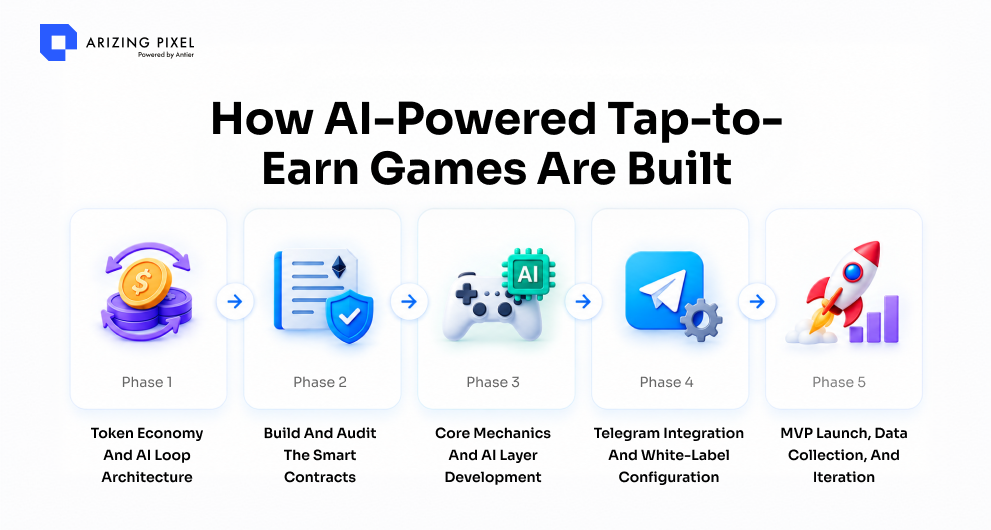
Phase 1: Token Economy and AI Loop Architecture
- Define the token emission schedule and model the sustainability curve against projected player cohort sizes
- Map the behavioral signals the AI system will monitor (session length, tap velocity, return intervals, referral patterns)
- Identify which player actions trigger reward adjustments versus which ones feed analytics only
- Start by choosing a blockchain that fits the game and its audience. TON works well for Telegram-native games because it connects naturally with Telegram and can support high transaction volumes. Ethereum-compatible chains are worth considering when the game needs wider DeFi integrations or access to a broader Web3 ecosystem.
Phase 2: Build and Audit the Smart Contracts
- Create the contracts that handle player assets, rewards, and staking.
- Keep important reward calculations on-chain where possible, rather than leaving everything to a centralized game server.
- Get the contracts audited before moving to testnet, especially when players can earn assets with real-world value.
- Add popular wallet options such as WalletConnect and MetaMask. For games built around TON and Telegram, Telegram’s wallet ecosystem can also be part of the setup.
Phase 3: Core Mechanics and AI Layer Development
- Build the core game loop with player engagement tracking built into the experience from day one.
- Link gameplay analytics with the reward engine to make reward pacing more responsive to player behavior.
- Introduce AI-based anomaly detection to identify repetitive or suspicious tap patterns associated with bot activity.
Phase 4: Telegram Integration and White-Label Configuration
- Use Telegram’s open bot API to deliver the game without requiring any client-side installation
- Configure leaderboard mechanics, referral chains, and community reward triggers natively within the Telegram interface
- For branded or DAO-specific builds, configure the white-label layer including custom token branding, community wallet logic, and branded reward notifications
Phase 5: MVP Launch, Data Collection, and Iteration
- Launch to a defined beta cohort and instrument every drop-off point in the session flow
- Run the first AI-driven reward adjustment cycle against real player behavior data, not synthetic pre-launch assumptions
- Iterate the token emission curve based on actual on-chain activity rather than holding to the launch-week projection
- Use player data to refine AI game monetization, testing IAP, NFT sales, staking, and ad-supported models across different player segments.

Bring player behavior, AI & blockchain rewards together in one connected game architecture.
Why Specialist Experience Matters
An AI-powered tap-to-earn game brings together several different technologies. Gameplay, tokenomics, smart contracts, wallets, analytics, and AI all have to work as part of the same product. Experience across these areas can help keep the development process connected from the start.
- Tokenomics becomes easier to plan with real project experience. What looks sustainable in a model can change once players begin earning and using tokens. Teams familiar with blockchain games can plan reward rates, emissions, and player activity with those real-world factors in mind.
- Smart contracts also benefit from an independent review. Contracts that handle rewards, staking, and digital assets should be checked before they manage real user value. A separate audit gives the project another opportunity to identify potential security or logic issues.
- AI should connect with the game economy as well. It can be used to understand player behavior, detect unusual activity, personalize challenges, and inform reward decisions. Linking those systems with the reward engine and blockchain infrastructure helps create a more consistent experience.
For teams entering this category, a specialist can provide AI-powered gaming solutions alongside Web3 development practices, blockchain expertise, and experience with AI-driven game economies.
Wrapping Up
The tap-to-earn market is changing rather than shrinking. One group of games continues to rely on static reward systems, while another is using AI to make gameplay and rewards more responsive. Titles built with AI-driven reward calibration, audited smart contracts, sustainable tokenomics, and Telegram-native delivery designed for long-term session behavior are on the other. The market data from Technavio, Business Research Insights, and RevenueCat points in the same direction: the opportunity is real, the risk is documented, and the architecture choices made in the first three weeks of a build determine which trajectory a title ends up on.
At Arizing Pixel, we build AI-powered tap-to-earn games from the token economy layer up, so the AI loop and the on-chain reward logic are designed together rather than integrated after the fact.
Frequently Asked Questions
01. Why are AI-powered tap-to-earn games struggling with player retention?
They often fail because AI is added superficially, leading to high player expectations that aren't met, resulting in a significant drop-off in engagement shortly after initial acquisition.
02. What is the projected growth for the AI in games market?
The AI in games market is expected to grow by USD 34.10 billion between 2025 and 2030, with a compound annual growth rate (CAGR) of 40.7%.
03. How should AI be integrated into tap-to-earn games for better player engagement?
AI should be designed into the reward loop from the ground up, allowing the system to learn what keeps each player returning, rather than just tracking past interactions.