✨ AI Summary
This guide helps game producers, art directors & studio outsourcing managers spot pipeline red flags and choose a reliable art partner before signing an NDA. It highlights practical risks across pipeline reliability, asset quality, IP ownership, and team communication, while outlining clear evaluation criteria and scorecard factors for vetting studios safely. It offers selection prompts to frame early studio conversations safely.
Selecting a game art studio often begins with a portfolio review. Characters look polished, environments appear detailed, and the studio showcases work that fits the visual direction of the game. Yet, portfolio quality alone offers limited insight into how that studio handles production deadlines, asset validation, revisions, team coordination, or technical requirements.
The real evaluation begins beyond the finished artwork. A game art outsourcing partner may deliver impressive visuals but still lack consistent workflows, structured reviews, or reliable delivery practices. These gaps often surface once production begins, affecting timelines, asset quality, and internal workloads.
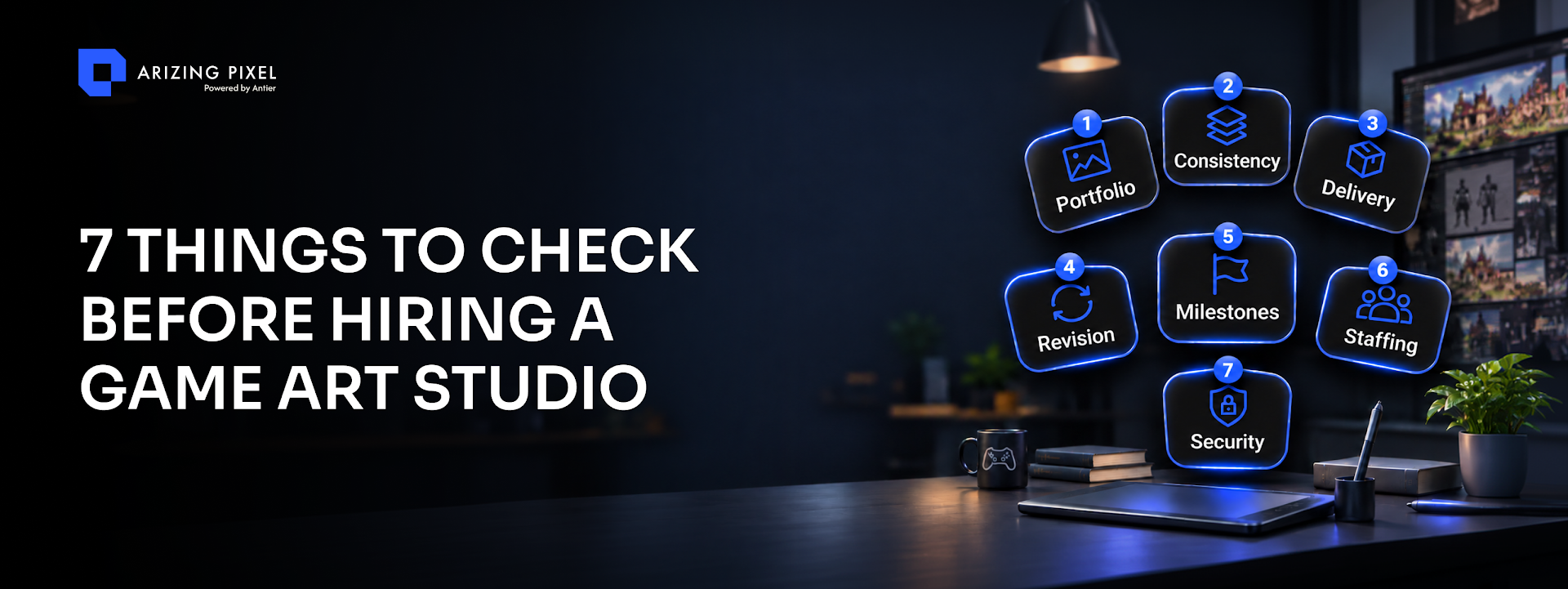
In 2027, evaluating a game art studio means looking at how it manages production, maintains art consistency, validates technical requirements, and handles revisions. This audit highlights seven pipeline red flags to identify before signing an agreement or sharing confidential project details.
7 Game Art Outsourcing Red Flags to Spot Before the NDA
1. Portfolio Pieces Have No Production Breakdown
A finished render can demonstrate an artist’s visual ability, but it rarely reveals the decisions made during production. A polished character, weapon, or environment may look impressive in a portfolio while leaving questions about geometry, material construction, optimization, and asset preparation unanswered.
The red flag: A studio presents finished artwork as evidence of production capability but cannot explain how the asset was created, validated, or prepared for use in a game.
A production breakdown helps establish whether the artwork was built around actual game requirements. For 3D assets, this may include topology, UV layouts, texture maps, polycount, material setup, rigging dependencies, and engine previews. For 2D artwork, the evaluation may involve layer organization, source files, export specifications, animation-ready components, and consistency between approved concepts and final assets.The level of detail you need depends on the type of work being outsourced. A studio producing stylized props may follow different technical requirements from a team building realistic characters or modular environments. The goal is to understand how the studio approaches the work, not to impose one production standard on every asset.
What to inspect
- Wireframes and geometry organization.
- UV layouts and texture maps.
- Material setup and rendering workflow.
- Source files and asset structure.
- Engine previews or integration examples.
- Production steps between concept approval and final delivery.
What to ask the studio
- Can you walk us through the production stages of a comparable asset?
- Which parts of the asset were created by your team?
- How do you prepare artwork for our target engine and technical specifications?
- What files are included in your final handover?
Audit action: Request a breakdown of one portfolio asset that resembles your project’s requirements. A clear explanation of the workflow is more valuable than another collection of finished renders.

Tell us what you’re building, and let’s explore the right game art support for your project.
2. The Studio Cannot Explain How It Maintains Art Consistency
Art consistency becomes increasingly important when several artists work on the same game. A production team may outsource dozens of characters, props, environments, UI elements, or textures across multiple milestones. Even when individual assets look good, differences in proportions, materials, color palettes, detailing, and visual language can make the final collection feel disconnected.A capable game art studio should have a process for translating approved art direction into production references that artists can follow. This process becomes particularly important when assets are distributed across different artists, workstreams, or production batches.
The red flag: The studio relies on individual artists interpreting references independently, without a defined system for reviewing and aligning their work.
Consistency is rarely achieved through reference images alone. Studios may use style guides, approved asset samples, visual callouts, material references, proportion guidelines, and review checkpoints. These resources help artists understand what the project expects before completing an entire batch.
An outsourcing partner should also explain how it introduces new artists to the project and how art leads or reviewers identify deviations from the approved visual direction.
What to inspect
- Art style guides and asset specifications.
- Approved sample assets used as production references.
- Art direction and review responsibilities.
- Batch-level quality checks.
- Processes for onboarding additional artists.
- Feedback documentation and correction workflows.
What to ask the studio
- How do you maintain visual consistency when several artists work on one asset category?
- Who reviews assets against our art direction?
- How do you introduce new artists to an established style?
- Can you demonstrate how feedback from an approved asset is applied to the next batch?
Audit action: Ask the studio to explain how it would produce five assets that belong to the same visual family. Look for a repeatable approach to reference interpretation, production, and review.
3. Game-Ready Delivery Is Treated as a Final Export
Artwork that passes a visual review may still require substantial work before it can enter a game build. Meshes may need optimization, textures may exceed memory budgets, materials may behave differently inside the engine, and files may arrive without the naming conventions or folder structure expected by the development team. These issues become particularly relevant when outsourcing environment assets, characters, props, animation, or other art that needs to integrate into an existing project.
The red flag: The studio considers an asset complete once it looks correct in a standalone render or its source application, without accounting for the target engine and project requirements.
Game-ready delivery should be defined according to the project’s technical specifications. These may include polygon budgets, texture resolutions, UV requirements, material configurations, collision meshes, LODs, rig compatibility, file naming, and engine-specific setup.
Not every asset needs the same technical treatment. A hero character, a background prop, and a mobile environment asset may follow different optimization requirements. The outsourcing team should understand those distinctions and apply the agreed standards to each deliverable.
What to inspect
- Target engine compatibility.
- Asset naming and folder structure.
- Mesh and texture optimization.
- Material and shader configuration.
- Collision and LOD requirements, where applicable.
- Rigging, animation, or dependency compatibility.
- Integration testing and validation procedures.
What to ask the studio
- Do you validate assets inside Unity or Unreal Engine?
- How do you handle project-specific performance budgets?
- What technical checks are completed before delivery?
- How do you identify and resolve integration issues?
Audit action: Request a demonstration of how one asset moves from the source application into the target engine. Examine the imported asset, material setup, file organization, and validation process.
4. Milestones Are Built Around Vague Deliverables
Milestone planning determines how an outsourcing project progresses, how feedback is collected, and when production decisions need to be made. A schedule that only lists delivery dates without defining the expected output at each stage can create disagreements about progress and completion.
For example, a milestone labelled “character completion” may mean a finished sculpt to one team, a textured and rigged character to another, or an engine-integrated asset to the client. Without clearly defined deliverables, both sides may interpret the same milestone differently.
The red flag: The studio provides timelines but cannot explain what each milestone includes, how approvals work, or what constitutes an accepted deliverable. Milestones should reflect the asset’s production stages and the project’s review requirements. Depending on the scope, they may include blockout, concept approval, modeling, texturing, rigging, integration, final review, and handover.
The milestone plan should also identify dependencies. An asset that requires an approved concept, a gameplay specification, or a technical review cannot move forward efficiently when those inputs are missing.
What to inspect
- Milestone descriptions and deliverable lists.
- Asset quantities assigned to each stage.
- Dependencies and required client inputs.
- Approval and acceptance criteria.
- Review windows and delivery schedules.
- Change-request handling.
What to ask the studio
- What exactly will we receive at each milestone?
- Which approvals are required before the next production stage?
- How are delays caused by dependencies tracked?
- How do you document milestone acceptance?
Audit action: Ask for a sample milestone plan for a small asset batch. Check whether the deliverables, review points, dependencies, and acceptance criteria are clearly defined.
5. Revision Handling Depends on Informal Communication
Feedback is a normal part of game art production. Concept adjustments, visual corrections, technical changes, and gameplay-related updates can influence an asset at several stages. The challenge is managing those changes without disrupting the entire production schedule.
When revision handling depends on scattered messages, verbal discussions, or undocumented instructions, artists may work from outdated feedback. Multiple reviewers may also provide conflicting direction, leaving the outsourcing team unsure which version should be followed.
The red flag: The studio cannot explain how it records feedback, prioritizes corrections, tracks revisions, or distinguishes approved scope from new requests.
A structured review process should provide a clear path for feedback from the client to the production team. It may include annotated images, task tracking, version references, consolidated feedback, review ownership, and change-request documentation. The process should also clarify how revisions affect delivery schedules. Corrections within the agreed specification should be distinguished from changes that introduce new requirements, additional assets, or a different art direction.
What to inspect
- Feedback collection and tracking systems.
- Review ownership and approval responsibilities.
- Version control or file revision practices.
- Consolidated feedback procedures.
- Correction and change-request policies.
- Schedule adjustments when scope changes.
What to ask the studio
- How do you manage feedback from multiple stakeholders?
- How do artists know which version of the feedback is approved?
- How do you track corrections across asset batches?
- How are changes outside the agreed scope evaluated?
Audit action: Ask the studio to walk you through a hypothetical revision cycle. Observe how feedback is recorded, assigned, reviewed, and incorporated into the next delivery.
6. Staffing Capacity Is Unclear or Tied to a Few Artists
An outsourcing studio’s ability to deliver a project depends on more than its headcount. The relevant questions concern which artists are available, how production responsibilities are distributed, who supervises the work, and how the team responds when workloads change.
A studio may have a strong portfolio created by a small group of specialists. That experience can be valuable, but it doesn’t automatically prove the team can handle a larger production volume, multiple asset categories, or overlapping deadlines.
The red flag: The studio presents its overall workforce as available project capacity without explaining resource allocation, specialist availability, or production responsibilities.
Scaling also needs to preserve quality. Adding artists to a project without appropriate onboarding, reference documentation, and review capacity can introduce inconsistencies and increase the workload for internal reviewers.
What to inspect
- Proposed team composition.
- Artist specialization and role distribution.
- Art lead and quality review responsibilities.
- Resource allocation for the project.
- Backup or replacement procedures.
- Artist onboarding and production continuity.
- Capacity to accommodate additional asset requirements.
What to ask the studio
- Which artists and roles are expected to work on our project?
- Who is responsible for art direction and quality reviews?
- How do you handle artist availability changes?
- What is your process for onboarding additional artists?
- How would you manage an increase in production volume?
Audit action: Ask for a proposed team structure for your project rather than relying on the studio’s total employee count. Evaluate whether the assigned roles support the scope and production schedule.
7. AI Usage, IP Ownership and Asset Security Remain Unexplained
Game art production increasingly involves a mix of digital tools, automation, and AI-assisted workflows. Depending on the project and studio policies, these tools may influence ideation, reference development, image generation, texturing, asset preparation, or other production tasks. For clients, the concern is not simply whether a studio uses AI. It is understanding where these tools are used, what material enters those systems, how outputs are reviewed, and what contractual protections apply to the delivered assets.
Confidentiality and ownership deserve equal attention. A project may involve unreleased characters, proprietary gameplay concepts, internal design documents, source files, visual references, or other materials that require controlled access.
The red flag: The studio cannot provide clear answers about AI-assisted production, asset ownership, licensing, confidentiality, or the handling of client files.
Before confidential material is shared, the client should understand the studio’s data handling practices and contractual obligations. This includes clarifying ownership of commissioned assets, rights to source files, third-party material, AI-related disclosures, and any applicable licensing conditions.
Security practices should reflect the nature of the project. Teams working with confidential game content may need restricted file access, approved storage platforms, controlled sharing, access revocation, and documented confidentiality obligations.
What to inspect
- AI usage policy and disclosure practices.
- AI tool approval and review procedures.
- Ownership of commissioned assets.
- Third-party material and licensing considerations.
- Source-file handover requirements.
- Confidentiality and NDA obligations.
- File storage, access controls, and sharing practices.
- Procedures for handling sensitive project material.
What to ask the studio
- Do you use AI-assisted tools anywhere in your art production pipeline?
- What client material may be submitted to third-party AI tools?
- How do you review and document AI-assisted outputs?
- Who owns the final artwork and source files?
- How do you manage access to confidential project files?
- Can your team work under our confidentiality and security requirements?
Audit action: Review the studio’s confidentiality, IP, AI, and file-handling policies before sharing sensitive project material. Involve your legal or procurement team when the project requires specific contractual protections.
Need a dedicated team for your game art workload? Share your brief and start planning.
The Game Art Outsourcing Studio Audit Checklist
Evaluating a studio across seven areas is easier when the findings are documented. Use the checklist below during portfolio reviews, introductory calls, technical discussions, and pilot evaluations.
Use this checklist before moving into detailed project discussions.
Portfolio and production transparency
- Production breakdowns are available for relevant portfolio work.
- The studio can explain its asset creation workflow.
- Source files and production stages can be demonstrated.
- Portfolio work aligns with the project’s art requirements.
Art direction and consistency
- The studio maintains documented art references.
- Review responsibilities are clearly assigned.
- Multiple artists can work within an approved visual style.
- Feedback is incorporated into subsequent asset batches.
Technical delivery
- Target engine requirements are understood.
- Asset optimization standards are defined.
- Naming, folder structure, and handover requirements are documented.
- Assets undergo technical validation.
Milestones and delivery
- Deliverables are defined for each milestone.
- Acceptance criteria are agreed upon.
- Dependencies and review windows are documented.
- Changes to scope have a defined process.
Revision management
- Feedback is consolidated and tracked.
- Review and approval responsibilities are established.
- Revision procedures are documented.
- Scope changes are evaluated separately from corrections.
Team and capacity
- The proposed team structure is available.
- Specialist roles are identified.
- Art direction and quality review capacity are established.
- Team continuity and resource changes are addressed.
AI, IP and security
- AI usage policies are understood.
- Asset ownership and source-file rights are clarified.
- Confidentiality requirements are reviewed.
- File access and data handling practices are documented.
How to Evaluate Game Art Outsourcing Services Without Sharing Confidential Material
A studio evaluation does not need to begin with a full project brief, unreleased character designs, or proprietary gameplay documents. You can assess several important production capabilities using public information, sanitized references, and limited test assignments.
Step 1: Review Public Production Evidence
Examine the studio’s portfolio, case studies, and production breakdowns. Look for work matching your asset types, visual style, and technical requirements.
Step 2: Request a Pipeline Walkthrough
Ask how the studio manages assets from briefing to final delivery, including production, reviews, validation, and handover.
Step 3: Prepare a Sanitized Brief
Share generic asset requirements, visual references, and technical specifications to assess how the studio interprets and plans production tasks.
Step 4: Run a Limited Pilot
Assign a small paid test project to evaluate visual quality, technical execution, communication, and delivery practices without exposing critical IP.
Step 5: Examine the Final Handover
Check file organization, technical specifications, source files, revision records, and
compatibility with your production workflow.
Step 6: Validate Contractual Requirements
Review NDA terms, IP ownership, AI usage, file security, project scope, and delivery obligations before sharing confidential material.
Game Art Studio Evaluation Scorecard
When multiple studios are under consideration, a scorecard can help your team compare them using consistent criteria. Rather than relying on portfolio impressions or sales presentations, assess each studio against the same production requirements.
| Evaluation area | Weight | What to evaluate |
|---|---|---|
| Art quality and style alignment | 20% | Portfolio relevance, execution quality and visual consistency |
| Pipeline maturity | 20% | Production workflow, documentation and review stages |
| Technical readiness | 15% | Engine compatibility, optimization and validation |
| Team structure | 15% | Specialist roles, art direction and resource allocation |
| Delivery management | 10% | Milestones, dependencies and acceptance criteria |
| Communication and revisions | 10% | Feedback tracking, responsiveness and change management |
| IP, AI and security | 10% | Ownership, confidentiality, AI disclosure and file handling |
Adjust it according to your project’s complexity, asset requirements, production stage, and internal evaluation priorities.
You can assign each category a score from 1 to 5:
1: No meaningful evidence provided.
2: Limited capability demonstrated.
3: Meets basic project requirements.
4: Strong capability with supporting evidence.
5: Clearly demonstrated, documented, and aligned with project requirements.
Multiply the score by the category’s weight to calculate a weighted evaluation. The resulting comparison can help identify where a studio performs well and where additional validation is required. A high score should support a decision, not replace one. A studio that scores well overall may still require additional verification in a critical area such as technical integration, confidentiality, or asset ownership.
Choosing a Game Art Studio That Fits Your Production
A successful game art outsourcing partnership requires more than visual quality. It depends on a studio’s ability to maintain art consistency, meet technical requirements, manage revisions, and deliver assets within established production workflows. Evaluating these capabilities early helps your team identify potential gaps before they affect production schedules or development resources.
At Arizing Pixel, we bring together concept artists, 2D and 3D artists, and other creative specialists to support game art production across characters, environments, props, and motion graphics. Our approach follows the project’s art direction and production requirements.
Planning your next game art project? Share your requirements with our team and let’s discuss how we can support your production.
Frequently Asked Questions
01. What should I look for in a game art studio's portfolio?
In addition to polished visuals, you should seek a production breakdown that explains how the assets were created, validated, and prepared for use in a game, including details like geometry, material construction, and optimization.
02. Why is it important to evaluate a studio's production processes?
Evaluating a studio's production processes is crucial because impressive visuals alone do not guarantee consistent workflows, timely delivery, or quality asset management, which can impact project timelines and overall quality.
03. What are some red flags to watch for when selecting a game art outsourcing partner?
Red flags include a lack of production breakdown in their portfolio, inability to explain asset creation processes, and insufficient validation of technical requirements, all of which can indicate potential issues in their workflow and delivery practices.