✨ AI Summary
In 2027, 3D game art costs more than 2D due to extra production stages: modeling, sculpting, retopology, UV mapping, PBR texturing, and 360-degree rigging. While AI speeds up early concepting, core 3D asset creation remains human-driven. 2D wins on speed and budget for mobile, hyper-casual, and live-ops titles. 3D justifies its higher cost in open-world, VR, and cinematic games where depth and camera freedom are essential.
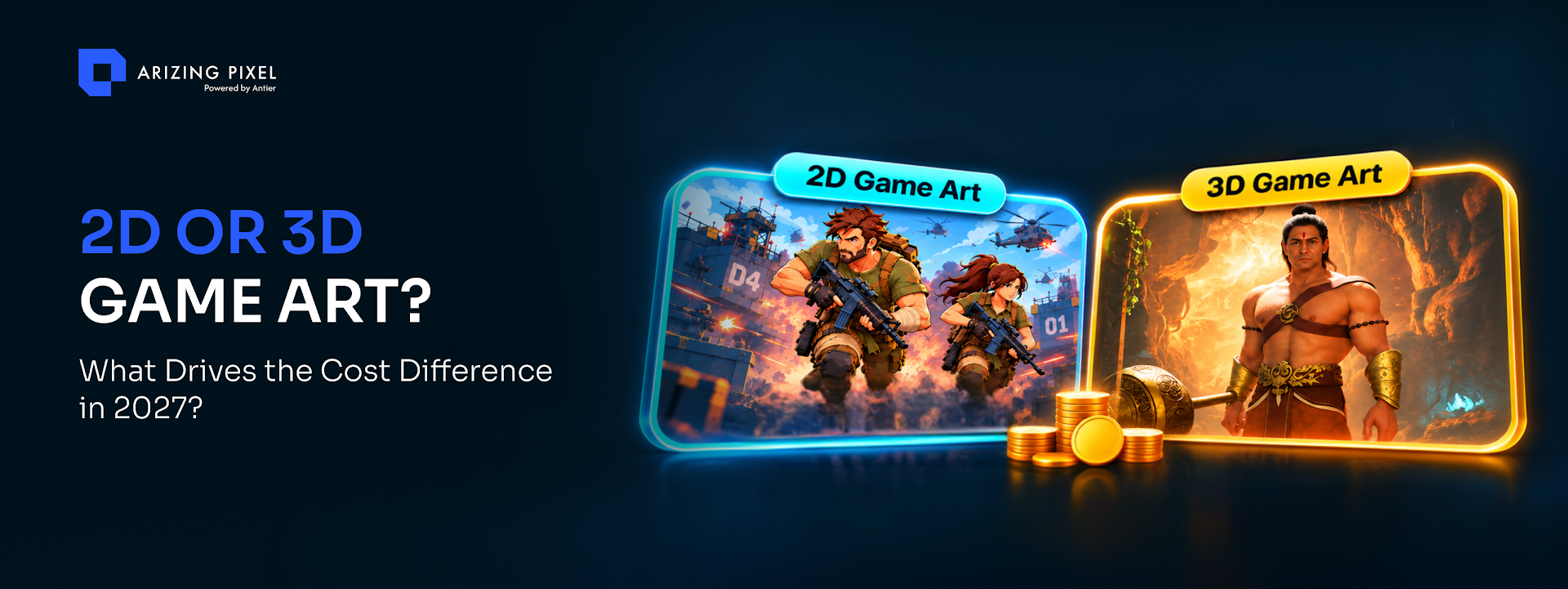
Why does 3D game art generally require more production effort than 2D? And how does that difference influence your game art budget? The answer isn’t limited to the tools or software involved. It comes down to the stages each asset must pass through before it’s ready for the game. Understanding these workflows gives you a clearer picture of what shapes 2D and 3D game art outsourcing costs.
By the end of this guide, every doubt you walked in with about 2D vs 3D cost will have a clear answer.
Why 3D Costs More Than 2D, and By How Much
Ask for a specific multiplier, and you’ll get a different number from every studio, because it depends on your style, your platform, and your asset list. What stays consistent is the structural reason behind the gap:
- 2D’s path: Concept, draw or paint, rigging if the asset needs to move.
- 3D’s path: Concept, modeling, sculpting, retopology, UV mapping, texturing, then rigging.
Every extra stage on the 3D side is paid labor hours. Stage count is the real multiplier, and it scales with your specific asset list, something no studio can quote you cold.
What Actually Drives the Gap
Four stages explain most of the difference between a 2D and 3D budget line.
- Modeling and sculpting: A 3D artist builds geometry, then often sculpts high-poly detail on top of it, capturing anatomy, folds, and surface detail that a flat 2D illustration handles in a single pass. 2D skips this step entirely.
- Retopology and UV mapping: A high-poly sculpt has to be cleaned into a game-ready low-poly mesh with a usable texture layout. This is a dedicated technical pass with no 2D equivalent; 2D goes from concept straight to final art.
- Texturing: 3D texturing usually means a full PBR material set, albedo, roughness, metallic, and normal maps, built to respond correctly under in-engine lighting from any angle. 2D texturing is the final paint and shading pass, already baked into the artwork.
- Rigging: Both disciplines rig characters that move, but a 3D rig has to hold up from every camera angle, which means a fuller skeleton and control setup. A 2D rig only needs to work for the angles the artist actually drew.

Get expert guidance on asset complexity and the right art pipeline for your game.
2D and 3D Cost Factors: What Changes the Number Inside Each
The four-stage breakdown explains why 3D costs more than 2D overall. It doesn’t explain why two 2D projects, or two 3D projects, can land at completely different price points. That comes down to a separate set of factors inside each discipline, and they matter just as much for your budget as the 2D vs 3D gap itself.
1. 2D Game Art Cost Factors
Within 2D specifically, cost scales with a different set of variables than the 2D vs 3D gap itself:
- Art style: A flat, vector-based style is faster and cheaper than a cel-shaded or hand-painted style with detailed shading.
- Character and asset count: Each character needs a consistent look across every pose and expression it appears in.
- Animation: Frame count and movement complexity scale cost independently of how detailed the base artwork is.
- Revision rounds: A late style change touches every asset built before it, well beyond the one in front of the reviewer.
2. 3D Game Art Cost Factors
Within 3D, the same four-stage breakdown repeats at different intensities depending on asset type:
- Polygon tier: A low-poly background prop and a high-poly hero character sit at opposite ends of the same pipeline, with very different time investment at the modeling and sculpting stage.
- Texturing complexity: A hero character usually carries a full PBR set, while a background piece often uses a simplified material pass.
- Rigging: Only enters the cost for assets that move. A static environment piece skips it completely.
- Platform and engine target: A mobile-optimized 3D asset needs a different poly and texture budget than a PC or console one, which changes how much of the pipeline runs at full detail versus simplified for performance.
Neither list moves independently of the other if your game mixes disciplines; a hybrid 2D/3D project inherits both sets of variables at once, which is its own budgeting conversation.
2D vs 3D Cost Factors at a Glance
| Factors | 2D | 3D |
|---|---|---|
| Biggest cost lever | Art style and detail level | Polygon tier and texturing complexity |
| Animation cost driver | Frame count, movement complexity | Rig complexity, camera-angle coverage |
| Platform sensitivity | Lower, style matters more than target | Higher, platform sets the poly/texture budget |
| Revision impact | Touches every asset sharing the style | Can isolate to the specific model/stage affected |
Where Each Discipline Actually Wins, and What 2027 Changed About It
The right choice comes down to how well each discipline supports your game’s requirements. While 3D production involves additional stages, these contribute to greater asset flexibility and visual depth. Engine tooling introduced in 2027 has also influenced how teams approach both workflows.
- Where 2D Still Wins on Cost
2D keeps its cost advantage anywhere iteration speed matters more than visual depth. Mobile and hyper-casual titles are the clearest case: shorter production cycles, simpler asset lists, and a player base that doesn’t expect photorealistic detail. Live-ops games that ship new content on a weekly or monthly schedule also lean on 2D’s shorter pipeline, since every stage 3D adds becomes a recurring tax paid on every content drop, cycle after cycle.
- Where 3D’s Extra Cost Pays Off
3D earns its extra stages in open-world, cinematic, and VR projects, where depth, lighting response, and camera freedom are the actual product. A flat 2D sprite can’t hold up when a player walks a camera around it from any angle, and VR specifically punishes anything that doesn’t read correctly in three dimensions. For AAA and AA productions built around character-driven storytelling, the extra rigging and sculpting investment is what lets a face actually read as emotional on screen.
The AI Factor
Generative AI sits inside both 2D and 3D pipelines now, mostly at the early concept and iteration stage. GDC’s 2026 survey found 36% of game industry professionals use generative AI tools at work, while 52% think it’s having a negative impact on the industry, up from 30% in 2025 and 18% in 2024. Visual and technical art workers are the most skeptical group surveyed, at 64%. Early drafts move faster in some pipelines because of this. The stages that actually separate 2D cost from 3D cost (modeling, sculpting, retopology, rigging) still run through human production either way, so the underlying gap between the two disciplines hasn’t moved.

Share your game concept and asset requirements. We’ll help you choose the right 2D or 3D approach.
Production Stages: 2D vs 3D, Side by Side
This table provides the foundation for the entire guide. Count the required production stages for each discipline to understand what drives the difference in production effort. It offers a clear breakdown of the work each asset goes through before reaching its final stage.
| Production Stage | 2D Art Production | 3D Art Production |
|---|---|---|
| Concept Development | Required | Required |
| Asset Creation | Drawing / Illustration | Modeling / Sculpting |
| Structural Preparation | Layer separation (if required) | Retopology & UV Mapping |
| Surface Detailing | Painting / Color / Detail pass | Texturing / PBR Material Creation |
| Technical Preparation | Sprite sizing / Export setup | Rigging / Skinning (if required) |
| Final Output | Flat image / Sprite / Sequence | Engine-ready 3D asset |
| Iteration Speed | Faster, fewer production dependencies | Slower, sequential workflow with stage dependencies |
| Revision Impact | Usually contained within the artwork | Changes can affect geometry, UVs, textures, rigging, and downstream stages |
| Production Cost | Lower | Higher |
How to Decide: A Quick Framework
Platform settles most of this before budget does:
- Mobile, hyper-casual, live-ops: 2D, by default. The format matches the iteration speed these genres require, and the player base isn’t evaluating your game on render fidelity. Every week you save in production is a week back in your content calendar.
- Open-world, VR, character-driven cinematic: 3D, by default. The format itself is the feature players are paying for. Trying to deliver camera freedom or emotional facial performance through 2D means fighting the medium instead of using it.
- Stylized indie, light-exploration narrative games: Both approaches can work, depending on your game’s production requirements. The key is to evaluate which stage breakdown, 2D or 3D, best aligns with your asset list, visual direction, and overall development needs.
Once you’ve sorted your project into one of these three buckets, the next step is to finalize your asset list. Define your hero assets, platform targets, and content cadence to establish clear production priorities and determine the right approach for your project.
Wrapping Up
The gap between 2D and 3D game art cost comes down to stage count, not negotiation or studio markup. 3D’s extra modeling, sculpting, retopology, and rigging stages are real production work, and Unreal Engine 5.8’s tooling has shortened some of that work without eliminating it.
Arizing Pixel builds both 2D and 3D game art, as a game development company that scopes every project against its actual asset list and platform target, so the discipline you choose fits your game instead of your assumptions about cost.
Frequently Asked Questions
01. Why does 3D game art require more production effort than 2D game art?
3D game art involves multiple stages including modeling, sculpting, retopology, UV mapping, texturing, and rigging, whereas 2D game art typically only requires concepting, drawing or painting, and rigging if necessary. Each additional stage in 3D adds to the labor hours and overall cost.
02. How does the complexity of 3D game art influence the budget?
The complexity of 3D game art increases the budget due to the additional stages required for production, such as modeling and texturing, which demand more time and expertise compared to the simpler process of creating 2D art.
03. What are the main factors that contribute to the cost differences between 2D and 3D game art?
The main factors include the stages of production (modeling, retopology, texturing, and rigging) that 3D art requires, which do not have direct equivalents in 2D art, leading to higher labor costs and varying price points for different projects.