
✨ AI Summary
– Agile game development integrates player feedback and playtesting into every sprint.
– Structured testing helps identify gameplay issues, prioritize improvements, and reduce rework.
– Analytics and player behaviour guide better engagement, retention, and release decisions.
– Arizing Pixel supports agile production through game engineering, AI integration, art, animation, and QA services.
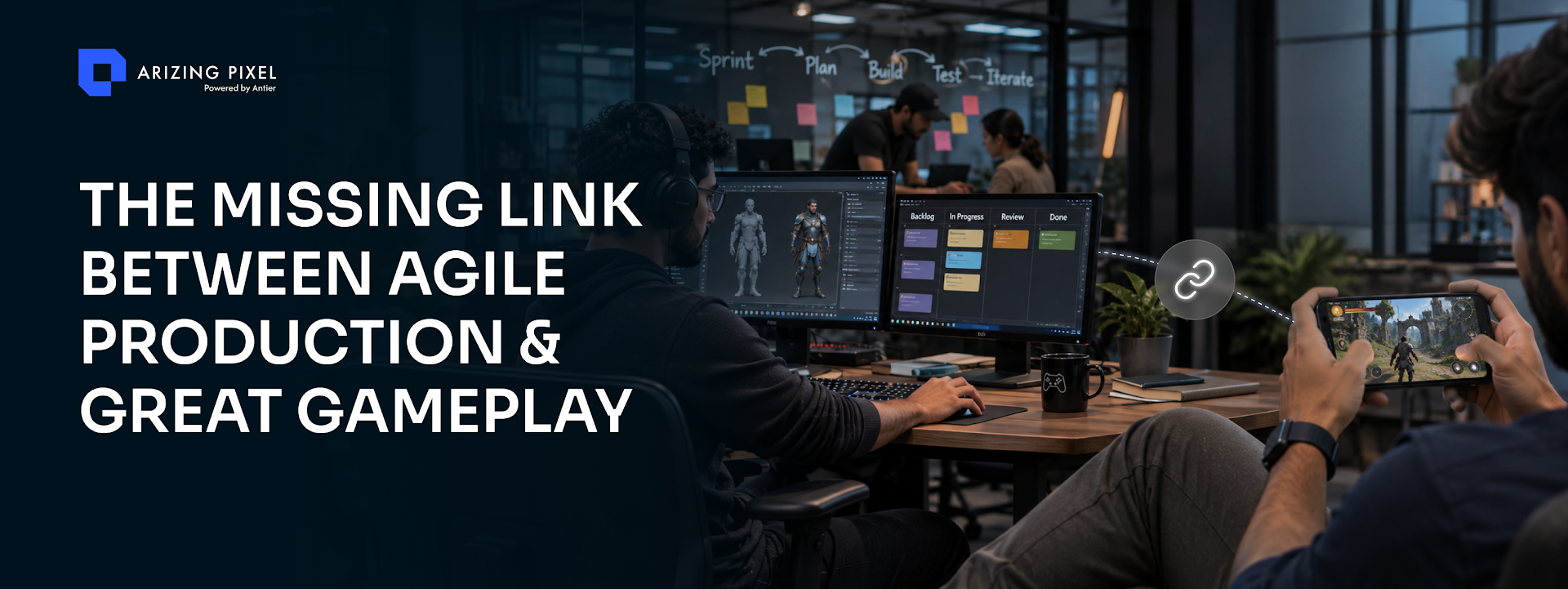
A feature can pass internal testing, meet sprint deadlines, and look perfect in a production roadmap, yet fail to connect with its intended audience. For game studios, this disconnect can lead to repeated development cycles, wasted resources, and gameplay experiences that struggle to retain players. Integrating player feedback into agile game development helps studios validate decisions earlier, prioritize improvements, and keep production aligned with audience expectations.
The 18th India Game Developer Conference (IGDC) brought developers and gaming communities together through esports, VR, and interactive experiences. Such interactions highlight why studios need to understand player behaviour and incorporate audience feedback into their development cycles.
The best way to do that? Embed structured player feedback into every single stage of your agile game development cycle.
Why Agile Needs the Player’s Voice
Agile development breaks game production into manageable sprints, allowing teams to build, test, and refine features incrementally. However, completing sprint objectives doesn’t necessarily mean the game is meeting player expectations. Integrating structured player feedback into each development cycle helps studios identify gameplay friction, validate feature decisions, and direct engineering resources toward improvements that make a measurable difference to the player experience. Without regular player validation, teams risk spending multiple sprints refining features that do not improve the overall experience. This can increase rework, create dependencies across gameplay systems, and affect planned release milestones. For production leaders, player feedback provides an additional decision-making layer to balance development priorities with actual audience expectations.
Consider a studio developing a third-person action game. Its engineering team has completed the core combat system, including character movement, attack animations, enemy AI, and special abilities. The features meet internal testing requirements and align with the sprint objectives. However, technical completion doesn’t necessarily indicate that the combat experience is intuitive, balanced, or engaging for players.
Then you put it in front of actual players, and everything changes. You watch how they panic during enemy encounters, miss obvious attack indicators, or discover weird ability combos you never intended. This is pure gold. It gives your team real, tangible targets for the next sprint.
Injecting this feedback strengthens your agile workflow across the board:
- Gameplay validation: Watching how players actually interact with your core mechanics.
- Experience refinement: Tweaking the weight of movement, control layouts, and navigation.
- Feature prioritization: Funneling developer resources into the things players actually care about.
- Creative alignment: Forcing design, art, and engineering onto the same page regarding the final player experience.
- Release readiness: Hardening the game through consecutive, brutal validation cycles.
The 5-Stage Process to Blend Feedback Into Every Sprint
You can’t just ask players, “Was it fun?” You need a system. Here is a straightforward five-stage loop to connect playtesting directly to your sprint execution.
Stage 1: Specify the Objective
Never run a test blindly. Are you testing combat responsiveness and matchmaking for a multiplayer shooter? Or are you testing the onboarding friction and session length of a hyper-casual mobile game? Lock in your evaluation criteria before a single tester touches the build.
Key indicators to watch:
- Tutorial completion rates.
- The exact time it takes to learn the core loop.
- Feature drop-off points.
- Frequency of gameplay attempts.
When you know exactly what you are hunting for, planning the next sprint stops being a guessing game.
Stage 2: Isolate the Increment
Prepare a focused playable build that isolates the mechanics, features, or environments you want players to evaluate. This could include a refined combat mechanic, a new character class, or a grey-box environment.
Context is everything here. The new feature has to sit naturally inside the core loop. For sourcing your testers, skip the random focus groups. Tap into your existing Discord community, genre-specific forums, or early-access mailing lists.
Stage 3: Watch What They Actually Do
Data gives you the “What”. Observation gives you the “why”. Combining both forms of feedback gives development teams a more complete picture. Analytics can reveal where players abandon a level or repeatedly fail an objective, while recorded playtests and direct observations help explain the reasons behind those behaviours. Looking at both signals prevents teams from making design changes based on isolated comments or incomplete metrics.
Say a player claims they loved a specific level, but your backend analytics show they spent twenty minutes running into dead ends in an optional zone. That mismatch reveals a potential gap between perceived enjoyment and actual gameplay experience. It gives level designers a clear signal to investigate pacing issues, confusing navigation, and unclear environmental cues.
Keep the feedback organized, so it actually gets used:
| The Issue | What You’re Tracking | Who Fixes It |
|---|---|---|
| Combat flow | Attack windows, input lag, ability spam | Gameplay Engineers |
| Level design | Getting lost, pacing, exploration rewards | Level Designers |
| Character feel | Animation clipping, movement weight | Art & Animation |
| Progression | Loot drops, skill tree confusion | Game Designers |
| Visuals | UI clutter, lighting issues | Art & UI/UX |
| Tech limits | Frame drops, infinite loading screens | QA & Engineering |
Stage 4: Convert Player Insights Into Sprint-Ready Tasks
This is where the lead producer steps in. You take those raw player reactions and filter them through three questions:
- Does fixing this actually make the game more fun?
- What’s the cost in art and engineering hours?
- Will changing this break a dependent system?
- Does this improvement align with the current production roadmap and release priorities?
Prioritization also requires understanding how a proposed change affects connected systems. Adjusting enemy visibility, for instance, might involve changes to lighting, materials, visual effects, and performance optimization. Evaluating these dependencies before assigning sprint tasks helps teams estimate effort accurately and avoid introducing new issues while resolving existing ones.
If players complain that enemies blend into the background, you don’t just write “fix combat.” That single note becomes specific tasks: tweak the rim lighting, adjust the material contrast, and add a hit-flash VFX. Just like that, you have actionable items ready for the next sprint backlog.
Stage 5: Validate and Repeat
Push the changes live. Whether it is a round of early game prototype testing or a late-stage beta, put the build back in front of the players. Measure the new reactions against your old baseline.
Build → Playtest → Analyze → Prioritize → Develop → Validate.
Player experience is now hardwired into your production schedule.
Tracking the Metrics That Actually Matter
Connecting qualitative feedback to hard metrics gives leadership a clear view of development progress.
| Metric | What it Uncovers | Production Relevance |
|---|---|---|
| Tutorial completion | If players grasp initial mechanics | Onboarding refinement |
| Level completion | Gameplay pacing and obstacles | Level design adjustments |
| Session duration | Depth of your core loop | Engagement optimization |
| Repeat sessions | Continued player interest | Progression system tweaks |
| Feature adoption | If players care about a specific mechanic | Feature prioritization |
| Crash/frame-time | Overall technical stability | Engineering optimization |
Consider a structured three-sprint playtesting cycle focused on tutorial completion. During the first sprint, teams establish a baseline by tracking where players struggle or abandon the tutorial. The second sprint introduces targeted improvements to instructions, controls, or progression cues. In the third sprint, teams evaluate the updated experience against the original metrics to determine whether the changes have improved onboarding.
Why Outsourcing Makes This Loop Work
Implementing continuous playtesting and feedback-driven improvements requires consistent development capacity across multiple disciplines. However, maintaining dedicated resources for gameplay engineering, art production, animation, and QA can put additional pressure on internal teams. For mid-sized gaming companies, co-development offers a way to expand production capacity, address specialized requirements, and maintain sprint commitments without disrupting existing workflows.
A specialized external partner drops right into your agile pipeline to handle the heavy lifting:
- Rapid Iteration: Providing game prototyping services to quickly visualize and test core mechanics before full production.
- Gameplay Engineering: Coding multiplayer loops and core interactions.
- AI Integration: Implementing AI non-player character architectures and automated testing workflows to modernize core mechanics.
- 3D & 2D Art: Building optimized environments, characters, and UI content.
- Animation: Crafting fluid combat sequences and cinematics.
- Secure Testing: Managing NDA-controlled playtests and ensuring strict IP protection for unreleased prototype builds.
- QA: Grinding through systematic regression testing.
In a strong co-dev model, the external team doesn’t work in a vacuum. Your production manager shares the playtest data, sets the asset needs, and aligns the external delivery with your internal sprint milestones. You keep total creative control while dramatically expanding your output.
Conclusion
Releasing a market-ready game means balancing tight mechanics with rock-solid performance. Studios can confidently hit these benchmarks by leveraging comprehensive game development services. As a full-cycle game development company, Arizing Pixel brings multi-disciplinary teams of designers, programmers, artists, and QA who actually understand agile milestone deliveries. We take your playtest feedback and translate it directly into technical reality, scaling our specialist teams up or down based on exactly what your current sprint demands.
We help drastically boost your studio’s efficiency by integrating advanced tools like dynamic difficulty tuning and automated testing workflows. Player expectations move fast. Partner with Arizing Pixel to build a workflow that moves faster. Check out our game development and 2D/3D art production services, and let’s build an experience your players won’t be able to put down.
Frequently Asked Questions
01. Why is integrating player feedback important in agile game development?
Integrating player feedback helps studios validate decisions earlier, prioritize improvements, and align production with audience expectations, ultimately enhancing the player experience.
02. What risks do studios face if they don't incorporate player feedback during development?
Without regular player validation, teams may spend multiple sprints refining features that do not improve the overall experience, leading to increased rework, dependencies across gameplay systems, and potential delays in release milestones.
03. How can structured player feedback be effectively integrated into the game development cycle?
Structured player feedback should be embedded into every stage of the agile development cycle, allowing teams to identify gameplay friction, validate feature decisions, and direct resources toward meaningful improvements.