✨ AI Summary
As game production pipelines scale for 2027, studio leaders must choose between In-House, Co-Development, and Traditional Outsourcing to manage scope, budget, and creative control. While co-development offers close collaboration on complex engine and gameplay systems, outsourcing provides cost-effective execution for defined assets like 3D models, QA, and localization.
A game studio preparing for 2027 may have its roadmap in place but still lack the team capacity or specialist skills to deliver. Hiring takes time, while outsourcing raises concerns about integration, communication, and quality control. The challenge is choosing the right production model for the game’s scope and delivery goals. For studio founders, publishers, and production directors, the choice between in-house development, game co-development, and outsourcing affects costs, creative control, coordination, and intellectual property (IP) ownership.
The XDS 2026 Insights Report highlights the growing importance of external development in game production. For studios evaluating co-development and outsourcing, the key consideration is not simply whether to work with an external partner, but how clearly responsibilities, communication, quality standards, and production oversight are defined. For 2027, the key question is: Which production model gives your studio the right capabilities, control, and delivery structure to ship the game effectively?
What Does the Industry Data Say About External Game Development?
External development has become an established part of game production. Studios can work with specialist providers across art, animation, engineering, porting, quality assurance (QA), localization and other production disciplines.
The XDS Insights Report examines how developers, publishers and service providers work together, including partnership challenges, service demand and production practices. Its findings provide a useful framework for understanding external development, although detailed statistics are available after securing the required publication permission.
For studios planning their 2027 production pipelines, the practical question is how to integrate external capabilities without losing visibility over delivery.
Three considerations deserve particular attention:
- Production capacity: External teams can help address workload peaks and specialist skill gaps without requiring every role to become a permanent internal position.
- Integration and communication: Distributed teams need clear ownership, regular build reviews, documented decisions and agreed escalation procedures.
- Commercial accountability: Defined deliverables, acceptance criteria and change-control procedures help both parties understand their responsibilities.
The value of an external partnership depends on how well the teams coordinate, not simply on how many specialists are available.

Stuck Between Co-Development and Outsourcing?
What is the difference between game co-development and outsourcing?
Game co-development and traditional outsourcing both bring external teams into game production, but they differ in how the work is managed and how responsibility is distributed.
- Game co-development involves an external studio working alongside the internal team on an agreed part of the game. The partner may take responsibility for a gameplay system, multiplayer functionality, a game mode, or a major content stream. Both teams coordinate through shared production plans, technical requirements, reviews and milestones.
- Traditional game development outsourcing typically involves assigning a defined package of work to an external provider. This could include a batch of 3D assets, localization, platform testing, or a set of animations. The provider completes the agreed deliverables, while the client reviews them against the specification.
The difference between the two comes down to integration and responsibility. Game development outsourcing works well when requirements are stable and expected outcomes can be evaluated independently. In contrast, co-development is better suited to projects that require ongoing technical decisions, evolving requirements, and consistent coordination with the broader production team.
Game co-development and outsourcing are two ways to extend a studio’s production capacity, but they are not the only options. In-house game development relies on the studio’s own employees to manage production, make technical decisions, and deliver the game. It gives the studio direct oversight and helps retain knowledge internally, but expanding the team may require additional hiring, time, and long-term operating costs.
Comparing the delivery models
| Factor | In-house development | Co-development | Outsourcing |
|---|---|---|---|
| Work scope | Core game development and internal systems | Features, systems or major content areas | Defined deliverables or services |
| Team integration | Fully integrated into the studio | Works closely with the internal team | Works to an agreed brief and scope |
| Creative input | Direct internal control | Collaborative input within agreed boundaries | Follows agreed specifications |
| Technical responsibility | Managed internally | Shared according to the agreement | Depends on contracted deliverables |
| Pricing models | Salaries, benefits, tools and operating costs | Dedicated team, time-and-materials, milestone-based or hybrid | Fixed-price, time-and-materials or per-deliverable |
| Management | Internal production management | Shared planning and coordination | Deliverable tracking and acceptance |
| Best suited for | Long-term core capabilities and direct oversight | Complex features and ongoing production collaboration | Defined work such as art assets, QA, and localization |
These are common arrangements rather than strict definitions. Outsourcing can involve long-term collaboration, and co-development contracts can assign tightly defined responsibilities. The agreement and the actual workflow determine how the relationship operates.
What affects game co-development costs in 2027?
There is no single, reliable global price for a co-development project. The game development outsourcing cost depends on the scope of work, team composition, location, team seniority, engine requirements, security obligations, and project duration. A studio building multiplayer infrastructure has different staffing requirements from one producing environments, character animation, or a playable prototype. A useful estimate begins with the work to be completed, the skills required, and the time needed to deliver and integrate it.
The cost comparison also depends on the production model. In-house development includes recruitment, salaries, benefits, equipment, and ongoing team management. Co-development adds external team costs alongside the internal resources needed for planning, collaboration and integration. Outsourcing costs depend on the agreed deliverables, project complexity, revision requirements and contract structure. A lower initial quote does not necessarily mean a lower total production cost if integration, rework, or scope changes are excluded. When planning a 2027 budget, studios should compare game development pricing models using the same project scope, staffing assumptions, and delivery requirements rather than relying on headline hourly rates alone.
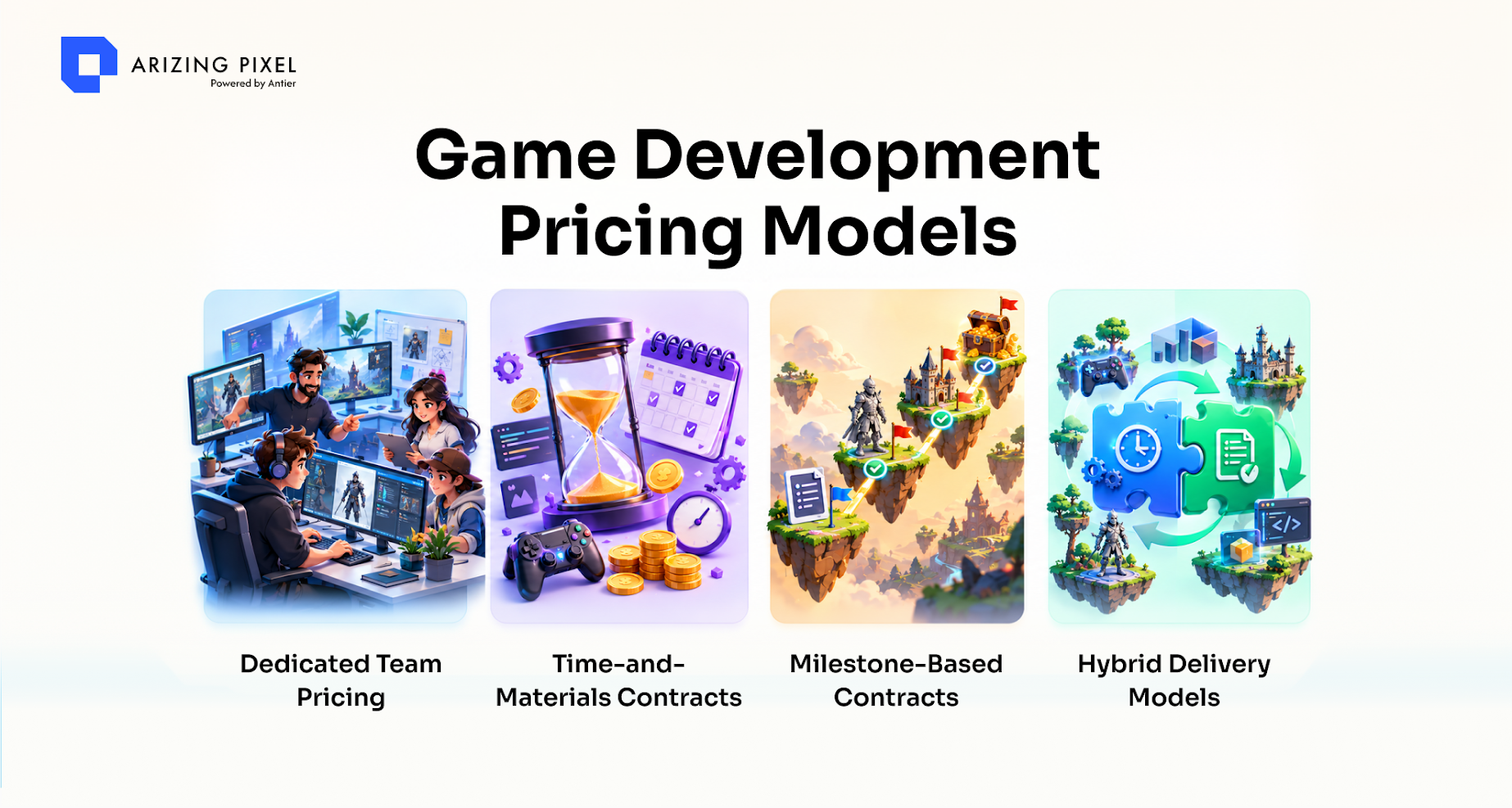
- Dedicated team pricing
The client reserves a team of developers, artists, designers, or QA specialists for an agreed period. The team works against the project’s priorities, with responsibilities divided between the client and the partner. This model suits a studio with continuing production needs or a roadmap likely to change over time. It provides access to a defined level of staffing capacity, but the client must keep the team supplied with decisions, feedback, and work that can be completed.
If approvals are delayed or dependencies remain unresolved, the studio may pay for capacity it cannot use effectively.
- Time-and-materials contracts
The client pays for the time used by the team. This approach can suit early-stage projects, technical discovery, and systems whose requirements may change during development. The main benefit is flexibility. The client can revise priorities as the game evolves, subject to the agreement. The trade-off is that the final cost depends on the amount of work required.
Regular estimates, sprint reviews, and clear approval procedures help the client understand how spending relates to progress.
- Milestone-based contracts
Payments are linked to agreed outcomes, such as a playable prototype, a completed gameplay feature, or a content area integrated into the main build. Milestone-based pricing can make progress easier to evaluate, provided the contract defines what completion means. A feature that runs in a demonstration environment may still require optimization, documentation, testing, and integration before it is ready for production.
The acceptance criteria should account for those requirements.
- Hybrid delivery models
Some studios combine a dedicated team for continuing work with milestone-based assignments for specific features or deliverables. For example, a studio may retain a co-development partner for gameplay engineering while commissioning a separate vendor for a defined set of character assets. This allows each relationship to match the type of work being performed.
The model also introduces additional coordination requirements. The studio must manage dependencies, delivery schedules, and quality standards across the participating teams.
What should the budget include?
When comparing proposals, include the following costs in the total project estimate:
- Discovery, technical planning, and onboarding.
- Development or production hours by role.
- Project management and communication.
- Code reviews, build integration, and testing.
- Revisions, bug fixes, and changes in scope.
- Security, documentation, and handover.
- The internal team’s time spent coordinating the partner.
For a 2027 project, request proposals using the same scope, assumptions, and acceptance criteria. Compare the expected deliverables, staffing commitments, and integration responsibilities before comparing prices.

The Right Development Model Starts With the Right Partner
How should you evaluate a co-development partner for a 2027 project?
When comparing game development outsourcing companies, studios should look beyond technical capabilities and assess relevant production experience. Ask for examples involving a comparable engine, platform, gameplay system, or production scale. Clarify what each team delivered, the responsibilities it held, and whether the work required ongoing integration with another studio.
Evaluate a potential partner across these areas before committing:
- Relevant production experience: Has the team delivered projects involving a similar game engine, platform, gameplay system, or production scale?
- Team structure and ownership: Who will lead the work, make technical decisions, and take responsibility for delivery?
- Workflow and integration: How often will the partner share builds, review feedback, and integrate code or assets into the main project?
- Quality assurance: What testing procedures, acceptance criteria, and defect-resolution timelines will apply?
- Communication and reporting: How will progress, risks, dependencies and delays be communicated to your internal team?
- Commercial and contractual terms: Are staffing commitments, milestone definitions, change requests, IP rights, security requirements and exit arrangements clearly documented?
- Continuity and handover: Will your studio retain access to source files, documentation and project materials if key team members leave or the partnership ends?
The answers should be specific enough to inform the production plan. Next, review the commercial terms. Confirm the staffing model, expected commitment, milestone definitions, change-control process, IP provisions, security requirements, and exit arrangements. Ask how progress will be measured and what evidence will be available to evaluate completed work.
Finally, assess communication and accountability. When comparing game co-development services, studios should assess the partner’s ability to work within their production process, manage technical dependencies, and meet agreed delivery milestones. The lowest quote or largest team is not necessarily the right choice. What matters is whether the partner’s skills, workflow, and responsibilities fit the project’s needs.
Who owns the intellectual property in co-development and outsourcing?
IP ownership depends on the contract, not simply on whether a studio chooses co-development or traditional outsourcing. Agreements should specify who owns newly created source code, artwork, designs, and other deliverables, as well as which pre-existing tools and technologies remain the external partner’s property.
Studios should also clarify licensing rights, third-party dependencies, access to source files and documentation, and what happens to project materials when the partnership ends. These terms affect the studio’s ability to update, distribute, and commercialize the game after delivery. Before signing, both parties should document ownership, permitted usage, licensing obligations, and handover requirements. Clear terms help prevent disputes and ensure the studio has the rights and materials needed to continue developing the game.
Wrapping Up
Choosing between in-house development, co-development, and outsourcing comes down to your team’s capabilities, production goals, and level of control. Before committing, assess the work required, the resources available internally, and the responsibilities an external partner can take on.
Arizing Pixel brings game development, art production, and immersive experience capabilities together within an integrated studio. If your team is planning its next game or expanding an existing production, discuss your project requirements to identify an approach that fits your goals.
Frequently Asked Questions
01. What are the main challenges game studios face when preparing for 2027?
Game studios may struggle with team capacity and specialist skills, as hiring takes time and outsourcing can lead to integration, communication, and quality control concerns.
02. What factors should studios consider when choosing a production model?
Studios should evaluate costs, creative control, coordination, and intellectual property (IP) ownership when deciding between in-house development, co-development, and outsourcing.
03. How can studios effectively integrate external development capabilities?
Studios should focus on clear ownership, regular communication, defined deliverables, and established procedures to ensure successful integration of external teams without losing visibility over delivery.