✨ AI Summary
A game development prototype tells you if your idea is fun. A vertical slice shows a few minutes of the game at launch quality, so funders can see what they are paying for. A game MVP is the smallest full version of the game you can put in front of real players to see if they come back. Each one answers a different question. Fund the one that answers the question your funder is asking right now.
Getting a new game funded is hard right now. In GDC’s 2026 State of the Game Industry survey of more than 2,300 people, 35% of developers said they mainly pay for their own projects. Only 20% had a publishing deal or project funding. Standing out after launch is hard too. SteamDB data reported by GamingOnLinux counted 19,008 new Steam games in 2025 by mid-December. Almost half of them had 10 reviews or fewer.
So funders want proof before they commit to game development pre-production funding or a full production budget. That proof usually comes as one of three builds: a prototype, a vertical slice, or an MVP. People mix up these terms all the time, especially the game prototype vs. vertical slice difference, and the mix-up costs money. Bring a grey-box prototype to a game publisher pitch that needs final quality, and you have answered the wrong question. Spend months polishing a slice before you know the core loop works, and you may polish the wrong game.
This guide covers what each build is, what it proves, what makes it expensive, and how to decide which one to fund next.
Prototype vs Vertical Slice vs MVP: What Each One Is
Studios use these terms slightly differently, and MVP in game development has the most meanings. Here is how this guide uses them.
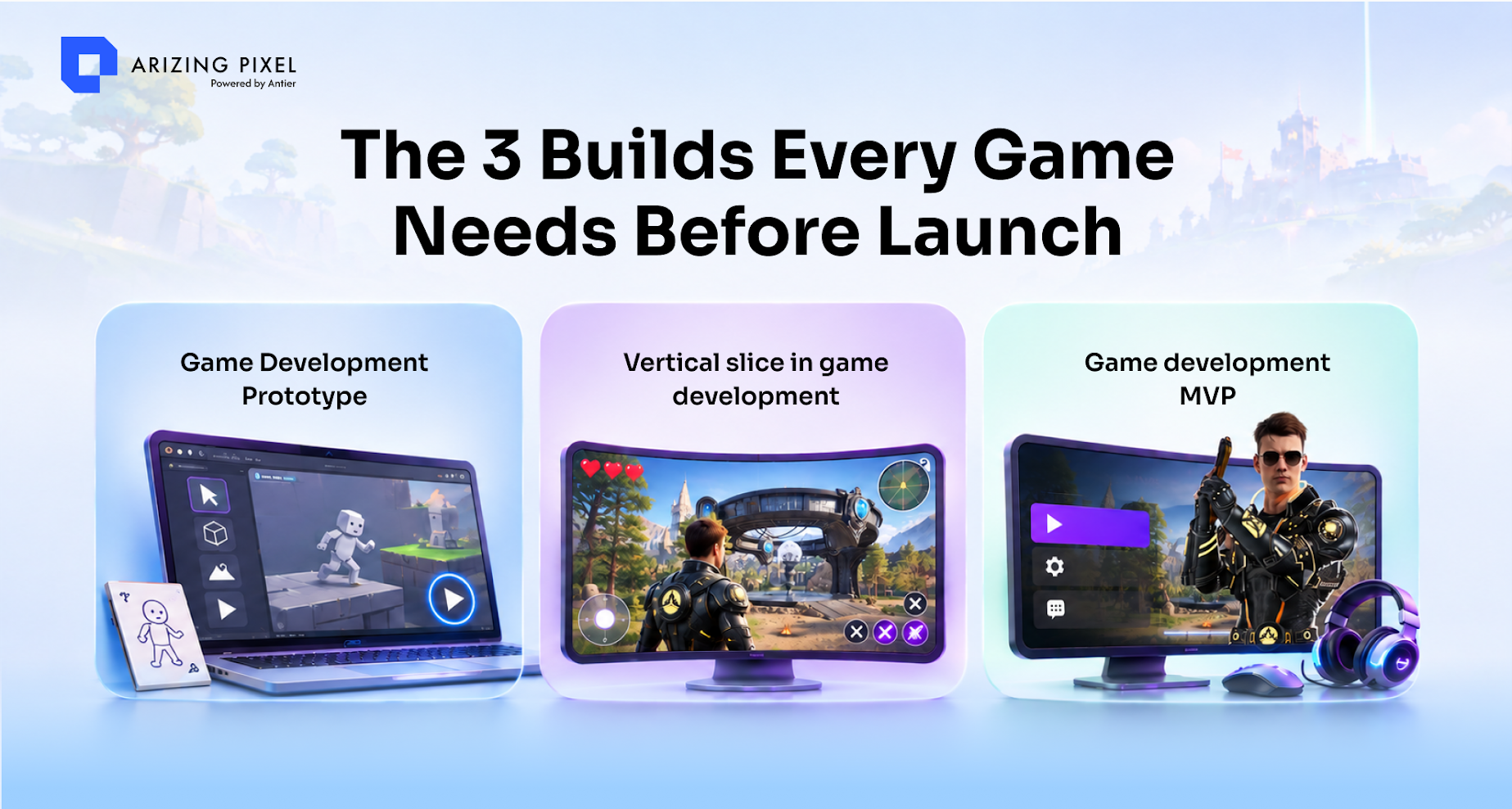
- Game Development Prototype
A prototype is a quick, rough test of one idea. The art is placeholder, and the code is held together with tape. That is fine, because it has one job: to find out if the idea is fun. Once it answers that, most teams throw it away and start clean.
- Vertical slice in game development
A vertical slice is a short piece of the game built exactly as it will ship. Think one level, one boss fight, or one mission. The art, animation, sound, UI, and performance all meet the launch standard. Anyone who plays it is seeing the finished game in miniature.
- Game development MVP
An MVP, or minimum viable product, is the smallest version of the game that real players can play from start to finish. It has enough content to keep people playing for a while and enough tracking to show what they do. Mobile teams often release it as a soft launch in a few countries. PC teams may run a closed playtest or early access.
Need launch-quality art without growing your team?
Some teams also build a proof of concept first. It checks a technical question, such as whether the online multiplayer code or a rendering approach will hold up, before anyone worries about fun.
| Build Type | Prototype | Vertical slice | MVP |
|---|---|---|---|
| Question it answers | Is the idea fun? | Can this team build it at this quality? | Will players stay and pay? |
| Quality bar | Placeholder | Launch quality, for a small piece | Shippable, with limited content |
| Who plays it | The team and small test groups | Publishers, investors, executives | Real players in a test market |
| What you walk away with | A go, pivot, or stop call | Proof of quality and real production numbers | Retention and spending data |
What Each Build Proves to Publishers and Investors
Each build takes one kind of risk off the table.
A prototype removes design risk. It shows that the core loop, the main action players repeat, works and that players want to do it again. On its own, a prototype rarely gets a game signed. It is most useful for your own greenlight decision and for early talks with funders who back small teams.
A vertical slice removes execution risk. It shows the team can deliver the quality it promised. A publisher can look at the art direction, feel the controls, and check the frame rate on real hardware. The slice also gives you real production numbers at the end of game development pre-production. Once you have built one level and one character to final quality, you know how long each asset takes. Multiply that across the full game and your budget stops being a guess.
An MVP removes market risk. A game MVP shows whether players stick around. GameAnalytics’ 2026 benchmarks give a useful bar. Across 16,262 mobile games, the top 25% brought back just over 30% of players the next day. The median game kept just under 4% of players a week later. On PC, across 3,582 games, the top 25% brought back 15% to 16% of players the next day. These numbers shift a lot by genre, so compare your MVP with games like it.
What to Bring to a Game Publisher Pitch
The vertical slice is the centre of most game publisher pitch meetings. Publishers will also ask about cost, time, and team, so bring these with the build:
- A playable slice that runs on the publisher’s target hardware without crashing
- A full-game budget built from the slice’s production rates
- A schedule with milestones and the team that will deliver them
- Two or three comparable games and how they performed
- A clear list of what in the slice is still placeholder
What Makes Each Build Expensive
Cost follows the quality bar. A short vertical slice can easily cost more than a long prototype.
| Build | Where the money goes | Where budgets go wrong |
|---|---|---|
| Prototype | Design time, a small team, quick tools | Polishing art that will be thrown away |
| Vertical slice | Final art, animation, effects, sound and UI; setting up the art pipeline; performance work | Changing art direction late; packing too much content into the slice |
| MVP | Enough content to keep players, analytics, servers, platform requirements, small ad tests | Adding features before the retention data comes in |
The cost of a game vertical slice
In vertical slice game development, this is the stage where spending jumps. The slice covers only a few minutes of play, but every asset in those minutes has to look finished. That puts a lot of the weight on art, animation, and effects. You also have to set up the full pipeline from concept sketch to in-engine asset, which a prototype never needs.
Four things decide how big that bill gets:
- How realistic the art is. Stylized 2D costs less per asset than realistic 3D.
- How many unique assets you need. Every new character, enemy, and environment adds modeling, texturing, rigging (the skeleton that lets a model move), and animation.
- Which platforms you target. Consoles and high-end PC need more optimization than mobile.
- Which engine features you use. Advanced lighting, physics, or online play add engineering time.
Mistakes also get more expensive as you go. Dropping a weak idea after a prototype costs little. Dropping it after a slice means writing off the art spend. Dropping it after a soft launch adds server and marketing costs on top.
Should You Fund a Prototype or a Vertical Slice?
The game prototype vs vertical slice choice comes down to one rule: fund the build that answers your biggest open question. Agree on what counts as a pass before work starts, so every build ends with a clear decision.
- Fund a prototype when the core mechanic is new or untested. It passes when people outside the team pick up the loop quickly and want another go. If it only feels fun once you imagine the final art, it has failed.
- Fund a vertical slice when the design is proven, and you need a publisher, investor, or board to commit to full production. It passes when it hits the target look and frame rate on target hardware, and the team can say how long each asset and level takes to make.
- Fund an MVP when you are ready to test the market. It passes when retention and spending match or beat similar games. If winning a player costs more than that player is likely to spend, it has failed.
Most games need all three, in that order. Skip the prototype, and design problems show up during the slice, when they cost far more to fix. Skip the slice, and production funding gets harder, because funders cannot see what the finished game will look like.

Tell us your deadline and asset list, and see what we can deliver in time.
When to Outsource Game Art for a Vertical Slice or MVP
Many studios hit the same wall during vertical slice game development. The art workload jumps from placeholders to finished assets, while the core team still needs to focus on design and code. An outside art team can take on the concept art, 3D models, animation, and effects for the slice, then grow with the project if it gets funded.
Some parts of a slice move to an outside team more easily than others:
| Usually outsourced | Usually kept in-house |
|---|---|
| Environment art and props | Art direction |
| Character modeling and texturing | Hero character Ideas |
| Animation and VFX | Gameplay tests |
| UI art | Final sign-off on quality |
Keep the decisions that define the game’s identity in-house, and hand off the volume work that follows them.
Prototypes usually stay in-house. They change every day and need the designers close by.
For an MVP in game development, outside help makes sense when content is the bottleneck. Extra levels, characters, or cosmetic items can be made in parallel while your team works on systems and analytics.
Before you sign with any art partner, check five things:
- Ownership: The contract should give you full rights to the art and every source file.
- Working files: Ask for the Blender, ZBrush, Substance Painter, and Photoshop files, plus the engine-ready exports.
- Engine fit: Make sure the team has delivered assets for your engine and version, such as Unity or Unreal Engine 5.
- Reviews: Agree on how often you will review work and who signs off.
- Production rates: Ask the team to track how long each type of asset takes, so you can use those numbers in your full-game budget.
Conclusion
A prototype tells you if the game is fun. A vertical slice tells funders your team can build it. An MVP tells everyone whether players will stay. Fund them in that order, agree on what a pass looks like, and be ready to stop when a build falls short.
The vertical slice in game development is where finished art takes a large share of the budget and does most of the convincing. Arizing Pixel is the best fit for studios and IP owners who need launch-quality art for a slice or MVP without growing their in-house team. The studio covers concept art, 2D and 3D game art, animation, VFX, and UI. The team works in Photoshop, Blender, ZBrush, and Substance Painter, and delivers engine-ready assets for Unity and Unreal Engine 5.
Planning a vertical slice or an MVP? Submit an art brief to Arizing Pixel and talk to the team about your project.
Frequently Asked Questions
01. What is the difference between a game prototype and a vertical slice?
A game prototype is a quick, rough test of an idea with placeholder art and code, aimed at determining if the concept is fun. In contrast, a vertical slice is a polished segment of the game that meets launch standards, showcasing finished art, animation, and gameplay.
02. What does MVP stand for in game development?
MVP stands for Minimum Viable Product, which is the smallest version of a game that players can complete from start to finish, containing enough content and tracking to gauge player engagement.
03. Why is it important to understand the differences between prototypes, vertical slices, and MVPs?
Understanding these differences is crucial because using the wrong type of build in a funding pitch can lead to misunderstandings and wasted resources, potentially costing developers money and time.