
✨ AI Summary
- The increasing demand for 3D game art is changing how studios approach game art production.
- More teams are partnering with specialized 3D art studios for asset production and capacity expansion.
- This blog post offers an insightful guide into modern 3D game art production, the role of AI, and the benefits of outsourcing for growing studios.
- It also describes the production pipeline from the initial brief to an engine-ready delivery, and what to look for when choosing a 3D game art partner.
- The blog post further breaks down the three main asset categories of 3D production: characters and creatures, environments and locations, and props, weapons, and vehicles.
Behind every detailed game world is a huge amount of 3D art production. A single project can require hundreds or even thousands of characters, props, environments, weapons, vehicles, and other assets, each built to meet a specific visual and technical standard.
That growing workload is changing how studios approach game art. More development teams are working with specialized 3D art studios to handle asset production, expand their capacity, and keep projects moving. In 2026, game art outsourcing is becoming a much bigger part of that production equation.
In this guide, we’ll break down what modern 3D game art production involves, where AI fits into the workflow, and when outsourcing makes sense for growing studios. You’ll also see how the production pipeline works from brief to engine-ready delivery and what to look for when choosing a 3D game art partner.
What 3D Game Art Actually Includes
Three asset categories make up the bulk of any 3D production scope.
- Characters and creatures: Base meshes, high-poly sculpts, retopologized game-ready versions, rigged skeletons, blend shapes for facial animation, and full texture sets in albedo, normal, roughness, and metalness maps
- Environments and locations: Modular tile sets, hero props, terrain geometry, sky and lighting assets, and destructible or interactive environment elements
- Props, weapons, and vehicles: Standalone objects with independent LOD chains, often needing separate collision geometry and physics-ready exports
Each category follows the same core production sequence: concept reference, high-poly sculpt, low-poly retopology, UV layout, texture baking, PBR material authoring, and final engine import with LOD assignment. The tools that handle these steps in professional production are Maya and Blender for modeling, ZBrush for sculpting, Substance Painter for texturing, and either Unity or Unreal Engine 5 for final engine integration, optimization passes, and lighting validation.
A 3D character asset for a mid-scope mobile title typically clears the pipeline in 3 to 6 weeks depending on complexity, style, and the number of revision cycles built into the brief. Environment hero assets run longer, often 6 to 10 weeks for a fully modular, engine-ready set. Platform constraints can compress or expand those timelines significantly, which is why platform-specific planning matters before production begins.
The AI Tradeoff in 3D Game Art Production
The GDC 2026 State of the Game Industry report surveyed more than 2,300 industry professionals and found that only 30% of people working inside game studios use generative AI tools, compared to 58% adoption in publishing, marketing, and support roles; source: BusinessWire, January 2026. The gap is wide, and it reflects a production reality that the numbers make plain.
Generative AI performs well at specific stages of the 3D art pipeline:
- Concept ideation and reference generation
- Texture variation at scale for environment assets
- Early-stage mood boards and style exploration
But game-ready 3D output from AI still requires substantial human intervention to become usable in a production pipeline. Topology needs to be clean for rigging. UV maps need to be logical for texture artists to work on. LOD chains need to be authored, not approximated. Collision geometry needs to be set separately from visual mesh geometry. None of these are steps that current generative AI handles reliably for engine delivery.
The honest tradeoff is this: AI is a useful pre-production and exploration tool, but studios that have tried to replace human 3D artists in final production have found that QA and correction time often eliminates the efficiency gain. For game-ready assets at production quality, human-led 3D artwork remains the current standard.
Need extra hands for your game art pipeline?
In-House vs. Outsourced 3D Art: A Practical Comparison
The outsourcing decision isn’t about capacity alone. Visual consistency across a large asset set is the bigger operational risk, and it’s the one most production leads underestimate.
| Dimension | In-House Team | Outsourced 3D Art Studio |
|---|---|---|
| Style guide fidelity | High, but dependent on retaining key artists | Maintained through single-pipeline ownership and art-direction handoff |
| Platform coverage (Roblox, Web3, Telegram) | Requires specialized hires per platform | Covered within a single engagement if the studio has confirmed multi-platform experience |
| Ramp time | 3 to 6 months to hire, onboard, and reach output velocity | Typically 2 to 4 weeks from signed brief to first asset batch |
| Pipeline ownership | Fragmented if art, rigging, and engine prep are separate roles | Consolidated when a studio handles modeling through engine delivery without external handoffs |
| Scalability | Constrained by headcount and hiring cycles | Adjustable by scope without HR overhead |
| Visual drift risk | Grows as team size increases without a strong art director | Managed through art bible adherence and style guide review checkpoints |
The game art outsourcing market was valued at approximately $4.57 billion in 2026 and is projected to reach $8.95 billion by 2034 at a CAGR of 8.7%, according to Data Insights Reports. The 3D gaming technology market, which includes the engines, tooling, and production infrastructure that 3D game art runs on, is projected to grow from $46.11 billion in 2025 to $200.12 billion by 2035 at a CAGR of 15.81%, per Market Research Future. To put that trajectory in context: the 3D gaming tech market is projected to expand by roughly the GDP of a mid-size European economy over the next decade.
Outsourcing is the right fit when a studio needs multi-platform production coverage without building separate specialist teams for each platform, when production is scaling faster than internal hiring can support, or when style guide consistency across hundreds of assets is at risk without a dedicated external partner to manage that fidelity.
It’s not the right fit when a studio’s art direction is still undefined. An outsourcing partner can execute against a style guide, but can’t substitute for one. Studios that enter a 3D art outsourcing engagement without a finalized art bible, reference images, or at minimum a signed-off concept batch often spend the first half of the engagement doing discovery work that should have happened before the brief was written.
How 3D Game Art Outsourcing Actually Works: The Production Pipeline
Here’s what a professional outsourcing engagement looks like from first contact through final handoff.
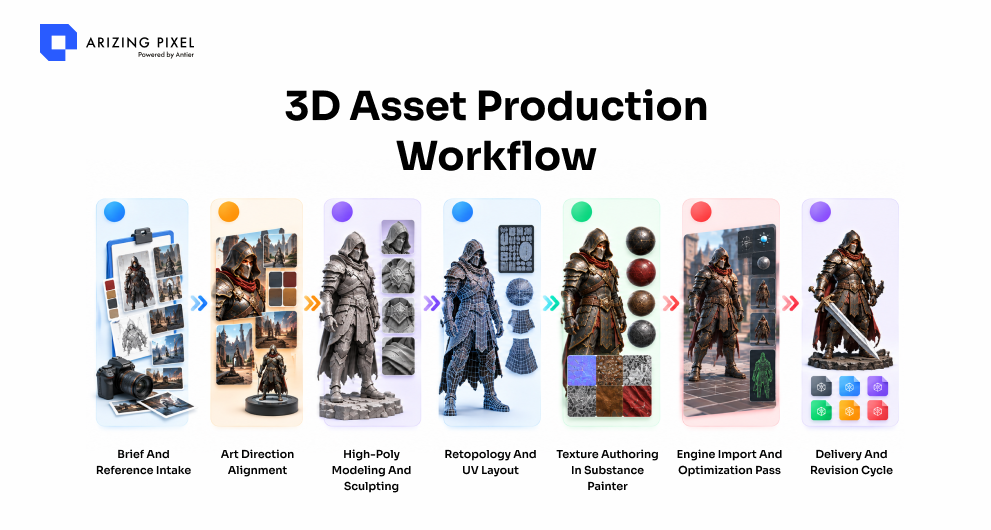
Step 1: Brief and reference intake
The studio receives concept art, style guide references, or art direction documentation. If concepts don’t exist yet, a concept art phase precedes 3D production. Asset lists are confirmed with platform-specific technical requirements called out per item.
Step 2: Art direction alignment
A sample asset, often a single character or hero prop, is produced first. This first asset functions as a style anchor. Every subsequent asset in the batch is held against it for proportion, material treatment, and silhouette clarity.
Step 3: High-poly modeling and sculpting
Artists build the detailed sculpt in ZBrush or equivalent. This is the detail-capture stage, not the game-ready stage. High-poly meshes are not shipped to an engine. They’re the source for baking.
Step 4: Retopology and UV layout
The high-poly sculpt is retopologized into a clean, low-poly game mesh with logical UV islands. LOD tiers are authored at this stage for the relevant platform’s performance budget.
Step 5: Texture authoring in Substance Painter
PBR texture sets are built from baked normal maps, ambient occlusion, and hand-painted or procedurally generated surface detail. Output formats are specified per engine target: Unity’s workflow differs from Unreal Engine 5’s Lumen-compatible material setup.
Step 6: Engine import and optimization pass
Final assets are imported into Unity or Unreal Engine 5, tested against the platform’s runtime constraints, and any draw call or memory issues are resolved before handoff. For Roblox builds, assets go through a separate conversion and testing pass.
Step 7: Delivery and revision cycle
Assets are delivered in the agreed format with source files. One to two structured revision rounds are standard in professional engagements. Open-ended revision loops are the single most common cause of timeline overrun in outsourced production.
Looking for a team to handle your 3D assets?
What to Look for in a 3D Game Art Company
Production leads evaluating a 3D game art company for the first time tend to ask about portfolio quality first. That’s reasonable, but it’s the second question, not the first.
The first question is whether the studio can cover the specific technical constraints of your platform target. A studio with a strong portfolio of PC and console assets may have no experience with Roblox’s skeleton constraints or Web3’s tokenization requirements. Portfolio quality matters. Platform fluency matters more for multi-platform builds.
Signals that indicate a mature 3D game art outsourcing studio:
- They ask about your art bible and style references before quoting scope
- They produce a style-anchor asset before beginning a full batch
- Their pipeline handles modeling, texturing, and engine delivery without external handoffs
- They can articulate the difference between Unreal Engine 5’s Nanite workflow and a standard LOD chain, and explain which your project needs
- They confirm platform-specific technical constraints in the brief, not after the first delivery
A 3D game art services partner running a fragmented pipeline, where modeling goes to one team, texturing to another, and engine prep to a third, introduces visual drift at every handoff. Style guide fidelity is maintained by ownership, not by documentation alone.
Wrapping Up
The real test of a 3D asset is what happens after it leaves the artist’s screen. Can it load properly in the engine? Does it meet the platform’s performance limits? Does it still look like it belongs in the same world as the rest of the game? Those questions are easier to answer when the people making the asset understand its final use. They are much harder when the work passes through several teams with separate briefs and priorities.
At Arizing Pixel, we build with the final delivery in mind. Our 3D game art outsourcing services cover the production journey from concept to engine-ready assets, with a focus on practical workflows, visual consistency, technical requirements, and production-ready delivery.
Frequently Asked Questions
01. What are the main categories of assets involved in 3D game art production?
The main categories include characters and creatures, environments and locations, and props, weapons, and vehicles.
02. What is the typical production timeline for a 3D character asset?
A 3D character asset for a mid-scope mobile title typically takes 3 to 6 weeks to complete, depending on complexity and revisions.
03. How is AI impacting 3D game art production?
AI is becoming an integral part of the workflow, influencing how studios approach asset production and potentially streamlining various stages of the process.

