✨ AI Summary
- Telegram game development has evolved significantly in 2026, with the focus shifting from viral airdrop games to more strategically designed and scalable platforms.
- This blog post is a comprehensive guide to developing successful Telegram games.
- It addresses the common causes of post-launch game failure and differentiates between bot-based and Mini App games.
- The guide advises on designing a sustainable token economy and outlines the importance of TON blockchain integration in the building sequence.
- It also discusses how to approach game monetization at a product level.
Telegram game development in 2026 is not what it was 18 months ago. The tap-to-earn wave that carried Hamster Kombat and Notcoin to 300 million combined users at peak has receded, and what remains is a more demanding, more valuable market. Games’ monthly active users on Telegram now sit at approximately 47 million, down 9% as tap-to-earn fatigue sets in, per recent market data. The developers building on this platform today are not chasing airdrop virality. They are solving harder problems: backend architecture that scales under traffic, token economies that do not collapse after the first distribution event, and session design that earns 30-day retention rather than a single viral spike.
This guide addresses those problems directly.
In this guide:
– The specific failure modes that kill most Telegram games after launch
– The structural difference between bot-based games and Mini App games, and when each architecture is the right call
– How to design a token economy that sustains engagement past the first airdrop
– Where TON blockchain integration fits in the build sequence
– How to think about Telegram game monetization at a product level, not just a feature level
Why Most Telegram Games Fail After Their First Traffic Spike
The post-launch retention cliff is the defining failure mode in this market, and it has three root causes that compound quickly.
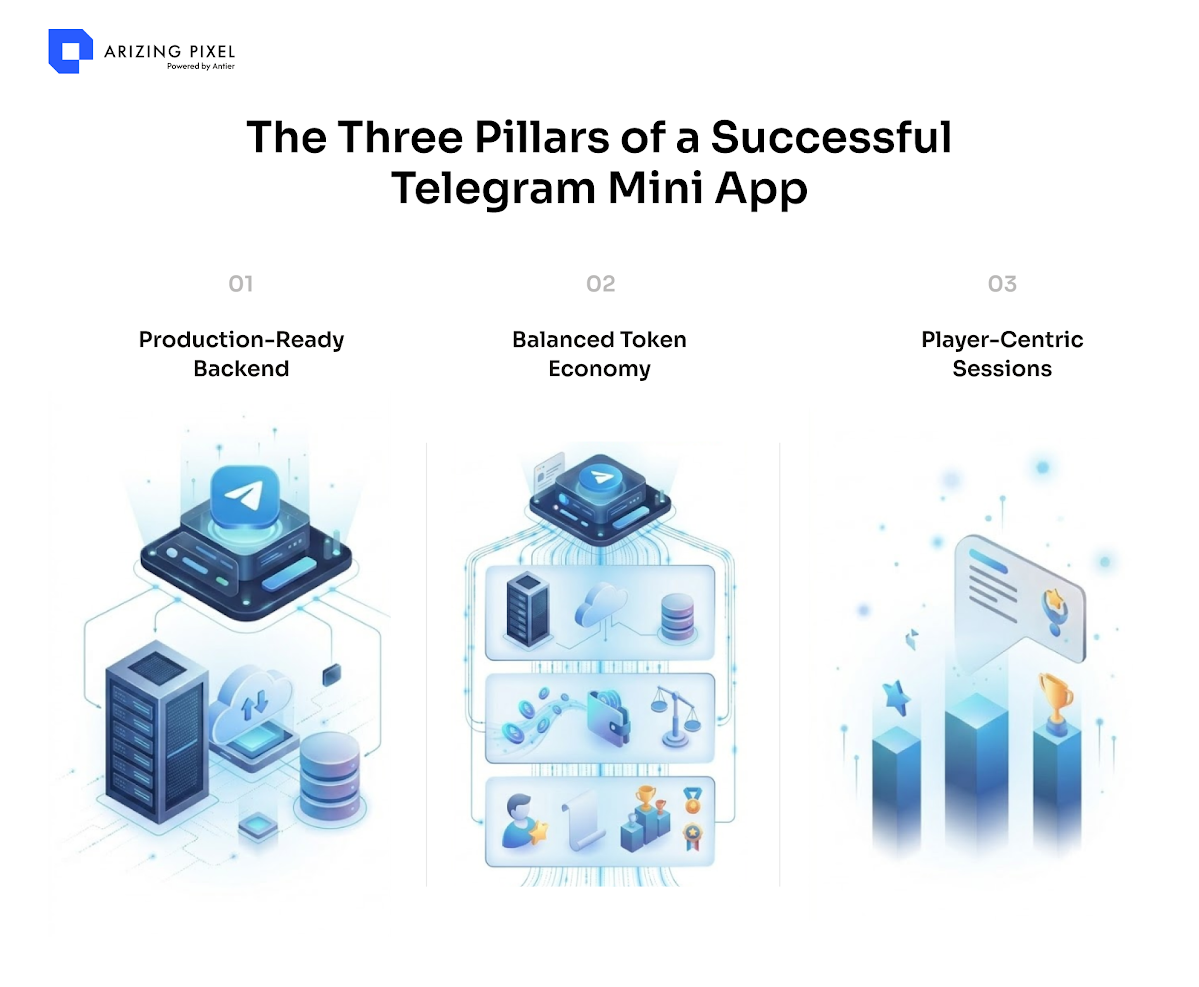
1. Production-Ready Backend
A bot-plus-lightweight-server setup that handles 10,000 concurrent users in testing will not hold at 500,000. Real-time multiplayer and leaderboard systems require WebSocket infrastructure, horizontal scaling, and stateful session management from the beginning; retrofitting these after a viral event is expensive and slow
Game state persistence needs a backend that can handle rapid writes; a simple REST API will become a bottleneck under load.
2. Balanced Token Economy
Airdrop-as-acquisition works. Airdrop-as-retention does not. When the reward that drove installs is distributed, players who came for the token, not the game, leave immediately. A sustainable on-chain reward loop requires a sink mechanism, a reason to spend tokens within the game that is more compelling than holding or selling them
Common sink failures: cosmetics with no gameplay value, pay-to-win mechanics that fracture the player base, and reward schedules that inflate supply without creating demand
3. Player-Centric Sessions
Tap-to-earn mechanics drove installs because they were simple, not because they were engaging. Session depth, the amount of meaningful decision-making a player does per session, is the variable that predicts 30-day retention, not session frequency. Games that add depth through progression systems, competitive mechanics, or social features before launch retain significantly better than those that bolt them on afterward.

Planning a game that can handle real player traffic?
Bot-Based Game vs. Mini App: The First Decision That Shapes Everything
The architecture choice you make before a single line of code is written will determine your retention ceiling, your monetization options, and how difficult a rebuild will be six months from now.
1. Bot-based games:
- Operate entirely through Telegram’s Bot API, responding to user commands and inline keyboards
- Low build complexity and fast to prototype
- Retention ceiling is structurally low; turn-based mechanics and asynchronous interaction limit session depth
- TON wallet integration is possible but adds friction because there is no embedded browser environment
Best fit: Viral distribution experiments, community engagement mechanics, or games where the core loop genuinely works as a command-response interaction
2. Mini App games:
- Run as web applications inside Telegram’s embedded browser, using HTML5, JavaScript, and the Telegram Web App SDK
- Full real-time multiplayer capability, animated UI, and persistent session state
- 7-day retention rates of 30–50%, compared to 5–10% for traditional DApps, per a February 2026 analysis by ChainPeak
- TON wallet connection is native and low-friction within the Mini App environment
Best fit: Any product where session depth, economy design, and long-term monetization are business requirements
In 2026, the strongest Web3 gaming experiences will be built as Mini Apps. What separates successful launches is the quality of the architecture behind them.
The Build Sequence That Reduces Rebuild Risk
Order matters. Studios that try to bolt blockchain, multiplayer, and economy mechanics onto a finished game rebuild more often than those who sequence the architecture correctly.
| Build Phase | Core Deliverable | Key Focus |
|---|---|---|
| Phase 1: Architecture | Mini App shell, backend infrastructure, WebSocket layer | Scalable, production-ready foundation |
| Phase 2: Core Gameplay | Primary gameplay mechanic, session state persistence | Validate player engagement |
| Phase 3: Economy Design | Token model, sink/source balance, reward schedule | Sustainable tokenomics |
| Phase 4: TON Integration | Wallet connection, on-chain rewards, NFT asset layer | Seamless blockchain integration |
| Phase 5: Multiplayer & Social | Leaderboards, real-time multiplayer, referral mechanics | Reliable social and competitive features |
| Phase 6: Monetization | In-app purchases, premium cosmetics, tournament entry | Balanced, player-friendly monetization |
TON blockchain integration fits in Phase 4, not Phase 1. Studios that lead with blockchain and follow with gameplay consistently produce products where the token is the product, and those products do not retain.
Let’s map out your Telegram game’s architecture before development begins
Designing a Token Economy That Survives the First Distribution Event
The platform context supports serious economic design. The addressable player base is large. The challenge is building an economy within that base that does not self-destruct.
A retention-first token economy has these structural properties
- Multiple token sinks with distinct value propositions: Cosmetics, competitive entry fees, governance participation, and crafting systems serve different player motivations and strengthen the in-game economy.
- Reward schedules that maintain momentum: Early players earn enough to stay engaged while preserving long-term value instead of concentrating rewards during the initial acquisition phase.
- Clear separation between social and economic currency: Status, leaderboard rankings, and cosmetic recognition should remain separate from tokens with on-chain value to create a more resilient economy.
- An NFT asset layer with gameplay utility: Assets that unlock features, enhance gameplay, or provide functional benefits retain holders longer than assets driven solely by speculative value.
Telegram game monetization begins at the product design stage. These systems should be planned before launch, allowing the economy and player experience to evolve together rather than being added after player expectations have already formed.
Telegram Game Development Cost: What Actually Drives the Budget
Telegram game development cost varies significantly based on architecture decisions, not just feature count.
Primary cost drivers:
- Backend infrastructure design: A scalable WebSocket backend with proper session management costs more upfront and significantly less in rebuild costs later
- Economy design and balancing: Economic modeling requires dedicated product time; studios that skip this spend it on post-launch patches
- TON integration depth: A basic wallet connection is straightforward; a full on-chain reward loop with NFT asset management requires smart contract development and audit
- Real-time multiplayer: Server costs and engineering complexity scale together; design the multiplayer scope before committing to a timeline
- AI-powered adaptive mechanics: Intelligent systems that personalize gameplay — adjusting difficulty, pacing reward delivery, or surfacing the right content at the right session depth- add development time that typically pays back in retention metrics
Budget ranges are wide because architecture ranges are wide. A bot-based community game and a production-grade Web3 Mini App with real-time multiplayer and a full token economy are not the same product category, and they should not be priced the same way.
The Final Words
The Telegram gaming market in 2026 is sorting itself into two categories: products built for a single viral event and products built for a player base. The former is cheap to build and expensive to maintain. The latter requires genuine architectural decisions, economic design expertise, and a studio that understands where the retention cliff is before the build starts.
At Arizing Pixel, we work with Web3 gaming founders and studio leads who have moved past the question of whether to build on Telegram and are now facing the decisions that determine whether their product survives its own launch. Our Telegram game development practice is built specifically for that stage. Ready to scope a production-grade Telegram Mini App?
Bring your concept to a technical conversation with our team. We will map the architecture, economic model, and build sequence before a single line of code is written.
Frequently Asked Questions
01. What are the main reasons why most Telegram games fail after their initial traffic spike?
The main reasons include inadequate backend infrastructure that cannot handle high traffic, an unsustainable token economy that fails to retain players after initial rewards, and poorly designed player sessions that do not encourage long-term engagement.
02. How can developers create a balanced token economy for their Telegram games?
Developers can create a balanced token economy by implementing a sink mechanism that encourages players to spend tokens within the game, rather than just holding or selling them. This can include meaningful in-game rewards and avoiding common pitfalls like pay-to-win mechanics.
03. What is the significance of backend architecture in Telegram game development?
Backend architecture is crucial as it must support real-time multiplayer interactions and manage high user traffic effectively. A robust setup is necessary from the start to avoid costly retrofitting after a game's launch, which can hinder performance and user experience.