✨ AI Summary
To overcome rigid NPC logic and pure AI unreliability, studios use a Hybrid AI architecture where SLMs act as advisors. A 3-tier pipeline (Perception, Cognitive Inference, and Deterministic Arbitrator) uses local SLMs to generate structured JSON intents. The game engine validates these intents before execution, ensuring low latency, quest safety, and smooth performance across platforms via Unreal worker threads or Unity Sentis.
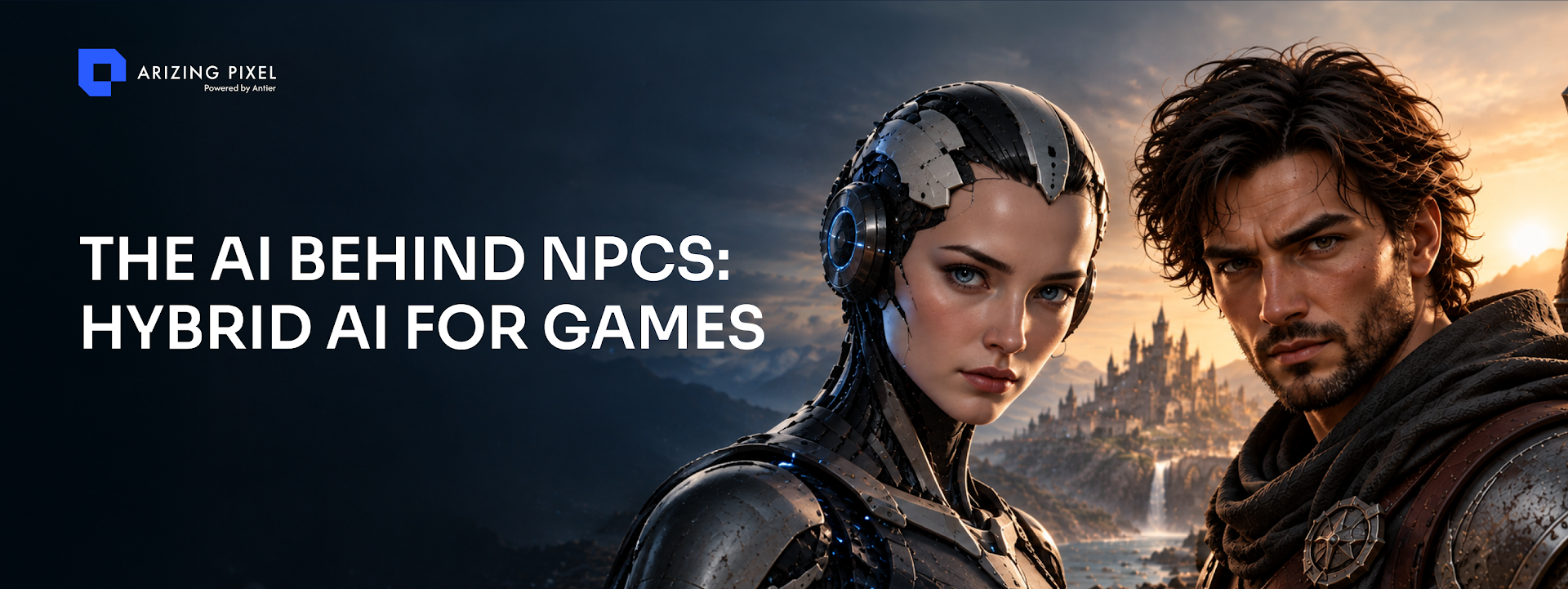
Integrating deterministic game logic with neural inference models (known as AI NPC engineering) enables non-player characters to perceive their environment, retain memory, and act dynamically in real time. Modern AI in game development combines neural inference with deterministic systems to make character interactions more adaptive without sacrificing gameplay control. Hybrid AI is one approach to NPC development, particularly for games that require flexible conversations and contextual interactions. Rather than replacing traditional game AI, it combines neural inference with deterministic systems to introduce adaptive character behaviour while keeping gameplay rules under engine control. Depending on the game’s requirements, studios can also rely on traditional techniques such as FSMs and Behavior Trees without integrating language models.
- Deterministic Cores (FSMs / Behavior Trees): Enforce game state rules and movement boundaries.
- Small Language Models (SLMs): Handle fluid conversation and contextual awareness.
David Ellison, CEO of Skydance Media, describes AI as a tool for empowering creative storytelling. CESA’s 2026 survey found that 85.8% of 1,349 surveyed Japanese game developers use generative AI. Meanwhile, Precedence Research estimates the global AI in games market at $8.50 billion in 2026. These figures reflect broader industry adoption, not necessarily AI NPC deployment in released games.
In this blog, we’ll explore how AI NPC game development works, where traditional logic has limitations, and how hybrid AI architectures can introduce more adaptive character interactions while maintaining gameplay control.
The Shortcomings of Static Logic (FSMs and BTs)
Traditional non-player characters operate through predefined rules, conditions, and behavioural systems. These systems can still respond dynamically to player actions, environmental changes, and gameplay events without requiring generative AI.
- FSM (Finite State Machine): Characters switch between predefined states (Idle, Patrol, Chase, Attack) when specific conditions or gameplay events occur. For example, an NPC may enter the Chase state after detecting a nearby player or return to Patrol when the player moves out of its detection range.
- BT (Behavior Tree): Behavior Trees organize NPC decisions into hierarchical tasks, conditions, and actions. The execution and evaluation of these nodes depend on the game engine and implementation. Some systems evaluate conditions during regular updates, while others support event-driven execution and callbacks to respond to gameplay changes.
- Production Constraint: As gameplay complexity increases, maintaining large numbers of predefined dialogue branches and behavioural conditions can become challenging. However, rule-based systems remain effective for predictable NPC interactions. Hybrid AI can complement these systems by introducing more flexible dialogue and contextual responses where needed.
Risks Associated With Generative AI Without Constraints
Integrating cloud-based LLMs into NPC systems without proper controls can introduce technical and operational challenges. These risks need to be addressed to maintain responsive gameplay, protect game-state integrity, manage operating costs, and support consistent character animations.
- Unacceptable Latency: Cloud-based AI inference can introduce additional response delays depending on the model, network conditions, request complexity, and server load. These delays can affect real-time conversations and combat interactions, making latency testing essential before deployment.
- Quest-Breaking Hallucinations: Without deterministic constraints, AI-powered NPCs may generate inaccurate information, make unauthorized promises, or suggest actions that conflict with established quest rules. Game logic must validate every proposed action, reward, and inventory change before execution.
- Excessive Cost of Unit Economics: Cloud AI costs depend on how frequently the model is called, the amount of input and output text processed, and the pricing of the selected model. Frequent or unnecessarily large requests can increase operating costs and affect LiveOps budgets.
Lack of Animation Synchronization: Raw text generated by an AI model cannot directly control skeletal rigging, facial blendshapes, or inverse kinematics (IK). Developers need structured outputs and animation mappings to translate AI responses into appropriate character movements and expressions.

Explore the possibilities of hybrid AI architecture for your next game development project.
Hybrid AI NPC Pipeline: The Way Production Studios Deliver NPCs
The bottlenecks are mitigated via a multi-tier hybrid pipeline consisting of three layers. In such a pipeline architecture, the neural model does not have ownership of the master game state. Rather, it acts as an advisor providing structured intents to the deterministic execution core.
| Architectural Layer | Primary Technology | Primary Functionality |
|---|---|---|
| Perception Layer | Spatial hashing, local vector database, engine telemetry | Captures player proximity, faction reputation, current quests, and latest events. |
| Cognitive Inference Layer | Quantized Local SLMs (ONNX / Sentis) or edge services API | Generates conversation replies, emotional transitions, and action intents. |
| Deterministic Arbitrator | Behavior Trees, C++/C# Rule Engine, NavMesh | Verifies intents against game rules, animates actions, and transitions states. |
Step 1: Context Aggregation and Multi-Tier Memory
Sending the entire game bible as part of the prompt is ineffective and costly for both computing and generation time. Game studios create a multi-level memory architecture of characters:
- Static Lore Anchor: A concise character profile defining personality traits, speaking style, faction loyalty, background, and taboo topics. Its length should depend on the character’s complexity and the context required by the selected AI model.
- Episodic Memory Buffer: Lightweight key-value storage storing important events in the player’s story.
- Working Sensory State: Real-time telemetry sent directly from the engine, including health status, weapon status, and weather.
Step 2: Grammar-Locked Constrained Inference
Instead of generating unrestricted text, the inference engine uses structured JSON output to make responses easier for the game engine to process. However, valid JSON does not guarantee correct or safe actions. Each response must undergo gameplay validation before execution.
JSON
{
“spoken_dialogue”: “Put that blade away before we talk prices, traveler.”,
“emotion_blend”: “Cautious_Angry”,
“gesture_trigger”: “Step_Back_Hand_On_Hilt”,
“proposed_action”: “LOCK_SHOP_INVENTORY”,
“trust_delta”: -15
}
Step 3: The Deterministic Arbitrator
Before execution, the game engine arbitrator validates each proposed action against predefined game rules. If an action is rejected, the associated dialogue and animation should also be adjusted to ensure consistency between the NPC’s response and actual gameplay.
Linking Intelligent Agents to Game Art, Rigging, and Engine Workflows
An AI-powered NPC becomes more lifelike when its behaviour is supported by well-designed character assets and animation systems. Integrating AI-generated speech and emotions with facial animation, rigging, and real-time rendering requires careful synchronization and performance testing on target hardware.
Collaboration between 2D/3D artists, riggers, and engine developers helps prepare character assets for AI-driven interactions and real-time animation:
- Topology and Facial Blendshapes for Real-Time Phonemes: Baked keyframes are used to produce pre-animated cutscenes. AI-controlled characters need a good facial topology and standardized visemes or ARKit blendshapes for the runtime audio-to-face system to lip-sync dynamically generated speech audio.
- Modular Animation State Graphs: If the inference layer generates “emotion_blend”: “Cautious_Angry,” Unreal Engine’s Control Rig or Unity’s Animator Controller blends upper-body posture with lower-body locomotion. A well-structured skeletal hierarchy and appropriate animation mappings can support smoother transitions, but rigs must be tested to identify potential mesh deformation and animation issues.
Platform-Specific Integration: Unity, Unreal, Mobile, Web3, Roblox, Telegram
Different platforms have different hardware, memory, and performance constraints. AI integration strategies should be selected based on the target platform, engine capabilities, model compatibility, and deployment requirements.
- Unreal Engine 5 (C++ Subsystems & Asynchronous Tasks): Running computationally intensive neural inference synchronously on the Game Thread can block frame updates and affect rendering performance. Developers can isolate model execution within a UGameInstanceSubsystem. Sensory requests are offloaded to background worker threads using FAsyncTask, while Behavior Tree decorator nodes check the thread-safe queue for finished JSON intents.
- Unity (Sentis & Compute Shader Execution): Unity Sentis is used for Unity builds targeting PC, console, and high-end mobile platforms. Quantized ONNX models run directly on the user’s GPU or CPU worker threads. Passing the character state array directly to pre-allocated tensor buffers helps avoid C# memory allocation spikes during active combat.
- Roblox and Lightweight Multiplayer Worlds: For external AI integrations, experience servers can use HttpService to communicate with an inference proxy. Server-side validation should control NPC actions, rewards, and game-state changes, while client scripts handle player-facing interactions. This approach protects gameplay logic and maintains consistent multiplayer experiences.
- Mobile, Web3, Telegram Games: Budget Android devices and browser-based Telegram mini-games have strict memory limitations. Depending on hardware, connectivity, latency, and cost requirements, developers can use local, cloud-based, or edge inference. Client-side bundles can remain lightweight while NPC dialogue and quest rewards are validated through trusted game logic to reduce exploitation risks.
These implementations are examples rather than universal requirements. Developers should evaluate engine versions, supported model formats, available hardware, and deployment constraints before selecting an inference architecture.

Have an idea for an AI-powered game? Let’s find the right approach to bring it to life.
Formal Production Guardrails: Steam Compliance, LiveOps, and QA Validation
Release of AI-enabled titles demands compliance with digital storefront policies and telemetry validation.
- Platform Compliance: Steam requires developers to disclose relevant generative AI content in its Content Survey. For live-generated AI, developers must also describe safeguards against illegal content. Studios should review platform policies and implement appropriate moderation controls before release.
- Prototype-First: Studios need to build a playable prototype first to validate any complex neural systems. It helps to track early retention and session length in order to understand whether dynamic conversations make gameplay better or only add complexity.
- LiveOps Telemetry: NPC conversations can generate useful telemetry for LiveOps teams. By analyzing dialogue patterns, quest progression, and player interactions, developers can identify friction points and refine NPC behaviour or gameplay difficulty.
Closing Thoughts
The true test of an AI NPC is how reliably it performs beyond a technical demo. Developers must evaluate latency, VRAM usage, quest integrity, and animation performance on target platforms. Collaboration between character artists and AI engineers helps identify technical limitations and build more consistent gameplay experiences.
As an AI game development company, Arizing Pixel brings together AI engineering, full-cycle game development, and 2D/3D art production to help studios build and scale intelligent gaming experiences across multiple platforms. If you plan to start a new game title, create an AI-based demo of your product, or scale an existing production, please discuss your needs with our team.
Frequently Asked Questions
01. What is AI NPC engineering in game development?
AI NPC engineering integrates deterministic game logic with neural inference models, allowing non-player characters to perceive their environment, retain memory, and act dynamically in real time.
02. How does hybrid AI improve NPC interactions in games?
Hybrid AI combines neural inference with deterministic systems to create adaptive character behavior while maintaining control over gameplay rules, enhancing flexible conversations and contextual interactions.
03. What are the traditional techniques used in NPC development?
Traditional techniques include Finite State Machines (FSMs) and Behavior Trees (BTs), which enforce game state rules and manage NPC behavior without the need for generative AI.