✨ AI Summary
- Telegram hit 1 billion monthly active users in March 2025, with over half regularly using Mini Apps.
- This presents a significant opportunity for game developers, but also challenges in ensuring user retention.
- This blog post explores the importance of architectural decisions in Telegram game development.
- It differentiates between Telegram bot games, Telegram Mini Apps, and Web3-integrated Mini Apps, and how these choices impact user retention and development cost.
- It stresses the importance of planning for scalability and sustained engagement from the outset, rather than focusing solely on initial user spikes.
Telegram crossed 1 billion monthly active users in March 2025, and more than 500 million of them interact with Mini Apps on a regular basis (Magnetto). The distribution opportunity is real. The survival problem is real too. For founders researching the cost to build a Telegram game, these architecture decisions are among the first factors to evaluate. It is the architecture decisions you make before a single line of code is written, and whether those decisions account for what happens after your first 100,000 users arrive.
What you will learn in this piece:
– The structural difference between a Telegram bot game, a Telegram Mini App, and a Web3-integrated Mini App, and why it matters before you scope your build
– Which technology stack decisions lock in your retention ceiling early
– How to evaluate a game development budget against your actual product goals, not just your launch timeline
– What the post-launch architecture for a live game looks like, including real-time infrastructure, token economy scaffolding, and live ops support
– Questions to bring to any development conversation before you sign anything
Why 2026 Is the Year Architecture Beats Hype on Telegram
The cautionary data is specific. Hamster Kombat reached 300 million all-time players as of August 2024, verified by Decrypt. By early 2025, the game had lost more than 97% of its active players, per CCN’s April 2025 retrospective. The lesson is simple: a massive launch audience does not automatically create long-term engagement. In 2026, founders will have a clearer benchmark for Telegram game development. The focus is shifting from generating an initial user spike to creating a product that supports sustained engagement, evolving gameplay, and measurable growth.
Telegram can deliver to the audience. The architecture determines how effectively the game turns that audience into lasting players.

Know Your Telegram Game Budget Before You Build
The Three Build Types: What You Are Actually Choosing Between
When evaluating the cost to build a Telegram game, the first consideration is the type of game you plan to develop. The answer shapes your backend requirements, retention potential, blockchain dependency, and total timeline.
1. Telegram Bot-Based Game
Gameplay runs through Telegram bot commands and inline keyboard interactions. No browser environment required, no WebApp API dependency, fastest to prototype, lowest infrastructure surface area
- Best for: Trivia games, turn-based mechanics, text-driven RPG loops, simple daily engagement tools
- Retention ceiling: Re-engagement is largely dependent on push notification strategy and daily reward design, particularly in the absence of real-time feedback loops.
2. Telegram Mini App Game (Non-Web3)
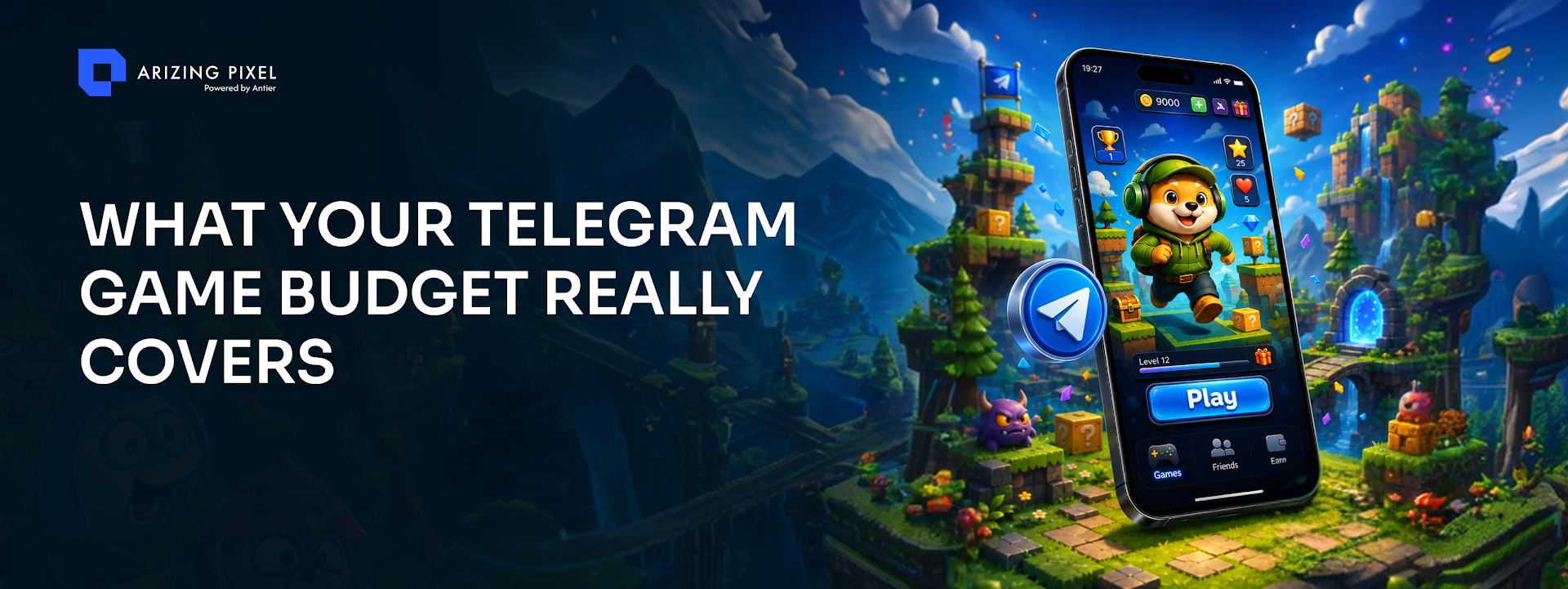
A full web application rendered within the Telegram chat interface using the Telegram Web Apps API (TWA). It supports rich UI, animations, leaderboards, real-time multiplayer through WebSockets, and competitive mechanics. The backend is typically built with Node.js or Python, with Redis used for leaderboard management and real-time state management.
- Best for: Hyper-casual and hybrid-casual games, competitive social games, branded engagement experiences, and any format where UI quality drives retention
- Retention ceiling: High, when live ops scaffolding (daily quests, seasonal events, social sharing loops) is built in from day one rather than added post-launch
3. Web3-Integrated Telegram Mini App
All Mini App capabilities above, plus TON Connect for non-custodial wallet interactions, on-chain reward distribution, tokenized in-game economies, and smart contract-based asset ownership. The TON blockchain serves as the native blockchain integration layer for this architecture, while TON Connect enables wallet authentication and transaction signing without requiring users to leave the Telegram environment. Backend and smart contract complexity increases significantly, with token vesting schedules, gas optimization, smart contract auditing, and in-game economy balancing becoming part of the overall build scope.
- Best for: P2E games, tap-to-earn formats with genuine token utility, GameFi products where ownership mechanics are a core retention driver, and studios with a token launch roadmap
- Retention ceiling: Highest potential, but also the most architecturally demanding to sustain. Economic imbalances compound quickly at scale.
A Quick Comparison Table
| Feature | Bot-Based Game | Mini App Game | Mini App Game |
|---|---|---|---|
| Rendering environment | Telegram chat interface | TWA in-app browser | TWA in-app browser |
| Primary API | Telegram Bot API | Telegram Web Apps API | Telegram Web Apps API + TON Connect |
| Real-time multiplayer | Limited | Yes, via WebSockets | Yes, via WebSockets |
| Blockchain dependency | None | None | TON blockchain |
| Wallet integration | None | None | TON Connect (non-custodial) |
| Token economy | None | Optional, off-chain | On-chain, smart contract-governed |
| Live-ops scalability | Moderate | High | High, with an additional economy layer |
| Retention architecture complexity | Low–Medium | Medium–High | High |
Timeline ranges reflect production-quality MVP-to-launch development. A Web3-integrated game with smart contract auditing, token vesting, and live ops infrastructure on day one requires the longer end of that range.
Behind the Budget: What It Takes to Build a Telegram Game
Understanding the cost to build a Telegram game starts with looking beyond features and evaluating the technology, infrastructure, and scalability your product requires.
- Infrastructure that holds under load:
A tap-to-earn game that reaches 500,000 users in its first week is not a successful MVP. It is a stress test. Backend architecture built for 50,000 users will not perform at ten times that load without specific design decisions made upfront: horizontal scaling, Redis-based state management, rate limiting on reward distribution, and event queue architecture for on-chain actions.
Real-time multiplayer systems (WebSockets with fallback logic) must be scoped as core infrastructure, not post-launch additions.
- Token economy design with long-term balance:
A token economy that inflates unchecked within 90 days of launch destroys retention regardless of how strong the initial viral loop was. The Hamster Kombat case, per CCN’s retrospective, is the clearest illustration of what happens when economy design is treated as a launch feature rather than a living system.
Budget allocation for economy modeling, vesting schedule design, and post-launch economy monitoring is part of a professional Web3 Telegram game build.
- Live ops scaffolding
Daily quests, seasonal events, referral mechanics, and push notification hooks are not features to add later. They are retention architecture. Games built with live ops scaffolding from day one outperform games that try to retrofit engagement mechanics after churn begins.
- Smart contract auditing
A gas-optimized smart contract that has been independently audited is not optional for a product with a public token. It is the difference between a credible product and a liability.

Have the Game Idea. Let’s Map the Build
What Your Telegram Game Budget Covers Under the Hood
A Telegram game budget covers much more than gameplay and visual design. It supports the technology, infrastructure, integrations, security, analytics, and scalability required to deliver a polished game and create a strong foundation for long-term growth.
A production-grade Web3 Telegram Mini App can include:
- Frontend development: HTML5, CSS3, JavaScript, or TypeScript powers the game interface within Telegram’s WebApp environment. The budget covers responsive UI, animations, interactive elements, and game-specific experiences.
- Backend development: Node.js or Python supports game logic, user accounts, APIs, rewards, player data, and server-side operations. The architecture can be designed around expected player volumes and future expansion.
- Real-time infrastructure: WebSockets enable live multiplayer interactions, while Redis supports leaderboards, session management, and fast-access game data. These technologies create a responsive experience for competitive and social gameplay.
- Blockchain integration: The TON blockchain enables on-chain rewards, digital assets, and transactions. TON Connect supports wallet authentication and transaction signing directly within the Telegram environment.
- Smart contracts: FunC or Tact can power token rewards, digital assets, and other on-chain game mechanics. The development scope can include contract optimization, testing, deployment, and security auditing.
- Analytics and monitoring: Custom event tracking provides insights into player behavior, session activity, retention, transactions, and token economy performance. These insights support data-driven game updates and live operations.
- Notification infrastructure: Telegram Bot API integration supports reward reminders, event notifications, player engagement, and re-engagement campaigns, helping maintain an active player community.
In short, your game development budget funds the complete technology foundation behind the player experience, from the interface and game logic to real-time systems, blockchain integration, analytics, and live operations.
Build In-House vs. Hire a Specialist: The Real Decision Criteria
This is the question underneath the Telegram game development budget conversation. Here is how to think through it honestly.
1. Reasons a Specialist Studio Makes Sense For Your Build:
- Your team has strong product instincts but no prior Telegram WebApp API or TON Connect implementation experience
- Your launch timeline does not have room for a 3-to-6-month learning curve on an unfamiliar platform
- Your product includes a token economy, which requires economy modeling expertise alongside engineering
- You are building for a user base designed to scale rapidly, with backend architecture planned to support growing demand from the outset.
- You need smart contract auditing and gas optimization integrated into the same development engagement.
- Your success is measured by retention, engagement, and long-term player growth alongside the completed product.
2. Reasons An In-House Build Is Viable:
- Your engineering team has shipped at least one production Telegram Mini App or TON-integrated product
- Your timeline allows for iteration rather than requiring a production-quality launch
- Your product scope is limited to a bot-based game or a simple Mini App without blockchain integration
The Honest Frame!
For any Web3 Telegram game with a token launch, a public economy, and a retention-dependent business model, the architecture decisions are too consequential to treat as learning exercises.
FAQ: What Funded Founders Ask Before Signing
- How much does it cost to develop a Telegram game in 2026, and what does the budget include?
- What factors influence the overall cost of Telegram game development?
- What is the difference between a Telegram bot game and a Mini App?
- What technology stack is required for a production-ready Telegram game?
- How long does it take to develop and launch a Telegram game?
- What makes a Telegram game scalable, engaging, and ready for long-term growth?
- Should you build a Telegram game in-house or hire a specialist development team?
A clear understanding of these cost drivers gives founders the foundation to plan, prioritize, and build with confidence.
Conclusion
Telegram game development in 2026 is a product discipline focused on long-term growth. The games that capture a durable share of that market will be the ones built with architecture that accounts for retention, economic balance, and live ops from the first design decision, not added as corrections after the launch spike fades. At Arizing Pixel, we build Telegram bot-based games, Telegram Mini App games, and Web3-integrated experiences with that architecture-first discipline, and we bring the same thinking to every Telegram game development costconversation, so you scope the right product before you commit the budget. Request your technical roadmap session today to bring your game concept, your go-to-market timeline, and your economy model questions. We will map the right architecture, stack, and development sequence for your specific product before you sign anything.