✨ AI Summary
- AI game development has become a significant part of the game production strategy, influencing how studios plan, build, test, and launch games.
- Google Cloud research found that 90% of game developers use AI, with 94% expecting it to reduce overall development costs.
- AI's role extends throughout the development lifecycle, aiding efficiency and enhancing player experience.
- It assists in concept development, asset production, NPC behavior, QA, and live operations.
- However, AI integration varies depending on the platform, requiring platform-specific planning.
AI game development now influences how studios plan, build, test, launch, and operate games. In 2026, AI has moved deeper into pipeline architecture, team composition, asset production, quality assurance, and player retention strategies. Google Cloud research conducted by The Harris Poll and published in August 2025 found that 90% of game developers already use AI within their workflows. The same research showed that 94% expect AI to reduce overall development costs over the long term.
For studios, the focus has shifted toward selecting the right AI capabilities for the right production environment. Every platform comes with its own tooling requirements, player expectations, technical constraints, and monetization models. A strong AI strategy, therefore, starts with platform-specific planning.
What We’ll Cover
- How AI supports each major stage of game production
- How AI integration differs across mobile, Web3, Telegram, and Roblox
- Which tools and technologies suit different game environments
- How a cross-platform AI integration process works
- When studios benefit from in-house AI capability or specialist support
- What realistic timelines look like for AI-assisted development
How Is AI Used in Game Development Today?
AI supports the complete game development lifecycle. Its role extends from early concept development through post-launch live operations, giving studios more ways to improve production efficiency and player experience.
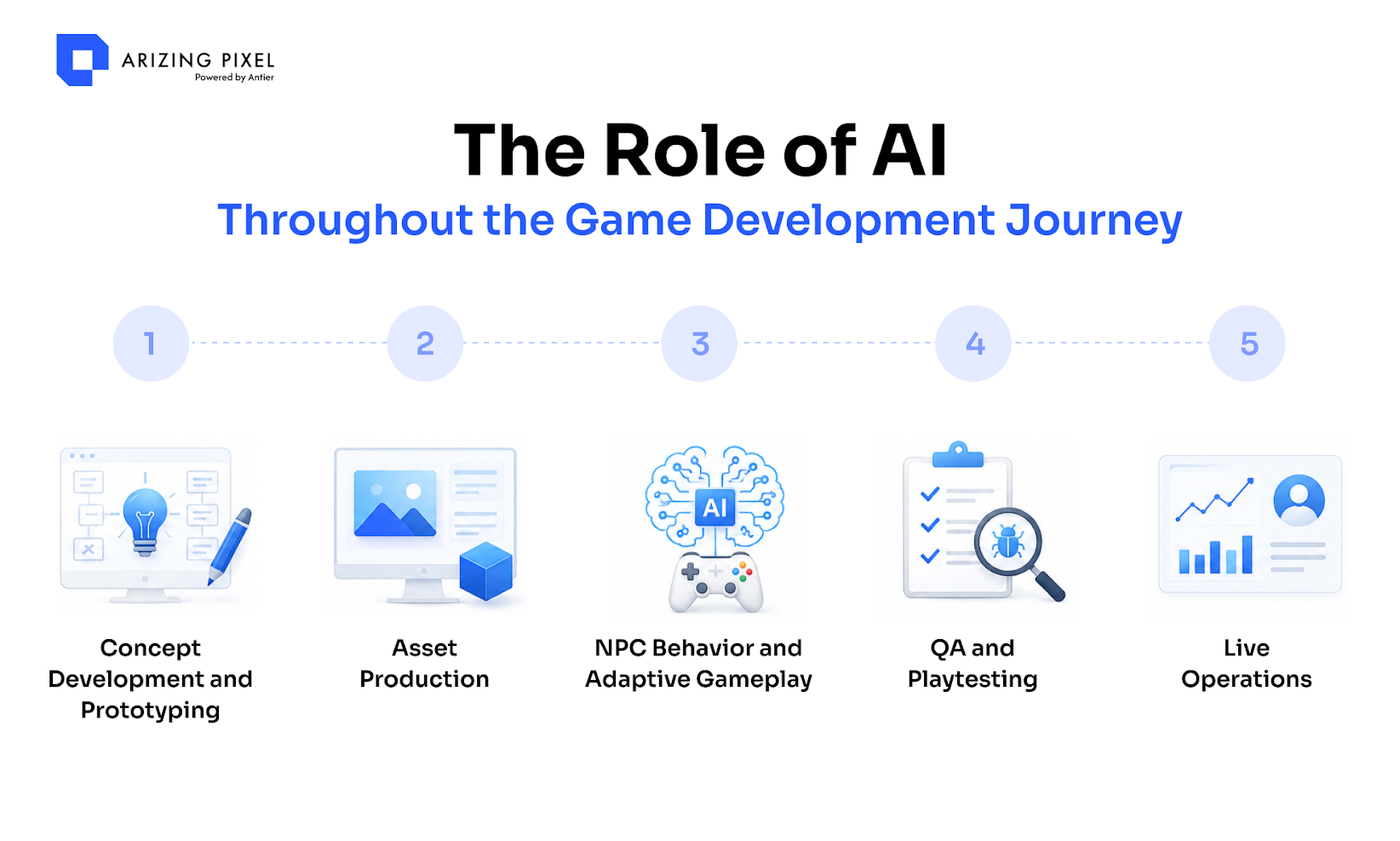
- Concept Development and Prototyping: Generative AI accelerates the exploration stage by helping teams quickly create environment concepts, character variations, gameplay ideas, and narrative branches. This gives creative teams more options during early discovery and supports faster validation of game concepts.
- Asset Production: AI-assisted tools support 2D and 3D asset creation, texture generation, animation workflows, and other repetitive production activities.
- NPC Behavior and Adaptive Gameplay: Machine learning can support intelligent NPC behavior, adaptive dialogue, player-specific interactions, and dynamic difficulty systems. These capabilities allow game systems to respond more effectively to player behavior and engagement patterns.
- QA and Playtesting: AI agents can simulate large numbers of player sessions and help teams identify edge cases, gameplay issues, and balance opportunities at scale. Human QA teams can then use this intelligence to focus their efforts on deeper validation and high-value testing.
- Live Operations: After launch, AI can support player segmentation, churn prediction, monetization optimization, and engagement analysis. These capabilities help studios make faster decisions throughout the live lifecycle of a game.
The GDC Festival of Gaming 2026 Trends Report, published in May 2026, highlighted the growing accessibility of generative AI tools across the industry. The conversation now centers on production deployment and effective implementation.

Get Your AI Game Development Strategy Right From Day One
The Generative AI in Gaming Market: Capital Is Following Adoption
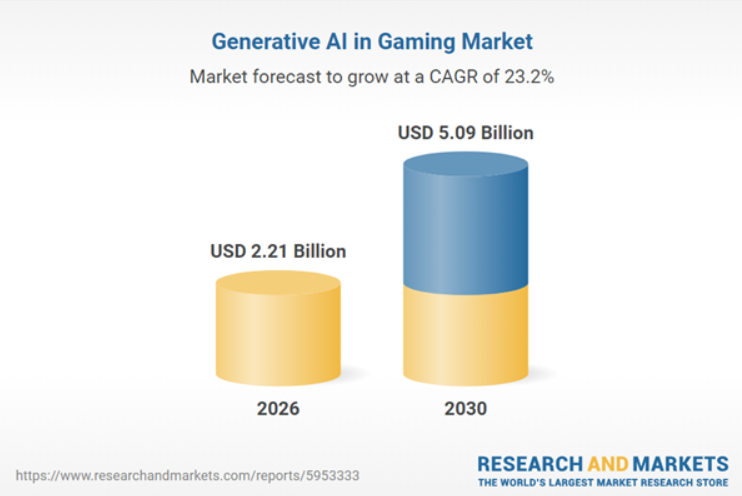
AI in gaming has developed into a significant investment category. According to a Business Research Company report published in July 2026, the generative AI in gaming market is projected to grow from $1.79 billion in 2025 to $2.21 billion in 2026, with a CAGR of 23.1%, before reaching $5.09 billion by 2030.
The global AI game development market was valued at USD 5.23 billion in 2025 and is projected to grow from USD 6.10 billion in 2026 to USD 18.75 billion by 2034, registering a CAGR of 16.8% during the forecast period, according to an Intel Market Research report.
For funded studios and technical producers, these figures provide useful context for technology and production budget decisions. AI capability increasingly shapes production speed, asset workflows, live operations, and player experience optimization.
Does AI Game Development Differ by Platform? Yes, Significantly.
AI integration changes according to the platform a game targets. A mobile hyper-casual title, a Web3 open-world game, a Telegram game, and a Roblox experience operate within very different production and technical environments. Each platform brings its own compute limitations, latency requirements, player data models, runtime environments, and monetization priorities.
The AI architecture should therefore align with the platform from the earliest planning stage.
| Platform | Primary AI Use Cases | Relevant Tools / Technologies | Production Impact |
|---|---|---|---|
| Mobile: Hyper/Hybrid Casual | Player behavior modeling, dynamic difficulty, personalized monetization, ad performance prediction | Unity ML-Agents, TensorFlow Lite, Firebase ML | Faster iteration, improved A/B testing, stronger D1/D7 retention strategies |
| Web3 / NFT / P2E | Adaptive NPC ecosystems, intelligent asset valuation, predictive engagement, fraud detection | Custom ML models, smart contract integration, Inworld AI, NVIDIA ACE | Dynamic economies, deeper engagement, improved ecosystem intelligence |
| Telegram Games | Lightweight adaptive mechanics, instant personalization, viral loop optimization | Server-side ML inference, Telegram Bot API integration, lightweight behavior trees | Faster session optimization and low-latency personalization |
| Roblox | Procedural content generation, behavioral NPC scripting, in-experience analytics | Roblox Luau scripting, ML integrations, external analytics pipelines | Greater session depth, creator tools, and moderation support |
Why Platform-Specific AI Planning Matters
A mobile game may require on-device AI inference within strict memory and compute limits. A Web3 title may combine machine learning with on-chain data structures, smart contract architecture, and economic design. Telegram games benefit from lightweight, responsive systems that support quick interactions and viral gameplay loops.
Roblox operates within its own development ecosystem and scripting environment, shaping how AI capabilities can support procedural content, NPC behavior, analytics, and creator experiences. Selecting the right architecture and toolchain early gives studios a stronger foundation for production planning and technology integration.
What Does a Cross-Platform AI Integration Process Look Like?
AI delivers the strongest production value when teams plan its role from the beginning of the development cycle. A specialist AI game development team can structure the process around the following stages.
Step 1: Platform-Specific AI Audit and Scoping
The first stage identifies the AI capabilities that align with the game’s platform, audience, gameplay systems, and monetization model.
The team evaluates:
- Compute requirements
- Available player and gameplay data
- Latency expectations
- Platform constraints
- AI use cases
- Toolchain requirements
Early prototyping can also help validate assumptions around player behavior before the full production architecture takes shape.
Step 2: Toolchain Selection and Pipeline Architecture
The team selects the engines, SDKs, AI frameworks, and supporting infrastructure required for the project.
For example:
- Mobile games may use Unity ML-Agents and TensorFlow Lite
- Web3 games may require custom ML integration alongside smart contract layers
- Conversational character systems may use platforms such as Inworld AI
- Real-time digital character experiences may incorporate technologies such as NVIDIA ACE
This stage produces the technical blueprint that guides the wider development team.
Step 3: AI-Assisted Asset Production
AI tools can support concept iteration, texture creation, asset exploration, and animation workflows while core gameplay development continues.
Running these activities in parallel can improve coordination between creative and technical teams and create more efficient production cycles.
Step 4: Adaptive Systems Integration
The development team integrates systems such as:
- NPC behavior models
- Dynamic difficulty mechanisms
- Player segmentation
- Adaptive interactions
- Engagement intelligence
Internal playtesting provides the behavioral data needed to refine these systems and align them with the intended player experience.
Step 5: QA Through AI Simulation
AI agents can simulate player sessions at scale and generate insights around edge cases, balance, and gameplay behavior.
This creates a larger intelligence layer for QA teams and helps them direct human testing toward complex scenarios and production-critical validation.
Step 6: Launch Preparation and Live Ops AI Setup
Before launch, teams can configure AI-supported live operations systems for:
- Player segmentation
- Churn prediction
- Engagement analysis
- Monetization optimization
- Retention strategies
This approach allows the game to enter live operations with its intelligence systems prepared for ongoing optimization.
Projects with AI embedded across the production workflow can also experience meaningful timeline efficiencies. The exact improvement depends on the asset volume, gameplay complexity, automation strategy, and maturity of the development pipeline.

Get Expert Guidance for Your AI Game Development
Should You Build AI Capability In-House or Work With a Specialist Team?
This decision depends on the studio’s long-term product strategy, existing technical expertise, platform requirements, and delivery timeline.
Both approaches can create strong outcomes when aligned with the right conditions.
1. When a Specialist Team Can Be the Right Fit
A specialist team can add value when:
- The game spans multiple platforms, such as mobile, Telegram, Web3, and Roblox
- The internal team has strong creative and game production expertise while expanding its AI and ML capabilities
- The project has a focused timeline for prototype, investor, or publisher review
- The studio requires platform-specific AI architecture from the start
- The team wants to accelerate access to established AI workflows and production expertise
Cross-platform development often requires several overlapping capabilities, including machine learning, game engineering, data systems, QA automation, live operations, and platform-specific integration.
2. When Building In-House Can Create Long-Term Value
An in-house approach can be particularly valuable when:
- The studio plans to develop multiple games within a similar technology environment
- AI capability will be reused across a long-term product portfolio
- The team already includes ML engineers with game production experience
- The required AI functionality is focused and clearly defined
- The studio has the resources to develop and maintain internal AI infrastructure
The decision should account for the complete production capability required. AI game development often involves more than one engineering role, bringing together ML specialists, data engineers, QA automation professionals, game developers, and live operations expertise.
A complete comparison helps studios select the model that best supports their product roadmap.
Conclusion: AI Has Become a Core Production Capability
AI is now shaping how modern games move from concept to live operations. The GDC Festival of Gaming 2026 Trends Report reflects the industry’s growing focus on practical deployment, while market projections show continued investment in generative AI for gaming. With the category projected to reach $5.09 billion by 2030, AI capability is becoming an increasingly important part of game production strategy. For studios, the opportunity lies in building AI into the right areas of the production pipeline. Platform requirements, player behavior, technical architecture, and commercial goals should guide every integration decision.
At Arizing Pixel, we integrate AI game development capabilities into cross-platform production workflows across mobile, Web3, Telegram, and Roblox. Our approach focuses on defining the right AI architecture, toolchain, and production strategy from the earliest stages of development.
Frequently Asked Questions
01. How is AI currently used in game development?
AI supports the entire game development lifecycle, aiding in concept development, asset production, NPC behavior, and quality assurance by enhancing efficiency and player experience.
02. What are the benefits of integrating AI into game production?
Integrating AI can reduce overall development costs, improve production efficiency, and enhance player engagement through adaptive gameplay and intelligent NPC behavior.
03. How do AI capabilities differ across various gaming platforms?
Each gaming platform has unique tooling requirements, player expectations, and monetization models, necessitating a tailored AI strategy for effective integration in mobile, Web3, Telegram, and Roblox environments.